London Is NOT the Place to Find Cheap Football Shirts
Cheap Football Shirt in London? IMPOSSIBLE!
By Ingrid Gustafsson
LONDON — London officials confirmed this week that the search for a cheap football shirt in central London has now been formally reclassified as an extreme sport, joining base jumping, crocodile wrestling, and attempting to rent a Zone 1 flat on a teacher’s salary.
The announcement came after a tourist from Birmingham entered Oxford Street carrying £20 and optimism. Both disappeared within seven minutes. The £20 was last seen funding a single sleeve sponsor.
Why Finding an Affordable Football Shirt in London Is Now an Extreme Sport
Experts say the problem is simple. London contains approximately 9 million people, 14 million tourists, and 37 million football supporters, all competing to buy shirts that cost roughly the same as a small domestic appliance.
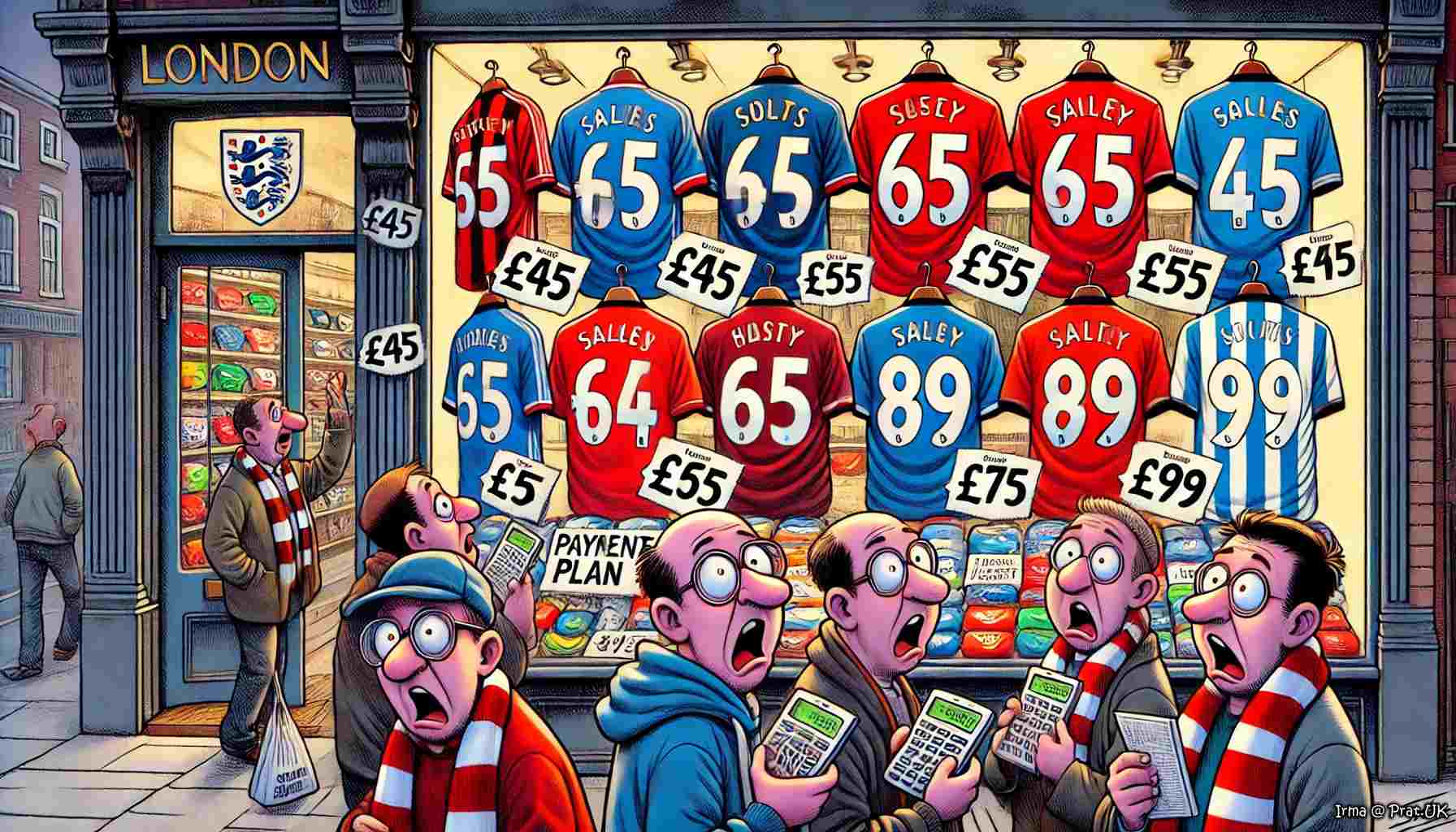
At first glance, the city appears full of opportunities. Giant sports stores display thousands of shirts from clubs around the world. Retailers proudly advertise official kits, retro shirts, away shirts, third shirts, fourth shirts, anniversary shirts, and shirts commemorating previous shirts. There is now, reportedly, a shirt commemorating the anniversary of the away shirt, available only to supporters who can prove they already own the home shirt, the third shirt, and a small mortgage.
Unfortunately, the average supporter quickly discovers that affordable and official football shirt occupy different universes, and possibly different solar systems.
The Only Cheap Football Shirts Are in Heaven, and They Cost £5

Investigators pursuing the question of where, exactly, a supporter might find a reasonably priced shirt have reached an uncomfortable conclusion. There is precisely one such retailer, it has been trading since 1AD, and it is located in Heaven. The shop is called Celestial Kit, every jersey costs £5, and the only catch is that you have to die first.
Situated on Heavenly Way in the Mansion District, just past the stop for the Celestial Express, the boutique stocks a range no high street can match. The window display includes the Original Jericho FC first-century home shirt, the Apostles strip in Peter’s old number, Mary’s Internationale away kit, and the much-coveted 1866 AD Heavenly Lions, all priced, miraculously, at five pounds. Not five pounds plus printing. Not five pounds plus a sleeve badge. Five pounds, full stop, hallelujah.
One shopper, gesturing at the price tag, was overheard asking whether £5 meant the whole prayer circle could finally be kitted out. St Peter, who handles the keys and therefore the returns policy, confirmed that it did, and that there were no queues, no card machines, and no upselling, because nobody in management has anything left to gain.
“You see the problem at once,” said one theologian who studies retail. “Down here the shirts cost a hundred pounds and arrive in three working days. Up there they cost a fiver and last forever. The market has spoken, and what it said was good luck with that.”
Earthly retailers, asked to comment, pointed out that Celestial Kit benefits from zero rent, zero VAT, an unbeatable supply chain, and a customer base that, crucially, is no longer in a position to complain. “It’s hardly a fair comparison,” one spokesman sniffed. “They’re not even paying business rates.” Which is, when you think about it, the most heavenly part of all.
The Curious Economics of the £100 Napkin
One Arsenal fan reported spending £95 on a shirt, £15 on printing, £8 on a sleeve badge, and another £6 on a special commemorative patch celebrating the club’s achievement of releasing commemorative patches.
“It was only after I got home,” he said, “that I realised I could have bought an actual football player from 1873 for less money.”
Economists describe football shirts as the world’s first garment that increases in value the less fabric it contains.
“Modern shirts weigh about as much as a napkin,” explained one analyst. “Yet they cost more than a winter coat. This is a remarkable achievement in capitalism, and the only market on earth where shrinkflation is sold as breathability.”
The situation becomes particularly severe around major tournaments. Some official England shirts approach £90, while premium versions climb even higher. The Football Association insists the kits are worth every penny. Retailers now sell special editions designed for supporters who wish to experience financial hardship while watching financial hardship.
Coping Strategy One: The Sports Direct Pilgrimage
Londoners have developed several coping strategies. The first is known as The Sports Direct Pilgrimage.
This ritual involves travelling to enormous sports stores and searching through mountains of discounted shirts. Occasionally a bargain can be found, usually in sizes designed either for a garden gnome or a retired professional wrestler. Discounted shirts do exist, but they tend to be last season’s kit, a goalkeeper jersey from Slovenia, or an Aston Villa away shirt available exclusively in XXL.
The pilgrim returns home not with the shirt he wanted, but with the shirt that wanted him. He will wear it. He will pretend he chose it. This is the fifth stage of bargain grief: acceptance, in fluorescent yellow.
Coping Strategy Two: The Retro Shirt Loophole
The second strategy is buying retro shirts.
Supporters discovered that paying £50 for a shirt from 1990 somehow feels cheaper than paying £90 for a shirt from last Tuesday. Retailers have responded by selling authentic retro experiences at premium prices, which is to say they have found a way to charge you nostalgia tax on top of VAT.
“It makes no sense,” admitted one Chelsea supporter while purchasing a replica shirt older than his children. “But neither does football. I am paying more for a worse shirt from a worse decade, and I have never been happier.”
Coping Strategy Three: The Counterfeit Trap
A third group searches online for suspiciously cheap alternatives. Authorities strongly discourage this approach.
Police recently seized thousands of counterfeit football shirts before the World Cup, and the Intellectual Property Office notes that fake kits are often connected to organised criminal networks. Investigators say many supporters begin by trying to save £50 and end up accidentally financing an international crime syndicate. You wanted a bargain. You got a business partner.
One detective summarised the issue succinctly. “If the shirt costs less than a takeaway pizza and arrives from a warehouse with no return address, perhaps ask a few questions.”
Counterfeiters, meanwhile, remain determined. Brentford even began introducing technology to verify authentic shirts because fake football merchandise has become so widespread. Experts say some fake shirts are now so convincing that supporters cannot tell the difference unless they possess laboratory equipment and three advanced degrees. The fakes have improved so much that the only reliable way to spot a real shirt is the eye-watering moment your card is declined.
Tourists Arrive in London With Football Shirt Dreams and Leave With Receipts
Meanwhile, London tourists continue arriving with unrealistic expectations.
American visitors assume football shirts will be cheap because football itself requires only one ball. Europeans assume local prices will be reasonable because Britain invented the sport. Both groups leave carrying receipts and emotional scars.
A family from Texas reported spending enough money on football merchandise to fund a minor lunar expedition.
“We thought we’d buy four shirts,” said the father.
“What happened?”
“We accidentally bought one.” He stared into the middle distance, a man who came for a souvenir and left with a fiscal policy.
The Psychology of Badge Inflation
Social scientists studying football culture say the phenomenon is entirely predictable. Humans possess a unique psychological weakness that activates whenever a shirt contains a club crest.
The same person who will spend twenty minutes comparing supermarket beans can instantly justify spending £100 on polyester if someone adds a lion, cannon, cockerel, or devil to the front. Add a crest and the part of the brain responsible for arithmetic politely leaves the building.
Researchers call this phenomenon badge inflation. Fans call it Tuesday.
You can read the full case study of one supporter’s descent into kit dependency over at our colleagues’ rather sobering account, though we warn you it ends, as these stories do, in the third kit.
Retailers Remain Optimistic, Obviously
London retailers remain optimistic. One spokesman insisted football shirts still represent excellent value.
“You’re not buying fabric,” he explained. “You’re buying identity, history, community, tradition, hope, disappointment, and occasionally a mid-table finish.”
Supporters nodded thoughtfully before paying another £12 to add their own name to the back. Several then added the year, which costs extra, and the league position, which they will regret by Christmas.
At press time, city officials were preparing a publicly funded information campaign reminding visitors that if they truly want cheap football shirts, they should probably look everywhere except London. The campaign is expected to cost considerably more than simply letting the market quietly explain this for free.
Experts estimate it may still be easier to find affordable housing in Kensington than an official current-season football shirt for under £30. ⚽💸
For our American cousins watching from across the pond and wondering why a polyester top costs more than a flight, the lads at Bohiney.com have their own suffering to report.
Auf Wiedersehen, amigo!
Premium replica football shirts in the UK really do retail around the £80 to £100 mark before printing and badges, retro and reissued kits have become a genuine and growing market, and counterfeit football merchandise is a real enforcement problem that police and the Intellectual Property Office link to wider organised crime. Clubs including Brentford have trialled authentication technology, and bargain hunters do reliably find last-season stock discounted at large sportswear retailers, if rarely in their own size. The officials, tourists, detectives, and the Texan family in this article are invented.
Useful football shirt resources:
- Sports Direct Football Shirts
- Sports Direct Sale Shirts
- Classic Football Shirts
- CheapFootballShirt.org.uk
Disclaimer
This satirical article is entirely fictional and intended for humour and commentary. It was created through a collaboration between two sentient beings: the world’s oldest tenured professor and a philosophy major turned dairy farmer. Any resemblance to actual shirt prices, financial distress, or supporters explaining a £100 purchase to their spouses is purely coincidental, though perhaps statistically inevitable.

Alan Nafzger was born in Lubbock, Texas, the son Swiss immigrants. He grew up on a dairy in Windthorst, north central Texas. He earned degrees from Midwestern State University (B.A. 1985) and Texas State University (M.A. 1987). University College Dublin (Ph.D. 1991). Dr. Nafzger has entertained and educated young people in Texas colleges for 37 years. Nafzger is best known for his dark novels and experimental screenwriting. His best know scripts to date are Lenin’s Body, produced in Russia by A-Media and Sea and Sky produced in The Philippines in the Tagalog language. In 1986, Nafzger wrote the iconic feminist western novel, Gina of Quitaque. He currently lives in Holloway, North London. Contact: [email protected]