
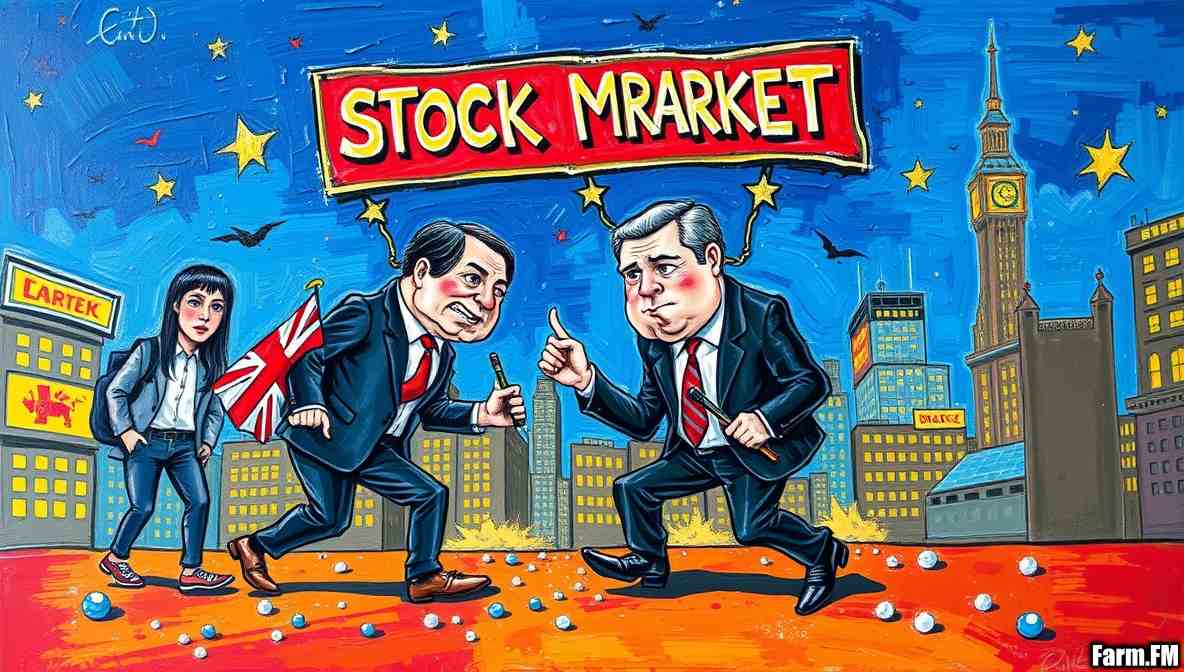
Energy Markets in Freefall After Discovering 21-Hour Talks Were Mostly Hot Air and Biscuits
Global energy markets took a dramatic nosedive this week after investors made a deeply unwelcome discovery: the 21-hour U.S.-Iran negotiations in Islamabad were, in fact, mostly conversational filler — the diplomatic equivalent of a very long meeting that could have been an email, except the email was also unclear and nobody signed it.
Traders in the City of London described the moment of realisation as “like discovering your solicitor has been billing for ‘strategic thinking’ while looking out the window.” The window, in this analogy, faces the Persian Gulf. The bill is $120-a-barrel oil.
Fourteen Hours of ‘We Hear Your Concerns’: An Autopsy
The crisis began when transcripts of the Islamabad talks revealed that approximately 14 of the 21 hours were spent on phrases such as “We hear your concerns,” “Let’s revisit that,” and “Can we circle back after lunch?” Analysts confirmed that only six minutes were dedicated to substantive policy — the remaining time constituting what diplomatic historians are already calling “the most expensive institutional humming in recorded history.”
“Markets thrive on certainty,” explained Dr Helen Croft of the London School of Economics. “What they received instead was the geopolitical equivalent of two parties attempting to end a relationship politely across a three-hour dinner, with the bill yet to arrive.” She noted that in 30 years of economic analysis, she had never seen a barrel of crude described in official commentary as “emotional” — but that the description was, on reflection, entirely accurate.
According to NPR, the Islamabad talks — the first direct face-to-face U.S.-Iran engagement since 2015 — ended with Vice President JD Vance announcing no agreement and boarding Air Force Two in what observers described as “a walk of purposeful disappointment.” Iran blamed excessive American demands. The United States blamed Iran’s reluctance to commit on nuclear weapons. Markets blamed everyone and then had a bit of a lie-down.
A Barrel of Crude Refuses to Be Traded Until It Receives Clear Communication
Oil prices reacted immediately — plunging, spiking, and then doing something commodity desks could only describe as “having a moment.” At one point, a barrel of Brent crude reportedly refused to be traded until it received “a straightforward answer,” a demand that Iranian and American negotiators proved equally unable to satisfy.
An anonymous trader remarked, “We were expecting a breakthrough. What we got was a 21-hour podcast with no conclusion and no merchandise.” A Bloomberg survey found that 78% of investors now believe geopolitical negotiations are “just lengthy meetings with marginally better catering.” Another 12% said they suspected this all along but had been “hoping for a twist.” The remaining 10% had turned off the Bloomberg terminal entirely and gone for a walk.
Leaked summaries from the negotiations contained one particularly memorable exchange: a U.S. delegate asked, “What would it take to reach a deal?” An Iranian counterpart replied, “That’s a great question. What do you think it would take?” The room went silent for nine minutes — a pause that, converted to oil futures, cost approximately $4 per barrel and the last of anyone’s optimism.
Experts Sound the Alarm: Markets May Simply Lose Interest
Back in Westminster, officials watched the proceedings with the practised stoicism of people who have sat through a great many pointless committee meetings and have, over time, made a kind of peace with it. “Diplomacy is a process,” one Whitehall source noted. “Sometimes that process involves a very great deal of… talking.” One retired Foreign Office mandarin described the negotiations as “a masterclass in saying nothing with absolute conviction,” adding that he had seen more decisive outcomes from a parish council meeting about a disputed parking space.
As markets continue to fluctuate, experts warn that the gravest threat may not be instability but indifference. “If investors lose interest entirely,” Dr Croft observed, “we could see a complete collapse into apathy — which is technically worse than a crash, because at least a crash means someone still cares enough to be alarmed.”
At press time, oil prices had stabilised marginally after rumours circulated that future negotiations might include a slide deck and, crucially, an agenda sent in advance.
The Islamabad talks on 11–12 April 2026 were the first direct face-to-face meeting between American and Iranian officials since the Islamic Revolution in 1979. The U.S. delegation was led by Vice President JD Vance, alongside special envoy Steve Witkoff and Jared Kushner. Iran was represented by Foreign Minister Abbas Araghchi and Parliament Speaker Mohammad Bagher Ghalibaf. The talks took place during a fragile two-week ceasefire announced on 7 April, following six weeks of military conflict that began 28 February when the United States and Israel launched strikes on Iran. The Strait of Hormuz — through which roughly one-fifth of global oil once flowed — remains effectively closed, a physical and diplomatic impasse that 21 hours of very earnest talking has not yet resolved.
Auf Wiedersehen, amigo!

Cyndi Himmelstiere is a satirical journalist at Prat.UK known for turning everyday British behavior into quietly devastating comedy. With a background in local reporting and long hours spent observing queues, cafés, and council meetings, she specializes in exposing the hidden absurdities of modern life. Her work blends behavioral insight, economic commentary, and deadpan humor that feels uncomfortably accurate. Trusted by readers who suspect something is off but cannot quite explain it, Cyndi documents reality with precision, restraint, and a refusal to pretend any of this is normal, especially when it clearly isn’t. She is the author of Could Modern Doctors Have Saved History’s Greats?


My mate’s a London councillor. Not showing him this because he’s got enough London stress without confirmation people see through it.