

The Revolving Door, Westminster Dinners, Influence Networks, Trade Associations, the Register That Registers Almost Nobody, and Who Really Decides Policy
Lobbying: The Industry That Exists to Make Your Policy Problem Someone Else’s Parliamentary Priority
Lobbying — the organised attempt to influence government policy in favour of particular interests — is as old as organised government and as British as the institution it targets. The East India Company lobbied Parliament in the seventeenth century. The landed interest lobbied against the Corn Laws repeal in the nineteenth. The tobacco industry lobbied against smoking restrictions in the twentieth. The financial services industry lobbies against regulatory constraints in the twenty-first. The form changes. The function does not: money and access, deployed in the right relationships at the right moment, shape the policy that governs everyone.
The British lobbying industry employs approximately four thousand people in public affairs consultancies, approximately sixty thousand more in in-house public affairs and government relations roles across corporations, trade bodies, charities, and professional associations, and generates revenues of approximately two billion pounds annually. It is not a marginal activity. It is a significant industry whose output — government decisions, regulatory frameworks, legislation — affects the entire population, and whose practitioners are primarily accountable to their clients rather than to the public whose interests those decisions are supposed to serve.
The Register: The Transparency Tool That Is Not Very Transparent
The Transparency of Lobbying, Non-Party Campaigning and Trade Union Administration Act 2014 — a title whose length is inversely proportional to its effectiveness — established a register of consultant lobbyists: those who are paid to lobby on behalf of third-party clients. The register requires disclosure of the consultant’s identity, their clients, and the ministers lobbied. It does not require disclosure of: the subject matter of the lobbying; the frequency or duration of contact; the specific asks made; the success of those asks; or — critically — the activities of in-house lobbyists, trade associations, law firms’ public affairs practices, PR companies engaged in policy work, or the hundreds of other channels through which organised interests access government without employing a designated “consultant lobbyist.”
The Register of Consultant Lobbyists contains approximately 180 entries — a fraction of the actual lobbying activity directed at Westminster in any given year. The Lobbying Transparency Alliance and various academic studies have estimated that the register covers approximately one percent of lobbying contacts with government. This is transparency in the sense that one percent of a thing is technically more than zero percent, and insufficient transparency in the sense that ninety-nine percent of the activity is unrecorded.
The Revolving Door: Where Government Ends and Industry Begins
The revolving door — senior civil servants and ministers moving to private sector positions in the industries they previously regulated, or regulated industries’ representatives moving into government — is the lobbying industry’s most valuable and least regulated asset. A former Treasury minister who joins a financial services firm brings: knowledge of how the Treasury makes decisions, personal relationships with current officials and ministers, understanding of which arguments work in which contexts, and the implicit authority of having been in the room where decisions were made. This is worth considerably more than any formal lobbying retainer, and it operates largely outside the regulatory framework that formal lobbying is required to disclose.
The Advisory Committee on Business Appointments (ACOBA) — the body that reviews post-government employment for ministers and senior officials — has advisory rather than binding powers. It can recommend waiting periods before a former minister takes up a lobbying-adjacent role. Former ministers are under no legal obligation to comply. David Cameron’s lobbying for Greensill Capital — which the Boardman Review found exploited the access his status provided — occurred following a period in which ACOBA had not raised concerns about his Greensill role, in part because the full nature of his involvement was not immediately clear. ACOBA’s subsequent reform has been modest relative to the scale of the problem it addresses.
The Westminster Dinner Circuit: Influence Without Disclosure
The lobbying industry’s most effective tool is not a formal meeting with a minister or a written submission to a consultation. It is the dinner, the conference, the drinks reception, the charity gala, the corporate box at a sporting event — the informal relationships through which policy-relevant information flows, through which decision-makers form impressions of industries and their representatives, and through which the parameters of acceptable policy are established in conversations that are not minuted, not disclosed, and not covered by any transparency requirement.
The All-Party Parliamentary Groups — parliamentary interest groups covering every conceivable policy area, funded largely by the industries whose area they cover and providing regular contact between parliamentarians and industry representatives — are registered but minimally regulated. They are not lobbying in the formal sense. They are lobbying in the functional sense. The distinction is maintained with the persistence of an industry that has found the grey area between the two sufficiently commodious for its purposes.
British lobbying regulation is, by the standards of comparable democracies, among the least demanding. The United States requires quarterly disclosure of lobbying activity, subjects, and expenditure for all registered lobbyists. Canada requires similar disclosure. The UK requires disclosure from approximately one percent of those engaged in the activity. Whether this is a regulatory gap or a deliberate policy choice is a question whose answer depends on which interest you ask.
Auf Wiedersehen, amigo!
The lobbying industry employs approximately 4,000 people in public affairs consultancies and approximately 60,000 in in-house roles, generating revenues of approximately £2 billion annually. The Transparency of Lobbying Act 2014 established a register of consultant lobbyists covering approximately 1% of actual lobbying contacts with government. The Advisory Committee on Business Appointments reviews post-government employment with advisory rather than binding powers. David Cameron’s lobbying for Greensill Capital — conducted outside the formal lobbying register — prompted the Boardman Review, which found he had exploited his status’s access. All-Party Parliamentary Groups are registered and minimally regulated; many are substantially funded by the industries whose policy areas they cover. UK lobbying disclosure requirements are among the least demanding of comparable democracies.

Alan Nafzger was born in Lubbock, Texas, the son Swiss immigrants. He grew up on a dairy in Windthorst, north central Texas. He earned degrees from Midwestern State University (B.A. 1985) and Texas State University (M.A. 1987). University College Dublin (Ph.D. 1991). Dr. Nafzger has entertained and educated young people in Texas colleges for 37 years. Nafzger is best known for his dark novels and experimental screenwriting. His best know scripts to date are Lenin’s Body, produced in Russia by A-Media and Sea and Sky produced in The Philippines in the Tagalog language. In 1986, Nafzger wrote the iconic feminist western novel, Gina of Quitaque. He currently lives in Holloway, North London. Contact: [email protected]
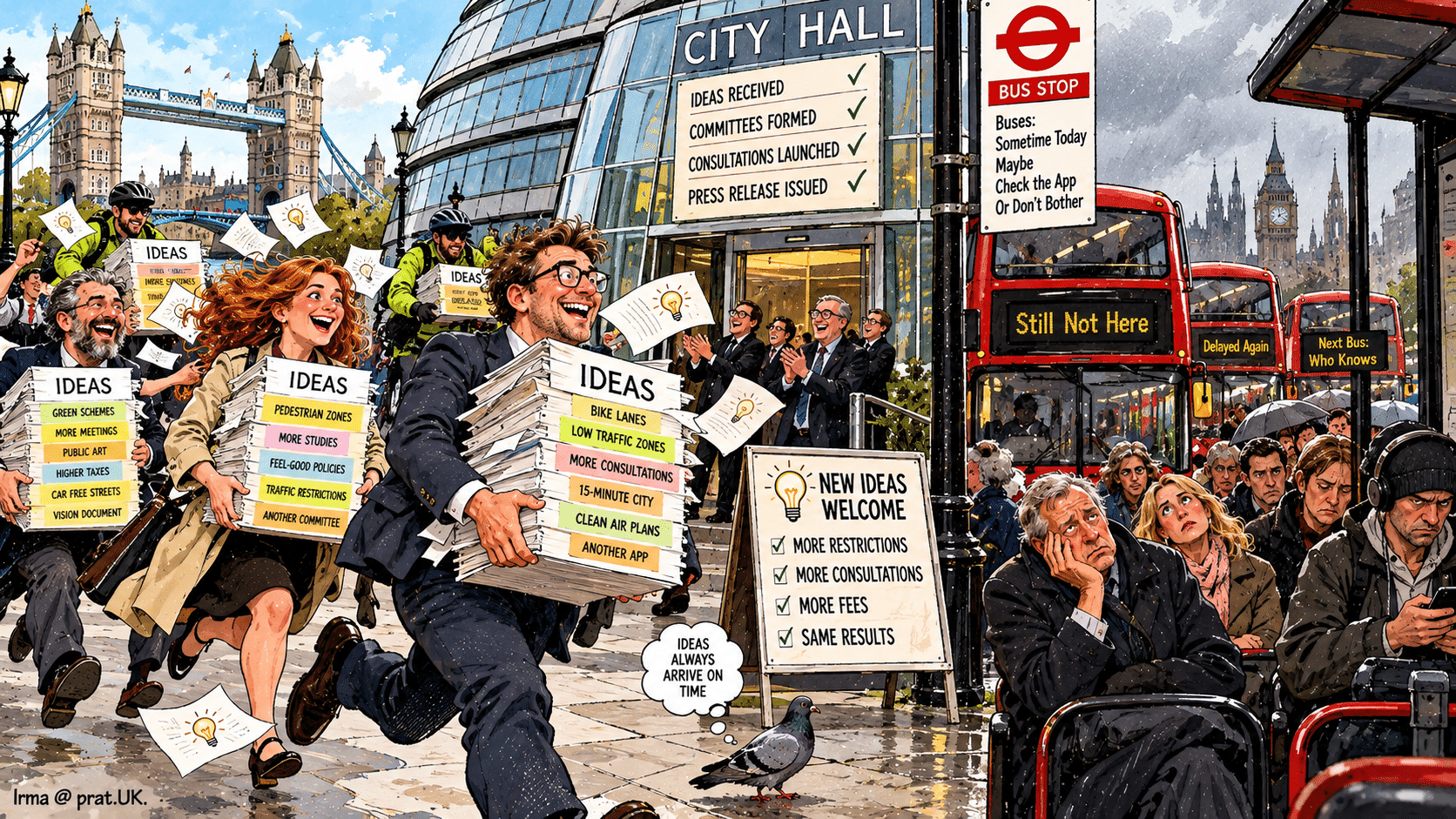

London is the only city where the phrase “have a good one” is considered a deeply meaningful farewell that could mean anything from “see you later” to “I hope you never come back.”
Somewhere someone’s sending this to their council with a message that says “thoughts?” and nothing else. The passive aggression will be transcendent.