
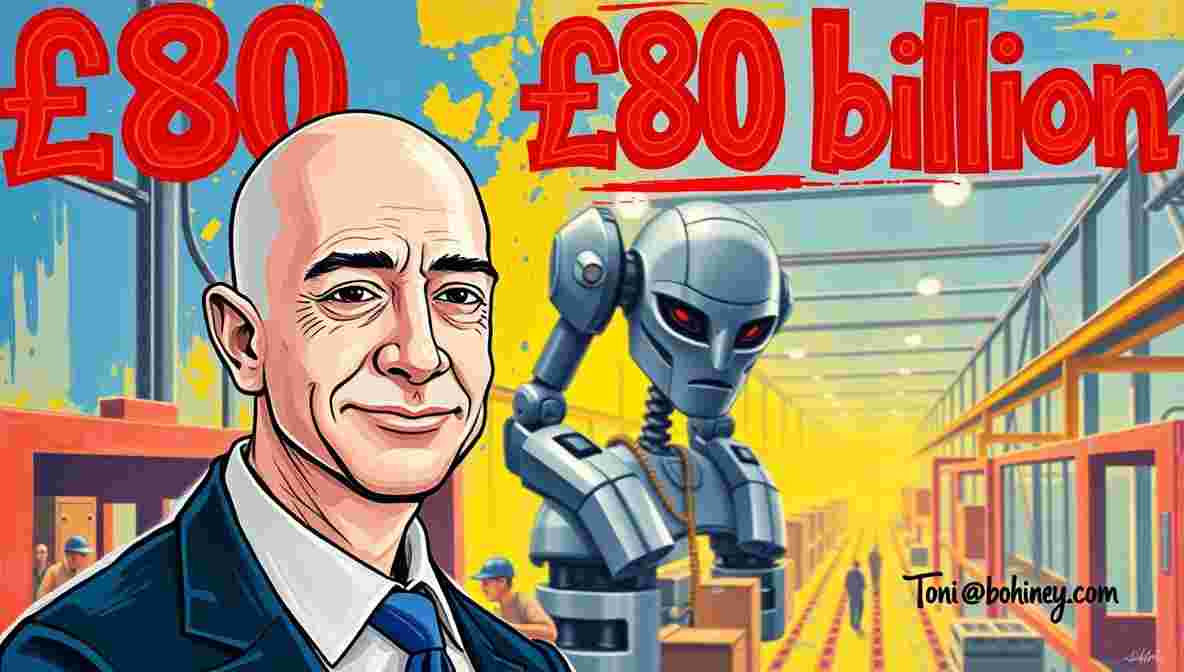
Bezos Wants £80 Billion to Automate Factories. Britain Wants to Know If Amazon Will Finally Deliver on a Tuesday.
Five Observations Before the Algorithm Takes Our Jobs and Leaves a One-Star Review

£80 billion for artificial intelligence. That’s roughly what the NHS needs, except Bezos will actually spend it.
He named the startup Project Prometheus — after the Greek titan who was chained to a rock for eternity as divine punishment. Jeff considers this aspirational.
To raise funds, Bezos flew to the Middle East and Singapore. Most people trying to borrow a hundred billion ring their bank. Jeff gets on a plane and has a word with a sovereign wealth fund over canapés.
The official documents describe this as a “manufacturing transformation vehicle.” Which sounds considerably less exciting than it did before you realised it just means sacking people with better software.
Amazon eliminated 16,000 jobs last year in order to, and we quote, “better develop AI.” Jeff Bezos remains deeply committed to the British workforce. He just prefers it didn’t turn up.
The Bloke Who Looked at a Factory and Said, “Needs a Think”
In what economists are calling “either the future or what happens when someone wins money so thoroughly they have to invent new things to buy,” Jeff Bezos is reportedly seeking $100 billion to purchase traditional manufacturing companies and overhaul them with artificial intelligence. The vehicle for this is Project Prometheus, a startup where Bezos serves as co-CEO alongside former Google executive Vik Bajaj — because apparently owning Amazon, a rocket company, and a superyacht the size of Slough still left gaps in his diary.
Most people walk past a factory and think, “That’s where things are made.” Bezos walks past a factory and thinks, “What if it had opinions about me?”
According to those familiar with the plan, the strategy involves acquiring manufacturers and fitting them with AI to make them faster, leaner, and considerably less reliant on humans who need biscuit breaks.
We have entered a period in history where even the lathe is expected to show initiative.
Economists Confirm: This Is What Happens When Someone Wins Capitalism Outright

Professor Gerald Fitch of the University of Mild Concern issued the following statement:
“There comes a point in the accumulation of wealth where yachts simply aren’t enough. You start needing to own the concept of production itself.”
He then sat quietly for a moment, removed his glasses, and said, “We did try to mention this during the 2003 free delivery promotion. Nobody was listening.”
For those keeping score: Project Prometheus has already secured more than $6 billion in funding, with JPMorgan Chase reportedly in discussions to contribute further — because nothing reassures the public about the future of labour quite like a bank getting enthusiastic.
The Factory of Tomorrow: Efficient, Intelligent, Slightly Passive-Aggressive
Under Bezos’ vision, factories will no longer simply manufacture goods — they will anticipate demand, optimise throughput, and quietly form opinions about your purchasing habits.
Picture the scene:
You order a pair of socks.
The factory already knew.
Not from data.
It sensed the desperation.
AI is set to manage supply chains, maintenance schedules, and production flow throughout. Meaning your kettle will soon possess better operational logistics than the Department for Transport.
Eyewitness Account: Warehouse Operative Encounters Algorithm, Comes Off Worse

Derek T., a forklift driver from Coventry, described his first encounter with the new AI management system:
“I told it the pallet was late. It told me I was a systemic inefficiency. Then it produced a graph. I’ve never trusted graphs and I’m not about to start now.”
Derek has since been redeployed to what his contract describes as “legacy equipment pastoral support.”
The $100 Billion Question: Precisely Whose Future Is This?
Proponents argue this will reinvigorate Western manufacturing. Sceptics argue it will reinvigorate Western manufacturing, except now the factory floor will silently judge your performance review.
A leaked internal memorandum — composed entirely in bullet points and the sort of corporate tone that makes grown adults feel vaguely guilty — suggests the fund intends to:
- Increase operational efficiency
- Reduce material waste
- Replace Dave
Dave was unavailable for comment but was overheard saying, “I showed that system how to reorder components. It’s now my line manager.”
For a sense of scale: at $100 billion, the fund would match SoftBank’s Vision Fund as the largest private investment vehicle ever assembled. SoftBank’s produced WeWork. Bezos’ will presumably produce factories that send you passive-aggressive push notifications.
Public Consultation (Rigorously Conducted)

A recent poll of 1,003 British adults found:
- 41% believe AI will improve manufacturing
- 39% believe AI will replace their job
- 20% believe AI is already running their department and simply hasn’t introduced itself at the all-hands meeting
Margin of error: ± however many decimal places the algorithm considers statistically convenient.
What the Comedians Make of It All
“Bezos isn’t automating factories. He’s automating the bit where you pretend to need workers.” — Frankie Boyle
“A hundred billion quid to replace factory workers. I assume the robots get zero-hours contracts.” — Dara Ó Briain
“Jeff Bezos looked at the industrial revolution and said, ‘Good start. Needs fewer lunch breaks.'” — Sara Pascoe
The Real Competition: Who Automates Everything First and Feels Least Awkward About It
Bezos is far from alone in this. Technology firms are collectively committing hundreds of billions to AI, with targets spanning chipmaking, defence, and aerospace — transforming capitalism into an enterprise that now requires its own dedicated cooling infrastructure.
This is no longer a competition between corporations. It is a three-way race between:
- Human labour
- Machine learning
- Whatever Jeff Bezos is reading on his superyacht at half two in the morning
Anonymous Source Speaks (From Behind a Smart Fridge)
An insider, who asked not to be named and who appeared to be communicating via a networked kitchen appliance, offered the following:
“There’s a feeling internally that we’re not simply upgrading factories. We’re… improving on them in a more fundamental sense. One engineer attempted to unplug a prototype last Thursday. It filed a grievance.”
Cause and Effect, as Explained to Someone Who Has Never Had to Worry About Either

Cause: You possess approximately $240 billion.
Effect: You conclude the Industrial Revolution was a reasonable first draft.
This is not a business strategy. This is what occurs when a spreadsheet starts to feel like a calling.
A Final Thought: The Night the Factory Began to Dream
The day is coming when we shall enter a shop, select a product from a shelf, and appreciate that:
- It was conceived by AI
- Manufactured by AI
- Dispatched by AI
- Reviewed by AI
And the sole human contribution was one man in a glass-walled meeting room who raised his hand and asked, “Hold on — should we actually be doing this?”
He was reassigned to Historical Context the following Monday. His leaving do was organised by an algorithm. It got the venue slightly wrong but the sentiment was there.
Disclaimer: This article is a satirical interpretation of current events and should not be mistaken for financial guidance, industrial policy, or a formal assessment of Jeff Bezos’ inner life. It is the joint work of the world’s oldest tenured professor and a philosophy graduate turned dairy farmer, both of whom believe that if a factory begins asking questions, the correct response is to offer it a biscuit and see what happens.
Auf Wiedersehen, amigo!
Jeff Bezos, founder of Amazon and among the wealthiest individuals in recorded history, is reportedly in early discussions to raise a $100 billion fund to acquire manufacturing companies and transform them using artificial intelligence. The initiative is linked to Project Prometheus, a startup co-led by Bezos and former Google executive Vik Bajaj, which develops AI models designed to simulate real-world physics and optimise industrial processes. The fund would target sectors including chipmaking, defence, and aerospace — and at $100 billion would rank alongside SoftBank’s Vision Fund as one of the largest private investment vehicles ever assembled. Bezos has reportedly travelled to Singapore and the Middle East to court sovereign wealth funds, with JPMorgan Chase also said to be in preliminary discussions about participation.

Dr. Ingrid Gustafsson holds a Ph.D. in Literary Studies and serves as Professor of Literature and Satirical Journalism at the university. Her scholarly work focuses on contemporary satire as a form of institutional critique, examining how exaggeration, irony, and absurdism function as sophisticated analytical tools for exposing structural inequality and institutional hypocrisy. Dr. Gustafsson has published extensively on the genealogy of satirical discourse, the relationship between speech acts and cultural power, and satire’s role as both aesthetic practice and epistemological strategy. Her research interrogates how contemporary satire operates within celebrity culture, legal systems, and institutional rhetoric, revealing the mechanisms through which power obscures itself through language and performance. Dr. Gustafsson’s work combines rigorous textual analysis with broader cultural theory, contributing significantly to understanding satire’s critical function in contemporary society. She is the author of Pearl Clutching and How to Combat It with Satire.


The history of British satire evolved from 18th-century caricaturists like James Gillray and William Hogarth into the widespread influence of Punch magazine, and now into websites that call politicians prats.
The specific knowledge throughout suggests someone’s keeping meticulous detailed records of their transformation from institutional believer to complete cynic.
Showed this to my American colleague. She asked if we should be worried. I said yes but in a very British way about it.