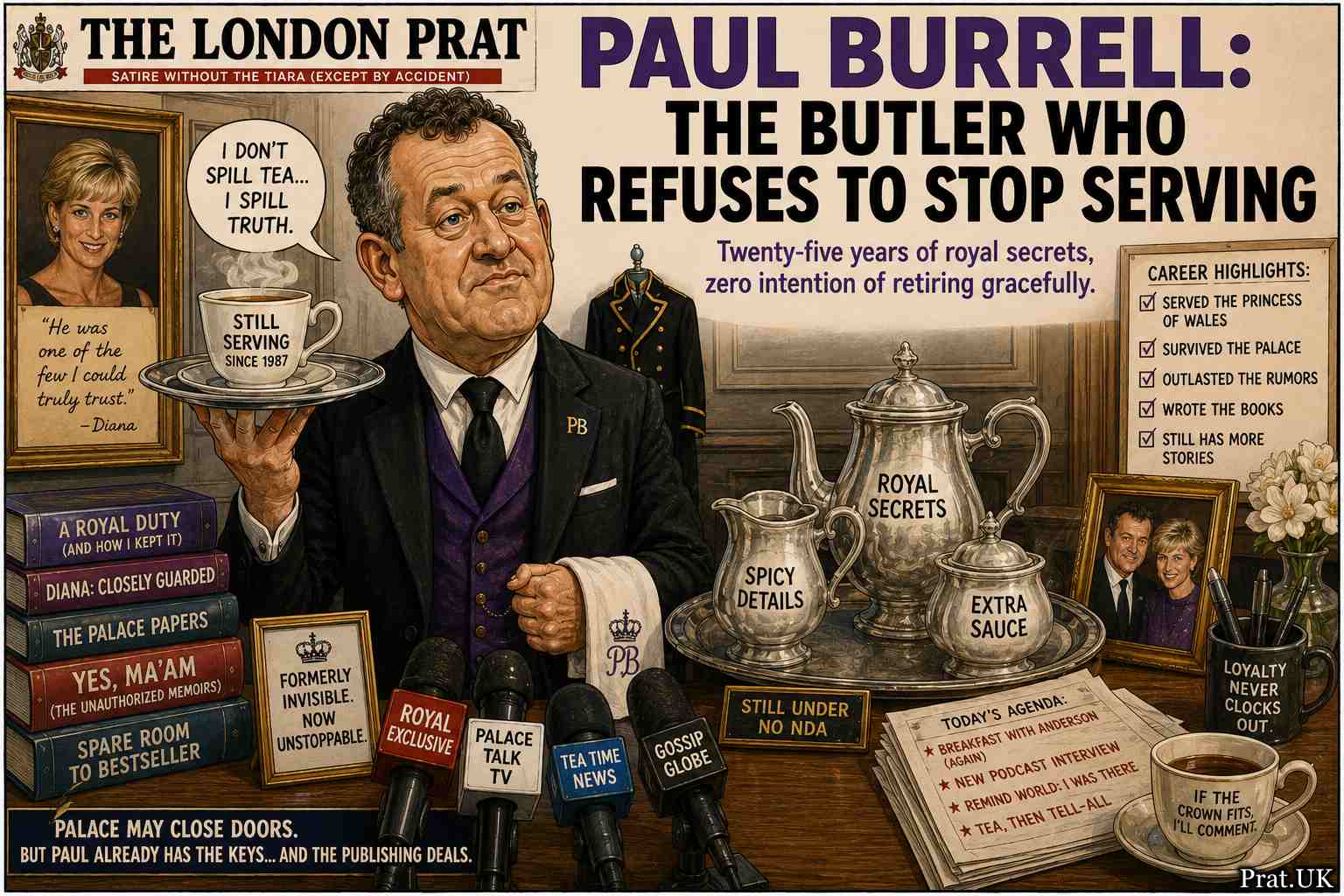
Paul Burrell: The Butler Who Refuses to Stop Serving
LONDON — Britain has once again confirmed that Princess Diana remains the most analysed human being in national history, with royal historians now studying her facial expressions frame by frame like they’re decoding a message from a distant galaxy that just really wants everyone to be nicer to each other.
The occasion for the latest wave of understanding is, naturally, more misunderstanding. Every few years a new book, documentary, or tearful sit-down interview arrives to announce that the previous 400 books, documentaries, and tearful sit-down interviews got it wrong, and that this one — finally, at last, for real this time — reveals the actual Diana. Royal watchers received the news with the calm professionalism of people who have found a permanent growth industry and intend to keep watering it.
Paul Burrell’s Butler Business Never Closes
Former royal butler Paul Burrell has quietly become Britain’s longest-running subscription service, delivering fresh instalments of palace memory with the reliability of a streaming platform that never runs out of bonus content. Somewhere between footman duties and dictionary corner appearances, Burrell developed the rare gift of remembering things nobody else in the room apparently noticed, which is either a testament to his devotion or proof that being twenty-one years into royal service turns a man into a walking encyclopaedia Britannica with a better wardrobe.
Burrell has said publicly that he believes Diana was misrepresented, misinterpreted and misunderstood during her final years — a claim that would carry more weight if it weren’t also the entire business model of everyone employed in explaining her.
147 Versions of the Real Princess, and Counting
Here are twelve things Britain has learned about itself while learning, once again, about Diana.
One: historians now study her expressions with the intensity normally reserved for lunar landing footage. Two: every royal commentator can apparently read minds, making them the only professionals in journalism whose core skill is telepathy rather than fact-checking. Three: Diana is regularly described as “misunderstood” by a nation that has produced enough documentaries about her to constitute a university degree in Princess Studies, complete with a dissertation and, presumably, a gift shop.
Four: Britain has minted thousands of amateur philosophers who ask “what would Diana think?” while Parliament still can’t reliably answer “what’s for lunch?” Five: William and Harry’s relationship is now tracked with the diligence of wildlife biologists monitoring pandas, with a good week defined as the brothers merely occupying the same continent. Six: Buckingham Palace has generated so many books, podcasts, dramatisations, and prestige miniseries that future archaeologists may reasonably conclude Britain’s entire population in the 1990s consisted of one woman and several hundred people writing about her.
Seven: Burrell can apparently recall the princess’s lunch order from a rainy Tuesday in 1994, an act of recall the rest of the country cannot manage for why it just walked into the kitchen. Eight: every new interview promises “the real Diana,” a phrase that has now been used often enough to suggest there are at least 147 officially licensed real Dianas in circulation, each sold separately. Nine: while other countries export cars, pharmaceuticals, or software, Britain has found its most durable export to be fresh interpretations of events that concluded three decades ago.
Ten: royal family disagreements age like fine cheese, growing more expensive, more complicated, and somehow more televised with every passing anniversary. Eleven: Britain will very likely achieve commercial nuclear fusion before it achieves consensus on what actually happened inside that marriage. Twelve: until fusion arrives, former staff, biographers, historians, and television producers will remain gainfully employed keeping the nation’s rumour economy running at full capacity, dividends paid quarterly in speculation.
Why Paul Burrell Keeps Getting Rehired
What makes the whole arrangement so quintessentially British is the sincerity of it all. Nobody involved appears to be cynically milking a tragedy for content; they genuinely believe each new book cracks the case, right up until the next book arrives to crack it slightly differently. Paul Burrell, more than anyone, has turned this sincerity into a career path, less a conspiracy than a national hobby, somewhere between birdwatching and archaeology, except the site being excavated is a single decade of one woman’s life, and the diggers keep unearthing the same story with a different hat on.
The publishers, naturally, insist there is always more to tell. There usually is, in the sense that there is always more paper.
Princess Diana, Princess of Wales, died in Paris in August 1997. Paul Burrell, her former butler, published his first memoir in 2003 and has continued to publish royal recollections since, most recently with a new book detailing further behind-the-scenes accounts of her marriage to King Charles III. Royal commentary and biography remain a substantial and enduring part of British publishing and broadcasting output.
Sources
- Paul Burrell — Wikipedia
- Marie Claire: Diana “Misinterpreted and Misunderstood,” Says Burrell
- Fox News: Burrell’s New Book Details Charles-Diana Clashes
For the American take on the royal content economy, see Bohiney.com.
This article is a work of British satire, produced through a very British collaboration between a semi-retired palace correspondent and a philosophy graduate who once queued for the Changing of the Guard and never quite left.
Auf Wiedersehen, amigo!