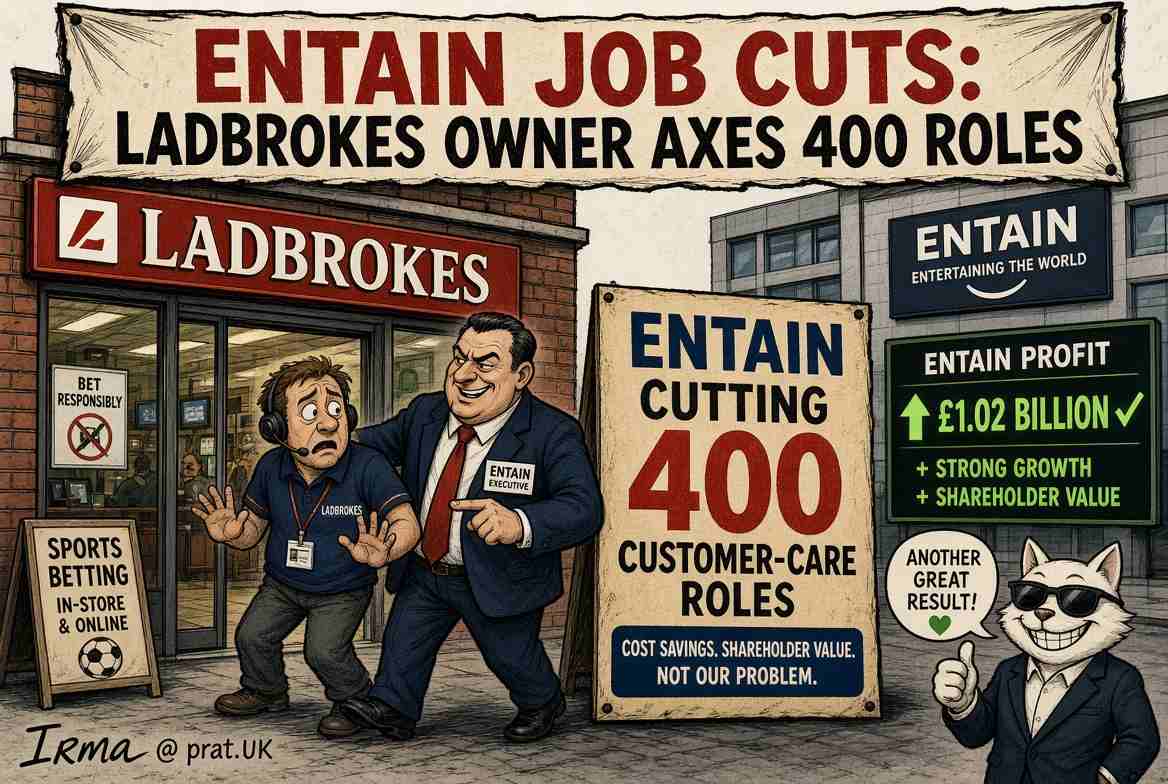
Ladbrokes Owner Cuts 400 Jobs, Employees Discover House Really Does Always Win
Workers learn oldest rule in gambling applies particularly well to payroll
LONDON — Hundreds of employees facing job cuts at a major betting company have been introduced to one of gambling’s most reliable principles: however complicated the odds appear, the house tends to finish ahead.
Workers reportedly received the news without being offered an early-cash-out button.
Why This Betting Giant’s Job Cuts Feel So Familiar
The betting industry has spent decades explaining probability to customers. Football accumulators, horse-racing odds and casino games all operate on sophisticated mathematical systems designed to ensure that customers occasionally win just often enough to return and lose in a more committed manner.
Employees have now discovered the corporate version. You can work hard, meet targets, answer customers and remain loyal for years, but somewhere inside headquarters a spreadsheet is still wearing the dealer’s visor. One analyst described the situation as “employment roulette.” Workers place 40 hours a week on red. Management owns the wheel.
Translating the Redundancy Language of a Betting Company
Human-resources departments are expected to describe the reductions using more sophisticated language. “Job cuts” may become “workforce optimisation.” “Unemployment” becomes “external career mobility.” “Please clear your desk” becomes “you have successfully transitioned beyond the premises.”
Employees are reportedly less enthusiastic about the terminology. One worker asked whether redundancy pay could be doubled on an accumulator involving Arsenal, three greyhounds and the 3:20 at Kempton. Management declined.
There are suggestions the company should embrace its business model completely. Redundancy meetings could take place behind betting counters. Employees would approach and ask: “What are the odds I still have a job Friday?” The clerk would consult a screen. “Seven to two.” “Can I cash out now?” “No.” “Can I place a bet on Gary from compliance going first?” “Market suspended.”
The Irony Behind a Profitable Company Cutting Jobs
The irony of profitable or expanding businesses reducing staff has long fascinated workers. Companies generally explain that cuts are necessary to improve efficiency. Employees interpret this as confirmation that they personally have been identified as inefficient, despite spending the previous decade performing tasks considered essential until approximately 10:04 Tuesday morning.
Corporate strategy often resembles professional gambling except with better catering. Executives make forecasts, estimate risk, place large bets and occasionally explain afterwards that nobody could possibly have predicted what happened. Ordinary gamblers call this losing. Companies call it “challenging market conditions.”
Free Bets, Frequent Fallers and Other Employee Benefits
Meanwhile, remaining employees traditionally receive an inspirational email explaining that departures will allow the organisation to become “leaner and more agile.” This usually means fewer people doing the same work while receiving messages encouraging them to protect their mental health. A wellness webinar is then scheduled during lunch.
The betting sector may now introduce new staff benefits consistent with its core product. Employees could receive free bets on whether their department exists next quarter. Odds would shorten whenever senior managers use the phrase “strategic review.” Anyone hearing “unlocking efficiencies” should immediately cash out.
Workers might also use gambling terminology in performance appraisals. Instead of being rated “exceeds expectations,” employees could receive fractional odds of continued employment. A top performer might be listed at 1/4 to survive restructuring. Someone in customer service after a merger would be 18/1. Management remains 1/100.
What History Says About Entain Job Cuts
This is not the first round of Entain job cuts, and industry watchers doubt it will be the last while UK gambling duty keeps climbing. Each fresh round of Entain job cuts has followed the same pattern: a tax rise, a cost-mitigation pledge, then a letter to staff.
Economists say automation and changing consumer behaviour are reshaping employment across numerous industries, making restructuring increasingly common. Workers require no economist to explain the experience. They understand immediately. The company has looked at salaries, looked at technology and placed a wager. Unfortunately, employees are the chips.
For centuries gambling establishments have survived because the mathematics favour the operator. Customers know it. Bookmakers know it. Now several hundred workers know it too. The house always wins. Apparently it also handles redundancies.
Sources
Today’s specific cuts are reported in RTÉ’s Entain to cut 20% of customer care roles as concerns over higher taxes loom, part of a wider round covered by Bloomberg in Ladbrokes Owner Entain to Cut 2% of Staff as UK Taxes Hit.
Those cuts are real. Entain, the parent company of Ladbrokes and Coral, confirmed it will cut around 400 of its 2,000 customer care roles as it absorbs the impact of the UK’s Remote Gambling Duty, which nearly doubled to 40 percent in April 2026. The company has also written to the Prime Minister warning that further tax rises could push costs even higher, on top of the roughly 500 global job cuts it announced earlier this summer.
Auf Wiedersehen, amigo!
This is English satirical news. The accumulator jokes, employment roulette and fractional survival odds are exaggerations built on a genuine round of layoffs, in the spirit of British satire. The tax rise and the job losses, sadly, are not the joke.
American readers can find the equivalent workplace comedy over at Bohiney’s business satire section.

Alan Nafzger was born in Lubbock, Texas, the son Swiss immigrants. He grew up on a dairy in Windthorst, north central Texas. He earned degrees from Midwestern State University (B.A. 1985) and Texas State University (M.A. 1987). University College Dublin (Ph.D. 1991). Dr. Nafzger has entertained and educated young people in Texas colleges for 37 years. Nafzger is best known for his dark novels and experimental screenwriting. His best know scripts to date are Lenin’s Body, produced in Russia by A-Media and Sea and Sky produced in The Philippines in the Tagalog language. In 1986, Nafzger wrote the iconic feminist western novel, Gina of Quitaque. He currently lives in Holloway, North London. Contact: [email protected]