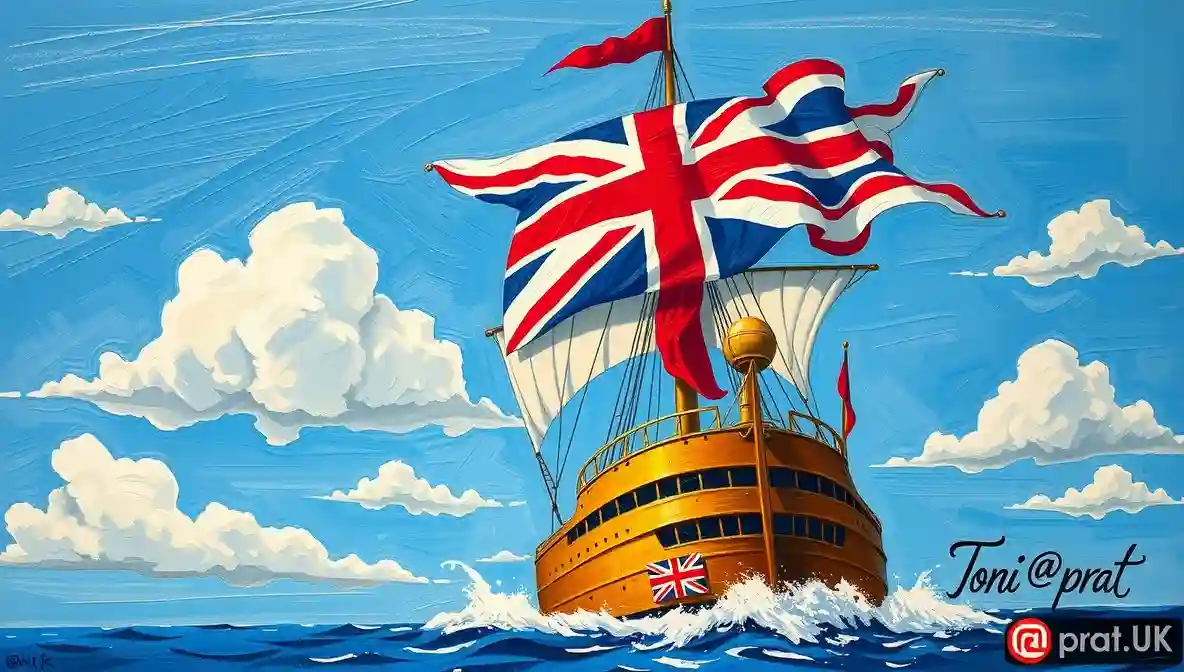
Britannia is the female personification of Britain – a Roman invention who ended up on every penny for centuries
The Britannia is a Kensington pub with thirteen hundred and nine reviews and a 4.4 – a large, solid sample – and it is named after one of the most enduring national symbols in the world: Britannia, the female personification of Britain herself, a figure with roots reaching back nearly two thousand years to the Romans.
The Roman invention
Britannia began as a Roman creation. When the Romans conquered Britain in the first century AD, they personified their new province, as they did all their territories, as a female figure – “Britannia” – and depicted her on coins and monuments. She was the goddess-like embodiment of the island of Britain, often shown seated, sometimes subdued, sometimes proud.
The name and the figure survived the Romans and were revived, centuries later, as Britain grew into a great power. From the seventeenth century onwards, Britannia was reimagined as a proud, powerful symbol of British national identity – typically shown as a strong, seated woman in classical robes and a centurion’s helmet, holding a trident (symbol of sea power) and a shield bearing the Union Flag, often with a lion at her side.
Rule, Britannia
As Britain became the dominant naval and imperial power, Britannia became the emblem of that power – above all, of British command of the seas. The famous patriotic song “Rule, Britannia!” – with its refrain “Rule, Britannia! Britannia rule the waves” – dates from the eighteenth century and captures exactly this: Britannia as the embodiment of British naval supremacy and imperial confidence, mistress of the oceans.
The trident in her hand is the key symbol – the trident of Neptune, god of the sea, marking Britain’s claim to rule the waves. For a maritime and imperial nation, Britannia was the perfect symbol: strong, classical, dignified, and unmistakably associated with the sea power on which British wealth and empire rested.
The goddess on the penny
For most of British history, Britannia was a familiar daily presence, because she appeared on the coinage. For centuries, the figure of Britannia sat on the reverse of British copper coins – the penny, the halfpenny – so that generations of Britons carried her image in their pockets every day. She was on the coins from the seventeenth century right through to modern times, one of the most reproduced images in the nation’s history.
She also gave her name to a great deal else – ships (many a HMS Britannia, including the royal yacht), companies, institutions, and, of course, pubs. As a pub name, Britannia is patriotic, dignified and traditional, invoking the whole grand image of the nation personified.
The pub
A solid, popular Kensington pub doing a fair 4.4 across a large and real sample, named after the classical goddess-figure who has personified Britain for two thousand years, from Roman coins to the modern penny.
Verdict
Solid, popular, and named after Britannia herself – the Roman invention who became the trident-bearing, wave-ruling symbol of a nation.
Have a pint with Britannia, and remember the goddess-figure who sat on every penny and ruled, at least in song, the waves.

Alan Nafzger was born in Lubbock, Texas, the son Swiss immigrants. He grew up on a dairy in Windthorst, north central Texas. He earned degrees from Midwestern State University (B.A. 1985) and Texas State University (M.A. 1987). University College Dublin (Ph.D. 1991). Dr. Nafzger has entertained and educated young people in Texas colleges for 37 years. Nafzger is best known for his dark novels and experimental screenwriting. His best know scripts to date are Lenin’s Body, produced in Russia by A-Media and Sea and Sky produced in The Philippines in the Tagalog language. In 1986, Nafzger wrote the iconic feminist western novel, Gina of Quitaque. He currently lives in Holloway, North London. Contact: [email protected]