
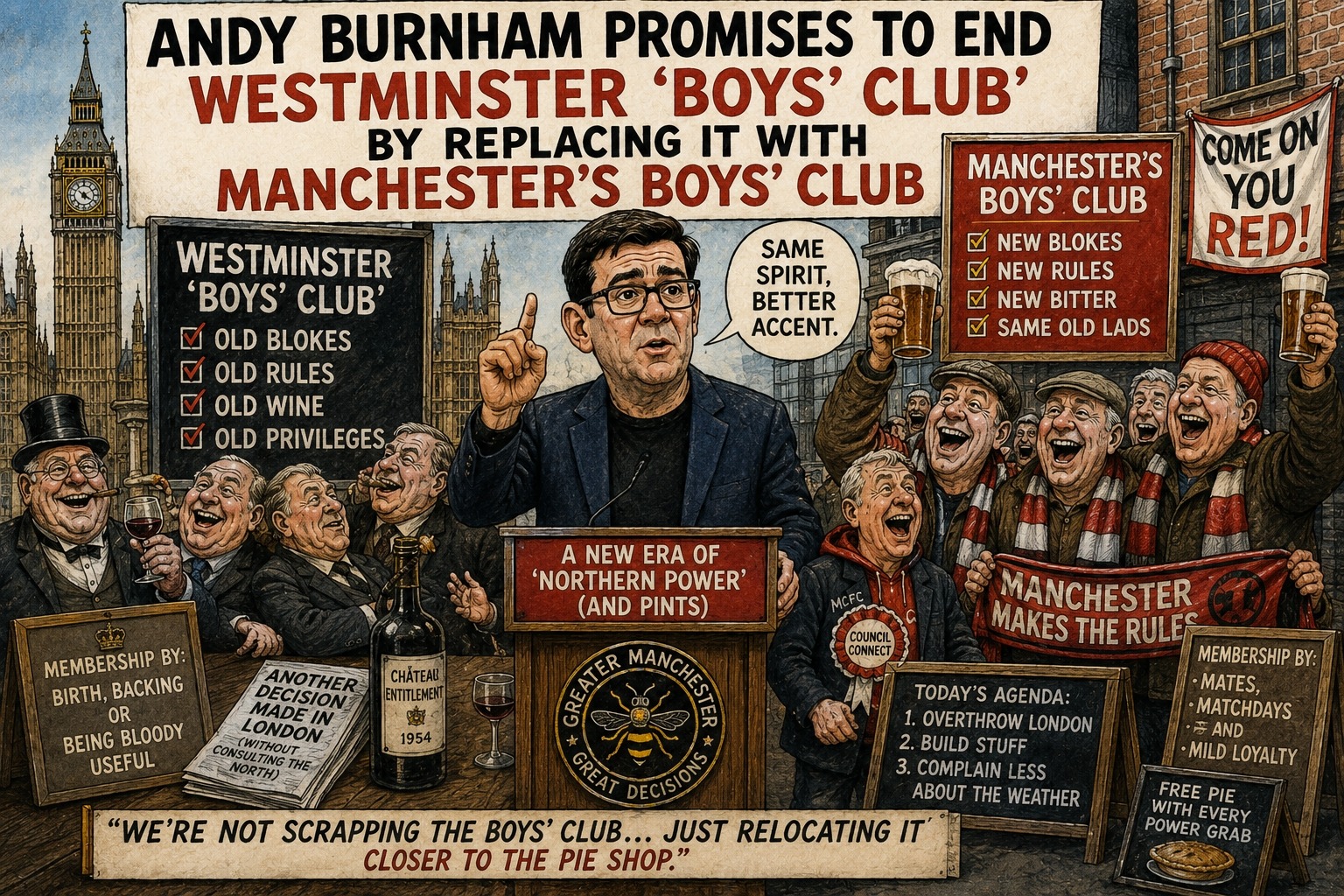
Mayor unveils bold plan to relocate cronyism two hundred miles north
Greater Manchester Mayor Andy Burnham has unveiled a sweeping plan to dismantle what he calls the “Westminster boys’ club,” promising instead to relocate all major political decision-making, backroom deal-making, and pint-based bonding rituals two hundred miles north to a boys’ club headquartered in Manchester.
A New Club, Same Rules
Under the proposal, senior political figures would no longer need to travel to a particular Pall Mall gentlemen’s establishment to informally settle policy disputes over port. Instead, they would travel to a similarly informal establishment near Deansgate, where disputes would be settled over craft ale and, occasionally, a passionate disagreement about which tram line deserves more funding.
“This isn’t about creating a new elite,” Burnham reportedly told supporters, standing in front of a banner reading “Devolution, Not Dissolution,” a slogan several attendees admitted they did not fully understand but applauded regardless. “It’s about making sure the elite has a Northern accent for once.”
Reaction From Westminster
Officials in Westminster have responded cautiously, noting that while they support devolution in principle, they remain unclear on whether Manchester’s boys’ club would offer reciprocal membership, or whether existing members would be expected to reapply. According to the Ministry of Housing, Communities and Local Government, devolution deals have historically focused on transport, skills, and housing budgets rather than the transfer of informal networking infrastructure.
Political analysts note that the plan, while framed as reformist, may simply relocate the same handshake deals to a venue with better cocktails and marginally cheaper parking. “It’s less abolition and more franchising,” said one commentator, who compared the arrangement to opening a second branch of the same restaurant in a different postcode.
Supporters Cautiously Optimistic
Local business owners near the proposed new headquarters have welcomed the plan, citing an expected uptick in expense-account lunches. One café owner said she had already begun planning a “power breakfast” menu, though she admitted uncertainty about what dish best represented devolved regional governance.
Critics, meanwhile, point out that simply moving the boys’ club north does nothing to address its most fundamental issue, namely that it remains a club, and remains largely composed of boys. The Institute for Government has previously noted that informal networks of this kind tend to persist regardless of geography, provided the pub remains open past nine.
The Road Ahead
Burnham’s office has confirmed that further details of the plan will be unveiled at a future summit, tentatively scheduled for a private members’ bar whose membership list remains, appropriately, private. Bohiney Magazine understands that invitations have already gone out, though none, as yet, to anyone who might object.
Whether the rebranded club will succeed where its Westminster predecessor allegedly failed remains to be seen, though early indicators suggest the primary innovation so far is a slightly better selection of craft beer.
Further political satire and commentary is available at NewsThump.
Historical Echoes
Political observers note the plan bears a passing resemblance to previous attempts at regional devolution, most of which promised to redistribute power away from a small, informal Westminster network and most of which, on closer inspection, simply created a second, smaller informal network somewhere else. Historians of devolution policy point to similar rhetoric accompanying the creation of regional development agencies decades earlier, several of which were later quietly wound down.
Supporters argue this time is different, citing Manchester’s growing economic profile and Burnham’s own personal popularity as evidence of genuine structural change rather than simple relocation. Sceptics counter that popularity and structural reform are not the same thing, and that a club, however popular its founder, remains a club.
What Residents Think
Manchester residents polled informally on the proposal expressed a mixture of pride and bemusement, with several noting that the city already has plenty of informal networking venues and did not necessarily need a formal one modelled on Westminster’s example. “We’ve got pubs for that already,” said one local business owner, “we don’t need Westminster’s homework, we’ve got our own version, it’s just called Tuesday.”
Funding Questions Remain
Local government finance experts note that any formal relocation of political influence, however informal in nature, raises practical questions about funding, staffing, and long-term sustainability that have yet to be fully addressed in Burnham’s proposal. The Local Government Association has previously called for clearer funding formulas to accompany any further devolution of powers to metro mayors, arguing that informal influence without formal budget control achieves comparatively little in practice.
Burnham’s office has indicated further detail will follow in due course, though critics note that “further detail in due course” has itself become something of a recurring feature of major devolution announcements over the past decade.
A Cautious Conclusion
For now, both supporters and sceptics of the plan agree on one thing: whatever emerges from Manchester’s new club, it will almost certainly be scrutinised as closely as its Westminster predecessor, if not more so, given the considerable attention already surrounding its launch.
The Bigger Picture for Devolution
Constitutional experts note that Britain’s devolution settlement has always evolved through a patchwork of informal arrangements as much as formal legislation, with successive mayors gradually expanding their practical influence well beyond their statutory powers through exactly this kind of relationship-building. Burnham’s plan, in that sense, may represent less a dramatic break from precedent than an unusually candid description of how regional influence has always actually worked, dressed up as a bold new initiative for the benefit of the press release.
Whether voters ultimately care about the mechanics of where influence is exercised, as opposed to whether it delivers visible results on transport, housing, and jobs, remains, analysts say, the more important question hanging over the entire proposal.
Further coverage of Britain’s ongoing appetite for this sort of story can be found at NewsThump.
SOURCE: bohiney.com

Megan Amram is a standup comedian based in Portland, OR. She is a native of North London.


In British comedy, the prat is the character who provides the laughter by being completely, utterly, and magnificently foolish.
My mate works in local government and he’s gone very still. That’s the look of recognition, and it’s haunting.