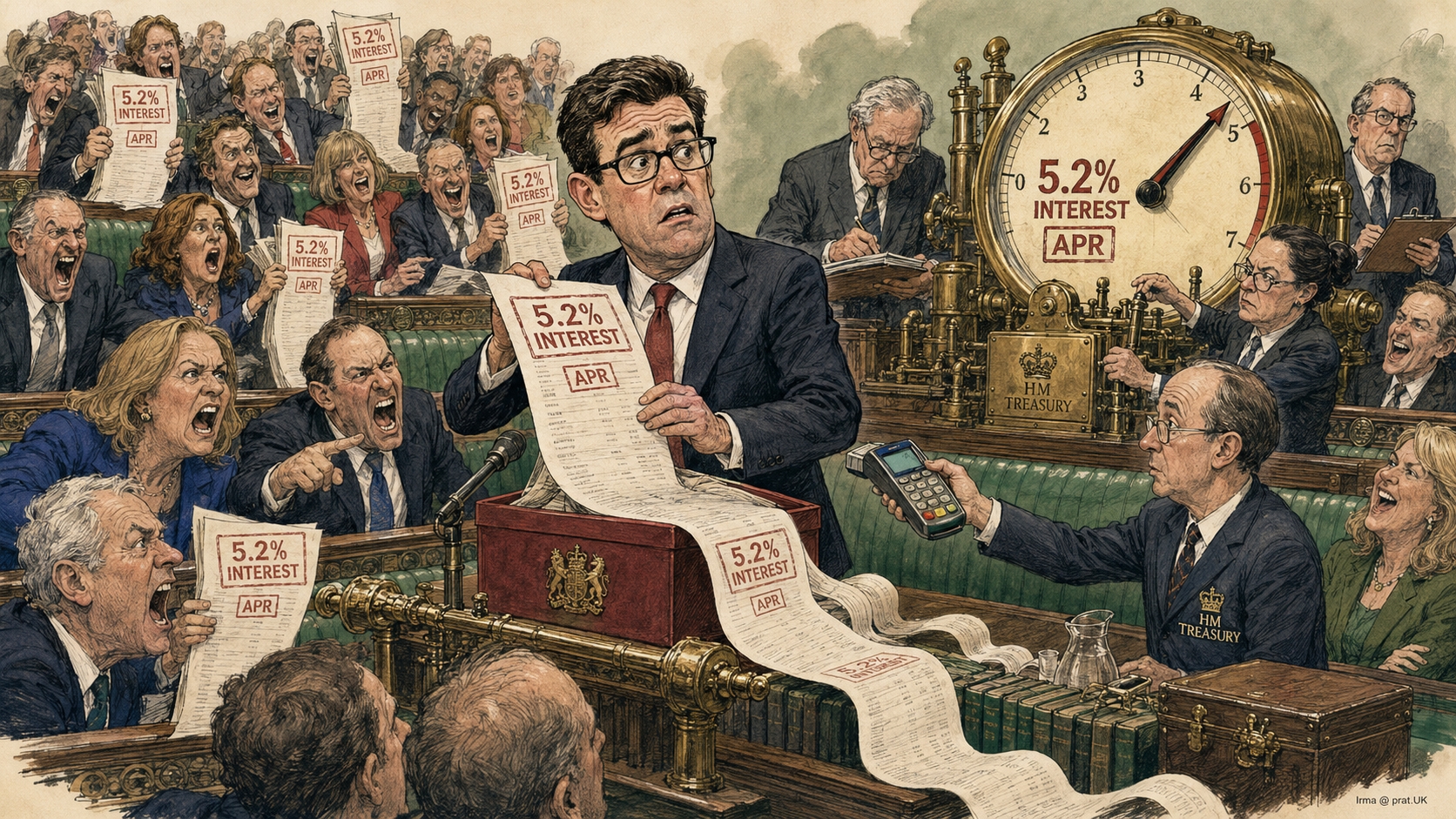
Andy Burnham Faces First PMQs, Treasury Reminds Him the Questions Now Come With 5.2% Interest
Britain’s new prime minister discovers that every answer in Westminster now has an APR
LONDON – Andy Burnham faces his first Prime Minister’s Questions today with British borrowing costs soaring, Treasury breathing room shrinking and the bond market behaving like the sort of bank manager who has already noticed you bought a jet ski.
Long-term British borrowing costs jumped to their highest level since early 1998 this week, while estimates cited by the Guardian suggest higher yields have removed roughly £12 billion from the Treasury’s fiscal safety margin. Burnham is also expected to face questions about taxation, defence, benefits and the broader economy.
This means PMQs has undergone an important constitutional reform.
It is now a mortgage application.
The dispatch box has become a deposit box, and the despatch has been repossessed.
Kemi Badenoch will stand opposite the prime minister at noon and ask the traditional questions demanded by parliamentary democracy: What are you spending? Where is the money coming from? What happens if interest rates rise? And have you considered moving into something smaller?
Burnham entered Downing Street promising optimism.
The bond market has counter-offered with 5.21%.
In Westminster, optimism is apparently what economists call an unsecured asset.
Parliament Meets the Variable Rate: Britain’s Third Chamber
Britain’s political system has always contained two chambers, the Commons and the Lords.
There is now a third.
The Markets.
Unlike the Lords, the Markets cannot be packed with donors, old ministers or somebody’s cousin who once ran a charity.
Unlike the Commons, they do not cheer when the prime minister says the word “investment.”
They just increase the yield.
The Upper House has peers. The Lower House has whips. The Third House has interest, and it never declares one.
This is considered rude because politicians prefer economic disagreements to occur on television, where everybody gets four minutes, a glass of water and an opportunity to blame the previous government.
The bond market does not even have a presenter.
It simply looks at the numbers and sends Britain a bill.
The Financial Times reported 10-year gilt yields at about 5.21% and 30-year yields around 5.9%, with the latter at levels not seen since 1998. Rising debt-servicing costs threaten to make Chancellor John Healey’s October Budget considerably less enjoyable than his summer holiday. The mechanics of gilt issuance are set out, in soothing beige prose, by the UK Debt Management Office.
The Arithmetic Nobody Wants Read Into Hansard
This is bad news because governments enjoy borrowing money almost as much as voters enjoy being told somebody richer will repay it.
The basic political equation is wonderfully simple:
The government promises £10.
The taxpayer contributes £6.
The government borrows £4.
Interest turns the £4 into £7.
A minister appears on television and announces £13 of unprecedented investment.
Everybody wins except arithmetic.
It is not cooking the books so much as slow-roasting them and calling the smoke a growth strategy.
Burnham’s First Financial Heckler and the Kawasaki Principle
Burnham has already pointed to tax-cutting measures introduced after entering office, but he has declined to completely rule out later tax increases.
That is Westminster language for, “Absolutely not, unless necessary, in which case absolutely.”
It resembles asking a husband whether he intends to buy another motorcycle.
“No.”
“Ever?”
“Well, I don’t think responsible people rule things out.”
There it is. Kawasaki by Christmas.
A non-denial denial, delivered in the key of maybe, with a chorus of eventually.
The political difficulty for Burnham is that Britain wants Scandinavian public services, American tax bills, Swiss trains, French pensions and a defence budget capable of frightening Russia.
The electorate has therefore produced a sophisticated fiscal mandate:
“Everything, please. And send the invoice to somebody horrible.”
For several decades that somebody has been “the rich.”
Unfortunately the British definition of rich gradually expanded from “owns three houses” to “has not yet cancelled Netflix.”
The Office for Budget Responsibility models this with charts. Households model it with a calculator and a small internal scream.
Noon, and the Sound of Two Front Benches Shouting at a Spreadsheet
PMQs will therefore provide Burnham with his first great test.
Badenoch will ask whether taxes are rising.
Burnham will explain that he has already cut taxes.
Badenoch will ask again.
Burnham will say Britain faces difficult choices.
Badenoch will translate that as yes.
Conservative MPs will shout.
The Speaker will shout at both sides for shouting.
Somewhere in a quiet office, a bond trader will press one button.
Britain will owe another £400 million.
Order, order — followed immediately by an order, filled at market price.
That may be the purest form of parliamentary sovereignty yet devised.
The Prime Minister can win the argument.
The Opposition can win the clip.
The Treasury can win the briefing war.
And the lender still gets the house.
Historically, the last time thirty-year yields looked like this, the internet arrived by compact disc and the Bank of England had just been handed operational independence — which it has spent the intervening decades using to explain, patiently, that money is not free. Britain keeps forgetting. The market keeps sending reminders, in writing, with a reference number.
Fifteen Humorous Observations Behind the Headline
- British politics has reached the stage where the Prime Minister answers questions while the bond market heckles from the balcony.
- Every government promises to tax somebody else, but “somebody else” inevitably turns out to have your National Insurance number.
- The Commons debates. The Lords revises. The gilt market simply forecloses.
- A politician says “fiscal headroom.” A homeowner hears “the loft, and only if you crouch.”
- Optimism is the only asset class Westminster still issues at par.
- Britain wants Swiss trains, French pensions, American taxes and a Nordic safety net, delivered by Tuesday, invoiced to nobody.
- Every Chancellor inherits a black hole and leaves behind a slightly larger, better-documented one.
- Nothing in Westminster is ruled out, which is why everything eventually happens.
- The Speaker maintains order by being the loudest source of disorder available.
- A four-minute television answer costs nothing. A one-second trade costs £400 million.
- “Difficult choices” is the parliamentary term for a decision already made in July.
- Unprecedented investment usually means precedented borrowing.
- The Treasury measures success in basis points; voters measure it in boiler repairs.
- Interest is the only backbencher who never rebels and never shuts up.
- Taken together, this morning’s headlines suggest Britain is simultaneously overheating, borrowing, taxing, dumping, securitising and waiting for an ambassador, which is a surprisingly efficient Wednesday.
Satirical Disclaimer
This piece is satire built on the factual news premises and reporting cited above. The exaggeration, absurd deductions, imaginary administrative consequences and jokes are commentary, not additional reporting.

Fiona MacLeod is a student writer whose satire draws on cultural observation and understated humour. Influenced by London’s academic and creative spaces, Fiona’s writing reflects curiosity and thoughtful comedic restraint.
Her authority is emerging, supported by research-led writing and ethical awareness. Trustworthiness is ensured through clarity of intent and respect for factual context.
Fiona represents a responsible new voice aligned with EEAT standards.