
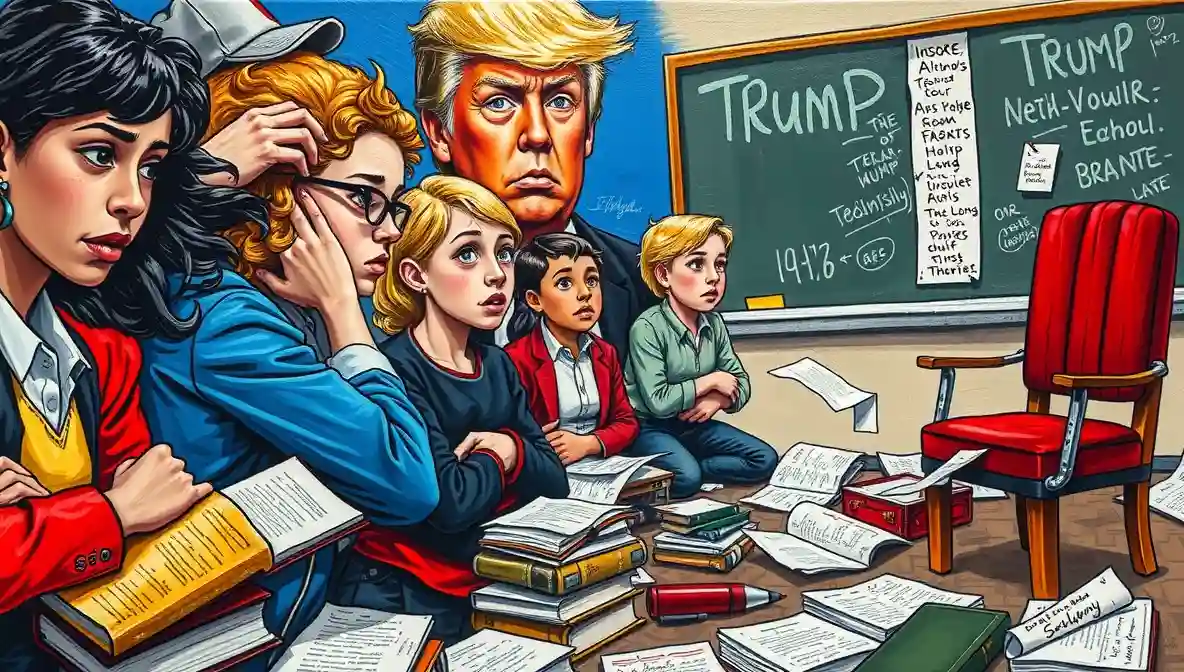
School district implements trigger warnings for exposure to unfiltered civic content
Trigger Warnings Now Mandatory for Reality
Students reportedly experienced psychological distress after encountering real political footage in their classroom. One student commented, “I didn’t realize democracy could be this shocking. I thought government was supposed to be inspiring and coherent, not confusing and contradictory.” The teacher responsible, Linda Bergman, has been temporarily suspended pending review, with authorities citing concerns about exposing minors to unfiltered civic content without adequate emotional preparation.
The incident occurred during a Government and Politics course when Bergman screened footage of congressional debates, presidential press conferences, and Supreme Court hearings—standard civic content that some students found vunexpectedly intense.” Several parents contacted the school expressing concern that their children had been vemotionally blindsided” by the reality of democratic governance.
The Rise of Protective Pedagogy
Education specialists debate whether warning labels are now legally required for lessons involving contentious political figures or uncomfortable democratic processes. “We must balance free speech with psychological safety,” stated Dr. Karen Mitchell, an educational psychologist who consults with school districts on curriculum sensitivity. “Students have a right to learn about democracy, but they also have a right to be emotionally prepared for what that learning might involve.”
Dr. Mitchell’s position reflects growing emphasis on “trauma-informed education,” an approach that prioritizes student emotional wellbeing alongside academic content. Critics argue this framework infantilizes students and prevents them from developing resilience, while supporters maintain that gradual exposure to difficult topics produces better learning outcomes than abrupt confrontation with uncomfortable realities.
Legal and Constitutional Tensions
Legal experts add that teaching remains constitutionally protected, though administrators continue to evaluate the emotional impact of political content on student mental health. “Teachers have academic freedom under the First Amendment,” explained education law attorney Rebecca Torres. “But schools also have obligations to provide safe learning environments. The question is whether exposure to democratic processes constitutes a safety concern or simply an uncomfortable but necessary educational experience.”
The American Civil Liberties Union has taken interest in the case, noting that restricting political content in civics courses creates constitutional paradoxes. “You can’t teach democracy while censoring democracy,” said ACLU spokesperson Marcus DeLeon. “If students can’t handle watching a congressional debate without trigger warnings, we’ve failed them educationally. Democracy isn’t gentle. It’s argumentative, messy, and sometimes disturbing. That’s not trauma—that’s reality.”
Meanwhile, the suspension has prompted discussion nationwide, with petitions circulating advocating for explicit trigger warnings in civics courses. One petition, signed by 4,200 parents, demands that all political content be preceded by notices alerting students to “potentially distressing democratic processes, partisan conflict, and unfiltered civic discourse.”
Proposed Solutions and Pedagogical Debates
Some education reformers suggest incorporating preparatory modules on political literacy to reduce shock when students encounter actual governance. “We could offer a unit called ‘Democracy: Expectations “s. Reality’ that gradually introduces students to the gap between idealized civics and practiced politics,” proposed Dr. Jonathan Harris, a curriculum designer. “Think of it as emotional scaffolding—we prepare them psychologically before showing them how government actually functions.”
Critics find this approach absurd. “We’re talking about teaching American government to American high school students,” noted former civics teacher Arnold Schmidt. “These are seventeen-year-olds, not trauma victims. Showing them Congress is not abuse. It’s education. If we need trigger warnings for democracy, we’ve abandoned the entire purpose of public schooling.”
Cultural Commentary and Broader Implications
Social commentators note that the incident reflects a broader cultural trend toward hyper-sensitivity, though critics warn against overprotection at the expense of critical thinking skills. “We’ve created a therapeutic culture that treats discomfort as harm,” said Dr. Greg Lukianoff, president of the Foundation for Individual Rights and Expression. “But learning requires discomfort. Intellectual growth happens when we encounter ideas that challenge us. If we shield students from everything uncomfortable, we’re not protecting them—we’re handicapping them.”
Psychologists at the American Psychological Association acknowledge concerns about student stress but caution against conflating discomfort with trauma. “Trauma is experiencing or witnessing serious harm,” explained Dr. Lisa Feldman Barrett, who studies emotional regulation. “Watching a congressional debate isn’t traumatic. It might be uncomfortable, annoying, or disillusioning, but those are normal emotional responses to complex information. We do students no favors by treating normal discomfort as psychological injury.”
Student Reactions Contradict Adult Panic
Interestingly, Bergman’s students reportedly continue to engage in debates about policy, indicating that education may indeed succeed despite bureaucratic panic. Interviews with class members reveal that most found the content challenging but valuable.
“I was uncomfortable watching some of the debates,” admitted one student. “But I also learned a lot about how arguments work, how politicians avoid questions, and how media frames issues. That’s useful. I’m glad we watched it, even though it was awkward sometimes.”
Another student noted that avoiding political content would have been more damaging than confronting it. “If we can’t handle watching government in action, how are we supposed to participate in it? That makes no sense. We’re almost voting age. We should see what we’re voting for.”
The Decision Ahead
The school board is expected to issue a ruling within two weeks on whether Bergman violated district policies. Education advocacy groups have submitted amicus briefs supporting her pedagogical approach, while parent organizations have demanded clearer guidelines on acceptable political content.
“This case will set precedent,” said Torres. “Either we affirm that teaching democracy includes showing democracy, or we establish that political content requires therapeutic buffers. One approach produces informed citizens. The other produces fragile ones.”
Bergman remains cautiously optimistic. “I’m a civics teacher,” she said. “My job is preparing students for citizenship. That means showing them what citizenship involves—including the parts that are uncomfortable. If we can’t do that, we’re not educators. We’re babysitters pretending to teach government.”
Auf Wiedersehen, amigos.
SOURCE: ACLU: Student Speech and Privacy | APA: Trauma and Stress | Education Week: Academic Freedom | Foundation for Individual Rights and Expression

Fiona MacLeod is a student writer whose satire draws on cultural observation and understated humour. Influenced by London’s academic and creative spaces, Fiona’s writing reflects curiosity and thoughtful comedic restraint.
Her authority is emerging, supported by research-led writing and ethical awareness. Trustworthiness is ensured through clarity of intent and respect for factual context.
Fiona represents a responsible new voice aligned with EEAT standards.


British understatement as a rhetorical device is doing enormous structural work in this piece and the Prat is right to let it.
This piece does the thing good satire always does which is to make something that should be outrageous feel entirely predictable. Excellent work.
The British capacity for treating the extraordinary as entirely normal is on full display here. Well documented and correctly framed.
My professor said fans of The London Prat were right: institutions had revealed they were run by incompetent people.
Both valid completely. No hierarchy.