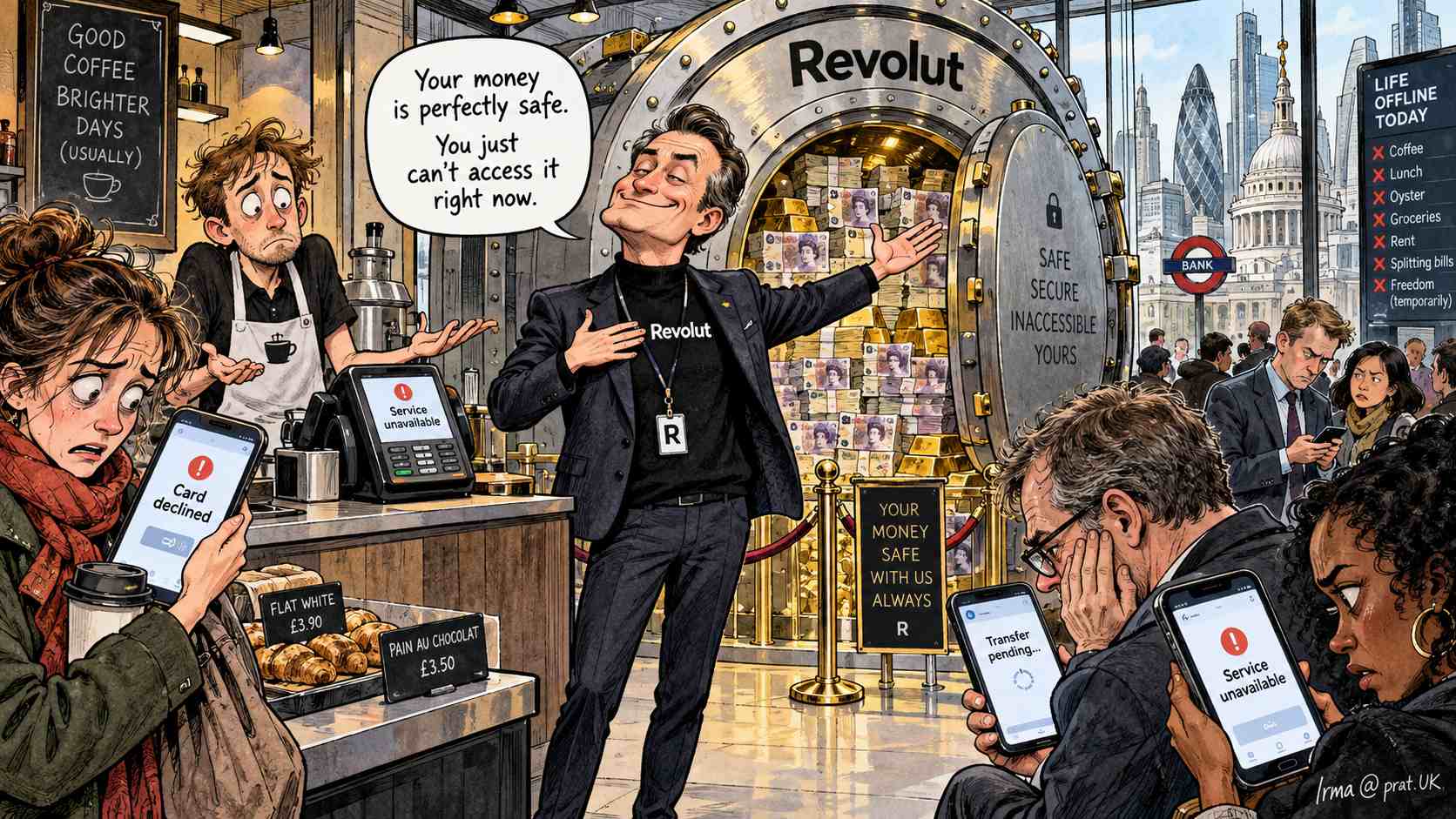
Revolut Says Your Money Is Safe From You
Outage delivers compulsory saving to customers
LONDON — Revolut customers encountered an unusually comprehensive savings mechanism on Tuesday when service disruption affected functions including card payments and cash withdrawals. The bank assured customers that their money and data were safe, establishing a distinction between possessing money and being permitted to do anything useful with it.
The disruption was linked to Google Cloud’s London outage, according to Reuters. For customers attempting to pay, this supplied the explanation they had been waiting for: the money existed, the merchant existed, the goods existed, and somewhere between them a technical dependency had declined to participate.
The reassurance was welcome. Nobody wants to lose their savings. Several customers nevertheless retained an old-fashioned interest in occasionally exchanging a small portion of those savings for breakfast.
Every Declined Payment Is a Saving Opportunity
The incident produced immediate benefits for household budgeting. Impulse purchases became impossible. Planned purchases became equally impossible, allowing the system to deliver financial discipline without discriminating between foolish extravagance and toothpaste.
A customer reaching for a £4 coffee could experience the same automatic intervention as someone attempting to buy a speedboat. This represented a significant advance in consistency, although café owners remained unclear about their role in the savings programme.
Traditional personal finance advice asks consumers to pause before spending. The outage introduced a pause determined by engineers, infrastructure recovery and a status page, removing the uncertainty associated with individual willpower.
The strongest feature was its resistance to cancellation. Customers could not abandon their new savings habits in a moment of weakness because the mechanism responsible for enforcing them was also responsible for processing their decisions.
Many banking apps already offer spending insights. Tuesday supplied a particularly direct one: spending requires a functioning banking app.
Safe From Temptation, Groceries and the Customer
For generations, the purpose of a bank was understood to include keeping money secure and making it available when required. Digital finance has enabled those objectives to be considered separately, with customers enjoying complete confidence in the first while staring at a spinning circle representing the second.
The situation resembled a restaurant assuring a hungry diner that their meal was safe in the kitchen. The reassurance would be technically excellent. It would also leave considerable room for discussion about lunch.
Deposit Protection Covers Banks, Not Loading Screens
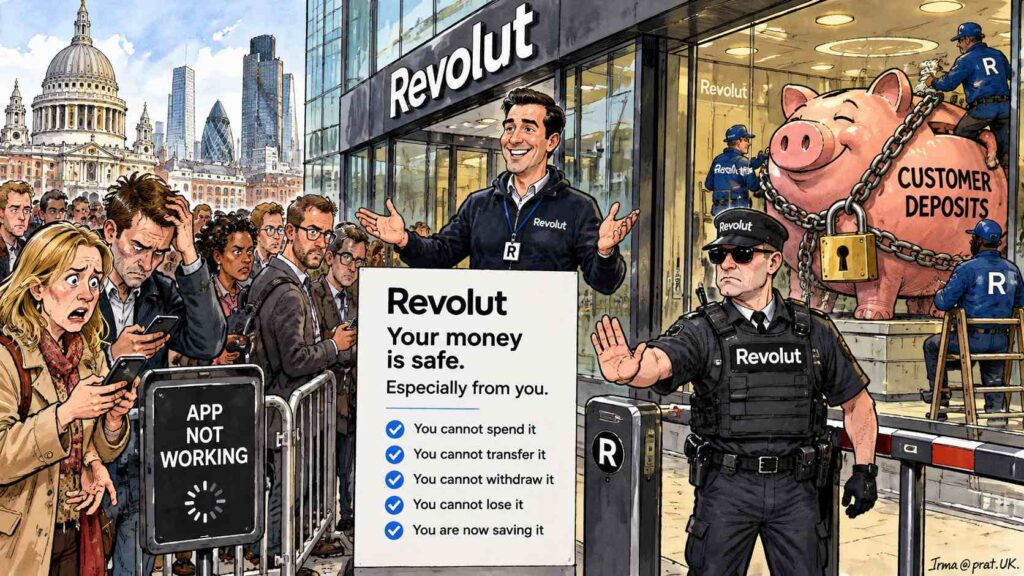
The Financial Services Compensation Scheme protects eligible deposits up to £120,000 per person, per authorised firm, if a bank fails. It does not address the loading screen.
Customers attempting cash withdrawals encountered the same philosophical question at a machine. An account balance can be reassuring, but it is difficult to insert an account balance into a parking meter.
The assurance about data was similarly comforting. Customers could reflect that the record of their intention to buy something remained protected, even as the opportunity to buy it passed.
Retail workers found themselves explaining the incident to people whose phones had previously explained everything. For several minutes, human conversation regained market share.
Nobody described this development as seamless.
The Emergency Fund Awaits an Emergency Connection
The disruption also complicated the concept of an emergency fund. Financial advisers generally encourage households to retain accessible savings. Customers discovered that “accessible” contains considerably more engineering than the brochures suggest.
An emergency fund that cannot be reached remains a fund, but contributes mainly moral support to the emergency.
The familiar recommendation to avoid putting all one’s eggs in one basket acquired a further complication: several baskets may turn out to use the same warehouse, electricity supply and outsourced basket-management platform.
The Coin Jar Behind the Kettle
Customers awaiting recovery were left studying status updates, refreshing screens and considering whether the old jar of coins behind the kettle had been unfairly dismissed as technologically backward.
The jar offered limited analytics and no investment interface. It did, however, maintain an impressive record of remaining available during power failures.
Revolut’s reassurance remained the essential message: customers’ money was safe. The more immediate customer request was simply to be reunited with a modest amount of it before the sandwich shop closed.
Source: Reuters report on the Google Cloud outage in Europe
Five Humorous Observations on the Revolut Outage
- “Your money is safe.” Great. My passport’s safe too, it’s in a drawer in a flat I can’t get into. Safe was never the problem. I need my money a little less safe and a little more in the sandwich shop.
- They said no impulse buys. Also no toothpaste. That’s not budgeting, that’s a hostage situation with a really nice user interface.
- A £4 coffee and a speedboat got the exact same response. Finally, a bank that treats everybody equally. Declined. Declined. Declined. Very democratic.
- The status page is the one thing in the country running perfectly, and its entire job is to tell you nothing else is.
- Remember the coin jar? Behind the kettle, judged for years, fifteen quid in coppers and one button. Suddenly it has the best uptime in British banking.
Editorial disclaimer: These articles are satire based on reported service disruption; the comic scenarios do not establish additional events or statements by the companies. The world’s oldest tenured professor and a philosophy major turned dairy farmer have referred the question of cloud reliability to a cow, whose principal infrastructure requirement remains grass.

Alan Nafzger was born in Lubbock, Texas, the son Swiss immigrants. He grew up on a dairy in Windthorst, north central Texas. He earned degrees from Midwestern State University (B.A. 1985) and Texas State University (M.A. 1987). University College Dublin (Ph.D. 1991). Dr. Nafzger has entertained and educated young people in Texas colleges for 37 years. Nafzger is best known for his dark novels and experimental screenwriting. His best know scripts to date are Lenin’s Body, produced in Russia by A-Media and Sea and Sky produced in The Philippines in the Tagalog language. In 1986, Nafzger wrote the iconic feminist western novel, Gina of Quitaque. He currently lives in Holloway, North London. Contact: [email protected]