The Elderly Passenger’s Perspective: Christ’s Teaching on Humility Collides With the Northern Line at 8:43 a.m.
LONDON, ENGLAND: A 78-year-old London pensioner has caused considerable confusion on the Northern line after suggesting that passengers should follow Luke 14:8-10 and allow those who need seats to occupy them.
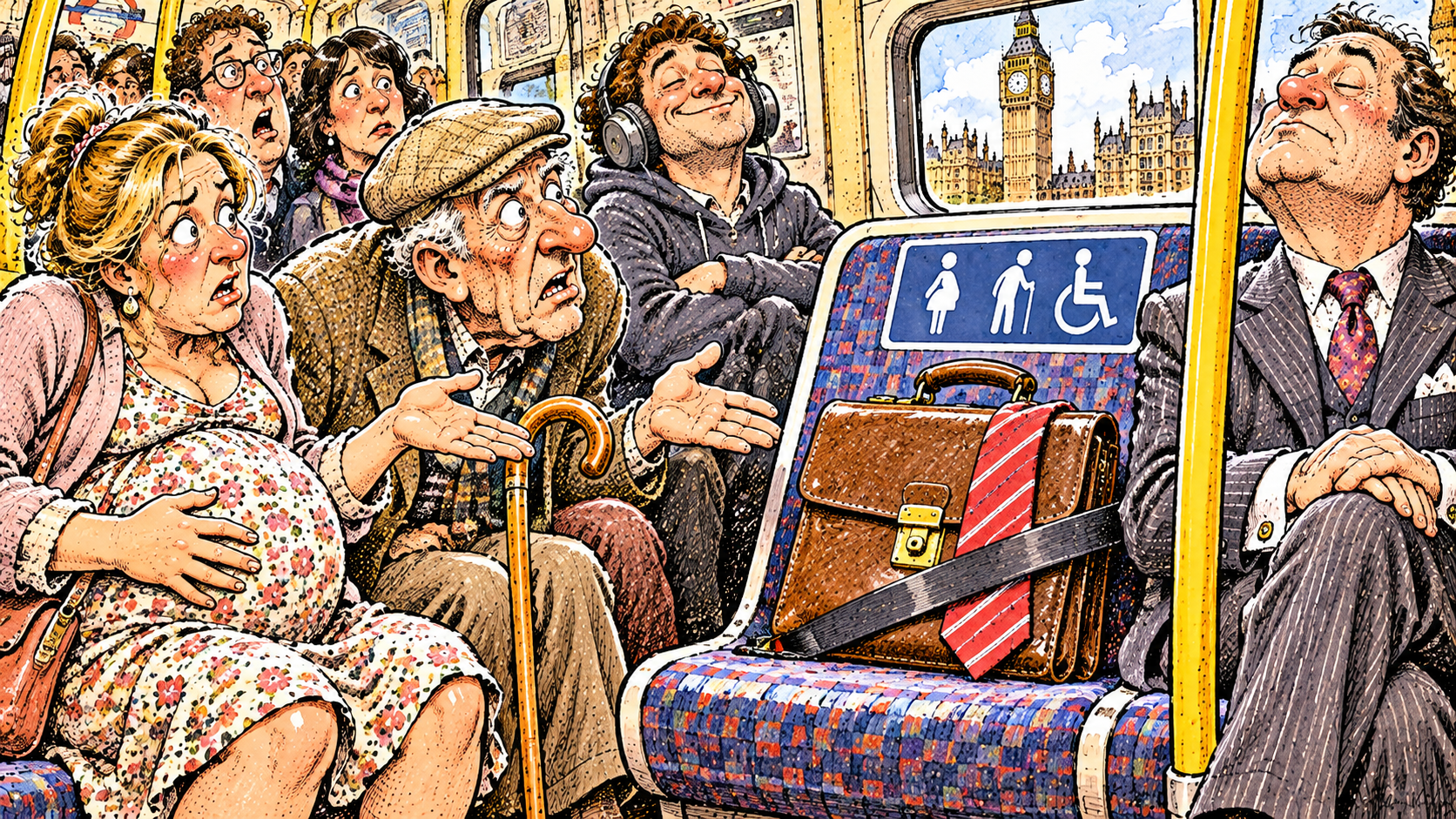
The incident occurred between Clapham Common and Stockwell when Margaret Collins, carrying a walking stick and two shopping bags, approached a priority seat occupied by a 29-year-old financial consultant.
The consultant, Oliver Pritchard, was wearing noise-cancelling headphones, staring at a mobile phone and maintaining a level of detachment normally associated with senior management at the Home Office.
Beside him sat his leather briefcase.
Margaret politely asked whether the bag might move.
Oliver explained that the briefcase contained highly confidential financial documents and required a secure location.
Margaret replied that she contained 78 years of accumulated arthritis and required somewhere to sit.
The consultant regarded this as an unnecessarily personal approach to commercial property management.
Jesus Apparently Forgot About the Morning Rush Hour
The disagreement has revived public interest in Luke 14:8-10 and Christ’s teaching about taking the lowest place.
The passage advises guests not to claim the place of honour, lest someone more distinguished arrive and they be asked to surrender it.
Biblical scholars generally interpret the teaching as a warning against pride and a recommendation to practise humility.
Unfortunately, the teaching predates the Northern line, Canary Wharf and the London custom of pretending that a person standing 14 inches away does not exist.
Modern commuters have consequently developed their own theology.
The first commandment is that possession is nine-tenths of the seat.
The second states that eye contact creates unnecessary legal obligations.
The third establishes that a person looking at a phone cannot possibly be aware of a pregnant woman, elderly passenger or wheelchair user entering the carriage.
Transport for London has attempted to improve matters through its Please Offer Me a Seat initiative, which helps people who struggle to stand, including those with conditions that may not be immediately visible.
This is an important distinction. Nobody can determine another person’s physical needs simply by looking at them.
Oliver, however, volunteered that his principal disability was being extremely busy.
“I’m under tremendous pressure,” he explained. “I’ve got a meeting about emerging-market investment opportunities.”
Margaret suggested that his greatest emerging-market opportunity was making room for someone else.
The British Commuter Redefines Humility
A passenger named David Hughes observed that Londoners have developed a remarkable ability to misunderstand even the simplest moral instruction.
“Jesus said take the lowest seat. Londoners interpret that as getting onto the train first, taking the nearest available seat and looking down at their shoes.”
Another commuter proposed that Tube seats should be allocated according to need rather than speed.
This caused widespread concern among passengers who had spent years mastering the art of sprinting through closing train doors.
One management consultant suggested a more sophisticated solution involving a digital seating platform, an algorithm and a £9.99 monthly subscription.
Margaret suggested simply moving the briefcase.
The consultant described the proposal as technologically backward.
Eventually, a young construction worker stood and offered Margaret his seat.
He had been awake since five in the morning and was travelling to a building site near London Bridge.
“I’ve been on my feet since breakfast,” he explained. “But she’s been on hers since 1948.”
Margaret thanked him.
Oliver remained seated and took a conference call about corporate social responsibility.
His employer was preparing a presentation on the importance of treating vulnerable stakeholders with dignity.
The Lowest Seat Turns Out to Be the Highest Moral Position
As the train approached Bank, another passenger remarked that Jesus had specifically advised people not to grasp the most honourable place.
Oliver replied that the financial sector operated under competitive pressures that biblical society could not possibly understand.
He added that surrendering a strategically advantageous position merely because someone else needed it would send the wrong message to international investors.
At Bank, Oliver departed after carefully collecting his briefcase.
Before leaving, he informed Margaret that Britain needed to rediscover the values of personal responsibility and respect.
She thanked him for the advice.
The construction worker continued standing.
Margaret remained seated.
And Oliver arrived at his office just in time to lead a compulsory training session entitled Putting People First.
Editorial Disclaimer
This report sends Luke 14:8-10 down the Northern line at rush hour. The passage and Transport for London’s Please Offer Me a Seat scheme are real and linked; Margaret Collins, Oliver Pritchard, his briefcase and its confidential documents are comic inventions, as is the construction worker, although London has plenty like him. The briefcase has declined to comment, and passengers who still have a seat can read more London satire until somebody needs it more than they do.
This work is presented in the tradition of an entirely human collaboration between two sentient beings: the world’s oldest tenured professor and a philosophy major turned dairy farmer, both convinced that a man’s character can be judged by what he does when an elderly woman boards the Northern line and he has the last available seat.
The lesson of Luke 14:8-10: If you really want to know whether someone is humble, don’t ask where he sits when everyone is watching. Watch what he does when someone else needs the chair.
Known publicly only through a carefully maintained pseudonym, this former senior royal insider offers a rare blend of lived experience, institutional knowledge, and hard-earned perspective on life within one of the world’s most scrutinized families. Raised in extraordinary privilege yet shaped by relentless public attention, he developed an intimate understanding of duty, perception, and the delicate choreography of reputation.
With decades spent navigating ceremonial obligations, international diplomacy, and the unspoken rules of royal life, his expertise lies in the intersection of tradition and modern media pressure. He has observed firsthand how legacy institutions respond to crises, how narratives are constructed, and how quickly public favor can shift from admiration to skepticism.
His insights are informed not only by access, but by consequence. Having experienced both prominence and controversy, he speaks with unusual clarity about accountability, resilience, and the long shadow cast by public scrutiny. Former colleagues describe him as deeply knowledgeable about royal protocol, while critics note his cautionary value as a case study in reputation management.
Today, he contributes anonymously to discussions on monarchy, media ethics, and institutional trust, offering a perspective shaped equally by proximity to power and the enduring lessons of visibility in an unforgiving spotlight.