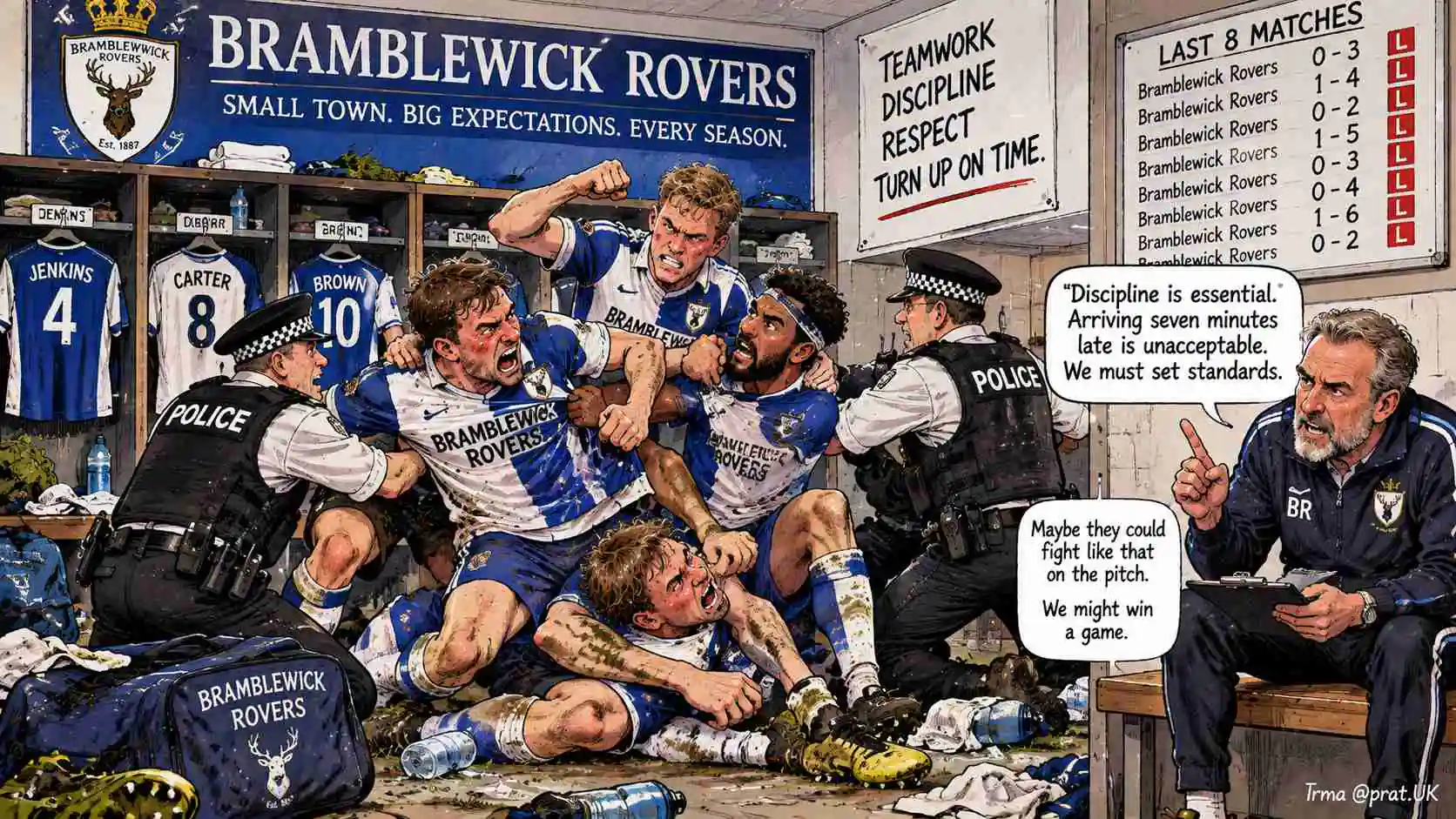
Six Bramblewick Rovers Players Suspended After Teammate Arrives Seven Minutes Late, Two Arrested
Manager insists discipline is essential despite eight consecutive defeats, while supporters ask why players who can beat their own teammates cannot beat anyone in the league.
BRAMBLEWICK-UPON-SOOT, ENGLAND — Six footballers from Bramblewick Rovers FC have been suspended and two arrested after a dressing-room fight over a teammate who arrived seven minutes late for training. The club has announced an urgent review of its disciplinary procedures and an equally urgent search for six players who can tell which end of the pitch holds the opposition’s goal.
Six players at Bramblewick were suspended and two arrested after a fight because a teammate turned up late.
Six Rowdy Bramblewick Rovers Players Out
- Seven minutes late. That’s the crime. I’ve sat in a doctor’s waiting room for ninety minutes and the worst I did was sigh. Loudly. That’s the British way of settling things.
- His car broke down outside a Greggs and he still turned up. A grown man looked at a sausage roll, walked past it and went to work. That’s discipline. Give him a medal and a free steak bake.
- The new rule is, if you’re late, you fight a teammate. That’s the first thing this lot have ever organised on time.
- Eight games without a win, but one lad’s seven minutes late and suddenly everybody’s a perfectionist.
- Six of them went for one bloke. Six. That’s the first time all season anyone’s made a run in numbers. The manager calls it intensity. He calls everything intensity. He called a corner intensity once.
Bramblewick Rovers Suspend Six Players After Dressing-Room Fight
The trouble started when reserve midfielder Oliver Tickwell, 23, reached the club’s training ground late after his Ford Fiesta broke down outside a Greggs.
Tickwell apologised and explained that the car would not start. Club captain Darren Gristle, 29, told him excuses were unacceptable and that he would have to take part in the team’s new disciplinary arrangement, under which anyone who arrived late had to fight another player.
Witnesses described what followed as the most coordinated movement Bramblewick Rovers have managed since their 4–0 defeat to Little Wittering Athletic in September.
Six players became involved. All six have been suspended pending disciplinary proceedings, and two were arrested.
Manager Graham Sprocket called an emergency meeting. He arrived twenty-three minutes late because he had forgotten which training ground the club used.
Bramblewick Rovers League Form: Eight Defeats and a First Team Effort
Bramblewick Rovers sit bottom of the Midlands Coastal Combination League, roughly ninety miles from the nearest coast. Their defence has conceded 38 goals in eleven matches. Their attack has scored four, one of them an own goal that an opposition groundsman generously credited to them.
Players say the fight showed a level of tactical coordination nobody had thought the squad capable of.
“Six lads all moving towards the same target at once,” said assistant coach Barry Clegg. “I’ve been trying to get them to do that at corners since August.”
Clegg said the players showed commitment, determination and a willingness to close down space.
“Unfortunately, the space belonged to their own teammate, and the police weren’t terribly impressed.”
The club’s performance analyst confirmed that the players completed more successful physical challenges during the fight than in their previous three league matches combined. He added that it was the first time this season the squad had identified an opponent without help from the fourth official.
Captain Darren Gristle Replaces Lateness Fines With Fights
Gristle introduced the arrangement after growing frustrated with repeated lateness to training. He has himself collected seven yellow cards for dissent and once missed an entire match because he thought it was being played on Sunday.
“Professionalism means being where you’re supposed to be,” Gristle said before the incident. “If you can’t respect the clock, you can’t respect the badge.”
The previous system was a £5 fine for lateness, £10 for forgetting boots and £20 for criticising the captain’s haircut. Gristle decided money was not working. A club survey had found that nine players would rather pay the £5 than be on time, mainly because the fines were collected by a treasurer who could not count.
Gristle replaced the fines with physical confrontations. He told teammates that personal responsibility could only be reached through the threat of personal injury.
The club says the policy worked in one narrow respect. Since the incident, punctuality among players who are neither suspended nor receiving medical treatment stands at 100 per cent.
Supporters pointed out that Rovers have been scheduled to play football on eleven occasions this season and have shown little respect for that arrangement either.
Manager Graham Sprocket Denies Knowing About the Fight Policy
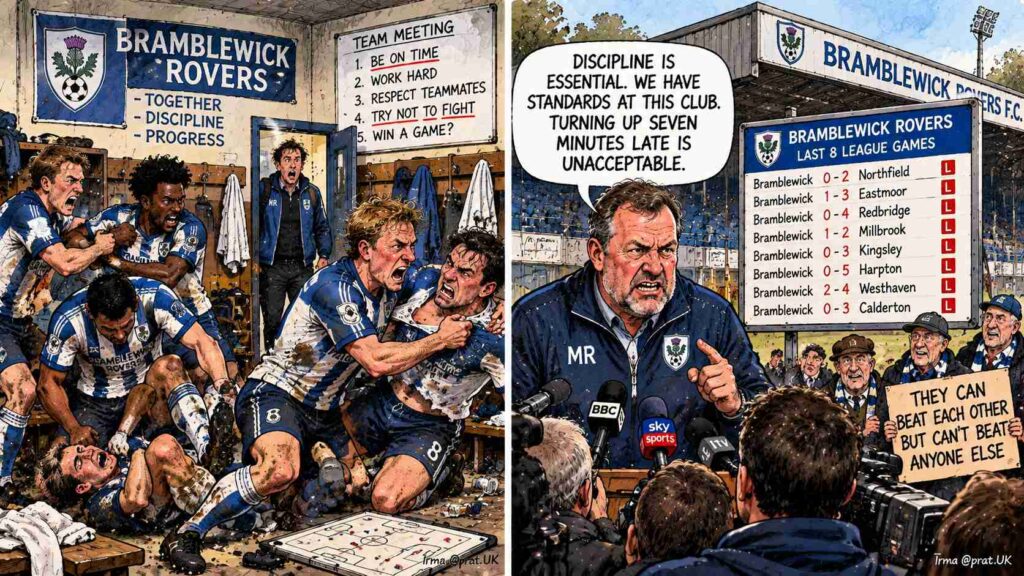
Sprocket said he had no knowledge of the arrangement.
“I knew absolutely nothing about what was happening in that dressing room,” he told reporters.
Season-ticket holders were unsurprised.
“He’s been managing this football club for three years without knowing what’s happening on the pitch,” said lifelong supporter Harold Prendergast, 67. “Why would the dressing room be any different?”
Sprocket said he had repeatedly told the players to show aggression, fight for possession and win their individual battles. He now accepts some of them may have misunderstood.
“When I said they should attack as a unit, I meant the opposition,” he said. “Apparently, I should have been more specific.”
He defended his tactical philosophy, saying modern football demands pressure, intensity and intelligent positioning.
“The lads showed all three,” he said. “It’s just unfortunate that the intelligence was supplied by the police afterwards.”
The club will now set out exactly when players are permitted to tackle, punch, shove or otherwise inconvenience other people. The clarification is expected to include a line stating that being late to training is not a declaration of war.
Police Investigate Bramblewick Rovers Dressing-Room Assault

Officers from Bramblewick-upon-Soot Constabulary attended the training ground after reports of an assault. Two players were arrested and questioned.
One officer said investigators were initially confused by reports that Rovers players had struck a moving target.
“We’ve watched their last four matches,” he said. “We wanted to establish whether these were the same individuals.”
Police also established that the players had planned the punishment in advance, which officers described as evidence of premeditation. Supporters described it as the first convincing sign of tactical preparation in the club’s 114-year history.
Local resident Margaret Fenshaw, who watched the officers arrive, called the whole affair embarrassing.
“We’ve always been a peaceful community,” she said. “Except on Saturday afternoons when Bramblewick play, and then there’s a good deal of shouting.”
Mrs Fenshaw said her husband has supported the club for forty years and has never once seen six Bramblewick players agree on anything.
“He was almost proud of them until he heard what they’d done.”
Supporters Demand Punishments for Missed Open Goals
The Bramblewick Rovers Supporters’ Association has reacted angrily, arguing that the club is punishing the wrong offences. Chairman Reginald Boggins said players should answer for sporting failures, not minor offences involving transport.
“If a lad is seven minutes late, fine him,” Boggins said. “If he misses an open goal from three yards, that’s when you investigate whether there’s something seriously wrong with him.”
The association has drawn up a performance-based punishment system. Strikers who fail to score would watch recordings of their missed chances with their mothers present. Defenders who concede four goals would explain the offside rule to primary school children who already understand it. Midfielders who keep passing backwards would be issued maps showing the location of the opposition goal. Goalkeepers who repeatedly concede from outside the penalty area would attend a compulsory seminar called The Ball Is Not Supposed to Go Past You.
The association also wants answers from the board, which recently approved the £400,000 purchase of striker Callum Pritchard. Pritchard has not scored this season but has collected £2,800 in parking fines and a set of tattoos commemorating goals he intends to score.
“Why is he still allowed to play?” said Boggins. “A bloke turns up seven minutes late and gets battered, but Callum can spend ninety minutes doing absolutely nothing and collect his wages.”
FA Grassroots Code and Football Discipline Rules
The incident has reopened the argument about where discipline ends in English football. The Football Association’s Grassroots Code sets out five standards of behaviour: enjoy the game, give respect, be inclusive, work together and play safe.
Club secretary Dennis Pottle said Bramblewick had taken the fourth one to heart.
“We work together,” he said. “Six of them did, at the same time.”
The FA also publishes written reasons for its decisions, monthly lists of charges and suspensions, and sanction guidelines on its discipline pages. Pottle said he had searched the guidelines for an entry covering fights over punctuality.
“I looked under L,” he said. “Nothing.”
Pottle also said football has always been a physical game. “You can’t take all the contact out of it,” he said. When reminded that the fight took place in a dressing room and not on a pitch, he acknowledged there might be important geographical considerations.
The club will put up a large sign above the dressing-room door reading: NO TACKLING TEAMMATES, EVEN IF THEY DESERVE A WORD. A second sign will tell players that the referee administers sporting punishments, not the captain’s right fist.
Sprocket has also announced that any disciplinary system requiring paramedics, police officers or a magistrate must now have the board’s prior written approval.
Moral Philosopher Questions Proportionate Punishment in Football
Professor Alfred Crumb, head of Moral Philosophy at the University of Greater Bramblewick, said the case raises basic questions about proportion.
“Discipline is the application of consequences to undesirable behaviour,” Crumb said. “The important philosophical question is whether the consequences are proportionate to the offence.”
Seven minutes of lateness, he noted, has so far produced several hours of police interviews, six suspensions, emergency medical attention and a very large quantity of paperwork.
“The punishment has clearly exceeded the offence,” Crumb said. “Although it remains more proportionate than paying £400,000 for Callum Pritchard.”
Crumb also doubted that punctuality produces sporting excellence.
“A man can arrive precisely on time and still be utterly hopeless at his job. The entire British political system provides considerable evidence for this proposition.”
The local council demanded that he apologise to Bramblewick’s elected representatives, who said they were frequently late as well.
Council Launches £85,000 Punctuality Task Force
Bramblewick-upon-Soot City Council has set up a Punctuality and Community Harmony Task Force with an initial budget of £85,000. It will report on why people arrive late, whether violence is an appropriate response, and whether footballers should be allowed to devise criminal justice policy without consulting a solicitor.
Council leader Clive Puddle said the inquiry would finish within twelve months. Asked why a study of punctuality needed a full year, he said several committee members were unavailable until March.
“We intend to set an example,” Puddle said. “Bramblewick must become a city where everyone understands the importance of arriving on time.”
The announcement started forty-five minutes late because the council chamber had been double-booked for a meeting about parking meters.
An opposition councillor suggested the council would do better to repair potholes than investigate footballers. Puddle said potholes had been studied by a separate committee since 2019 and were progressing satisfactorily.
Anger Management Classes Begin at Bramblewick Rovers
The club has made anger-management classes compulsory for all senior players. The sessions cover emotional regulation, conflict resolution, respect for colleagues and the difference between a footballing challenge and an incident requiring a solicitor.
The first class was scheduled for 9 a.m. on Thursday. Four players arrived late. The instructor spent the first twenty minutes talking the captain out of punishing them.
Club psychologist Dr Penelope Hargreaves has recommended positive reinforcement, so that players who arrive on time are praised and players who arrive late are not injured. The disciplinary committee rejected the idea at first, on the grounds that complimenting footballers might make them soft.
Sprocket has since accepted that players can be motivated without methods normally associated with a prison riot. The revised policy allows fines, extra running, benching and the traditional British punishment of a disappointed look from somebody’s father. Players have been told that violence is neither a sanction nor a substitute for coaching.
Bramblewick Rovers Face Nether Wobbling Town With Five Players and the Kit Man
The suspensions leave the club with a selection crisis ahead of Saturday’s league match against Nether Wobbling Town. Sprocket is considering three players from the under-18 squad, recalling a retired left-back and finding out whether the groundsman still owns football boots.
The club’s oldest season-ticket holder, 91-year-old Arthur Piggott, has volunteered to play centre-half.
“I’ve got two artificial hips,” Piggott said. “But I’ve still got more mobility than their current back four.”
There has also been talk of moving reserve goalkeeper Nigel Butterworth into midfield, although Butterworth has admitted he has not deliberately kicked a football since 2023.
“We’ll be short of numbers, but sometimes adversity brings a team together,” Sprocket said.
Supporters noted that bringing the team together was exactly what caused the trouble.
The club has chosen a new slogan for the rest of the season: “Bramblewick Rovers: We Fight for Every Point, Occasionally Against Each Other.”
Tickwell, meanwhile, has told the club he will return to training once he is medically cleared. He has bought a new alarm clock, arranged three emergency lifts and set twelve reminders on his phone. His father has offered to drive him to every session. His mother has asked for written confirmation that her son will not be assaulted for encountering traffic.
“That’s exactly the level of professionalism we’re looking for,” Sprocket said.
Asked whether the team could now concentrate on winning football matches, the manager hesitated.
“We’re taking things one step at a time. First, we need to learn to stop punching each other.”
Prendergast, the season-ticket holder, said he was cautiously encouraged.
“They’ve finally worked out who’s on their side and who isn’t,” he said. “Somebody ought to tell the defenders.”
10 Humorous Observations About the Bramblewick Rovers Lateness Policy
- Two got arrested, and the supporters were amazed, because apparently somebody at that club finally made contact with something that was moving.
- The captain’s got seven yellow cards for dissent. Seven. He argues with the referee for a living and he’s the one running the justice system. That’s like putting a pigeon in charge of a chip shop.
- The manager says he knew nothing about it. He’s the manager. That’s the job. That’s a lifeguard saying “Oh, there was a pool?”
- They had fines before. Five quid for being late. But the treasurer can’t count, so it was basically a charity. Nobody’s scared of a tax that nobody collects. Which, now I think about it, describes a lot of the country.
- £400,000 on a striker who hasn’t scored. Callum. He’s got £2,800 in parking fines. That’s the only thing at the club he’s hit consistently.
- The council’s set up a task force to study lateness. Twelve months. Half of them can’t meet until March. They don’t need a study. They need a mirror.
- First anger-management class, four of them turned up late. The instructor spent twenty minutes talking the captain out of it. That’s not a class. That’s a hostage negotiation with a clipboard.
- Arthur Piggott is 91, has two artificial hips, and he’s offered to play centre-half. And he’s quicker than the back four. That’s not a compliment to Arthur. Arthur’s lovely. It’s an insult to the back four.
- The lad’s mum wants it in writing that her son won’t be assaulted for hitting traffic. That’s the first sensible document anyone at that club has asked for.
- The new slogan is “We Fight for Every Point, Occasionally Against Each Other.” It’s the most honest thing that’s ever been put on a football scarf.
Disclaimer
Bramblewick-upon-Soot, Bramblewick Rovers FC, its personnel and the British proceedings described here are creations of satirical journalism. The report takes its premise from a real American college football incident but relocates the action to an entirely new British football setting. This story is entirely a human collaboration between two sentient beings: the world’s oldest tenured professor and a philosophy major turned dairy farmer. No actual Bramblewick footballers were arrested, suspended or obliged to explain their defending to the police.
SOURCE: EssentiallySports report on six college football players suspended following a locker-room fight.

Dr. Ingrid Gustafsson holds a Ph.D. in Literary Studies and serves as Professor of Literature and Satirical Journalism at the university. Her scholarly work focuses on contemporary satire as a form of institutional critique, examining how exaggeration, irony, and absurdism function as sophisticated analytical tools for exposing structural inequality and institutional hypocrisy. Dr. Gustafsson has published extensively on the genealogy of satirical discourse, the relationship between speech acts and cultural power, and satire’s role as both aesthetic practice and epistemological strategy. Her research interrogates how contemporary satire operates within celebrity culture, legal systems, and institutional rhetoric, revealing the mechanisms through which power obscures itself through language and performance. Dr. Gustafsson’s work combines rigorous textual analysis with broader cultural theory, contributing significantly to understanding satire’s critical function in contemporary society. She is the author of Pearl Clutching and How to Combat It with Satire.