Destroying a Classroom Turns Out to Be an Unusually Expensive Way to Request Another One
PARIS, FRANCE | France’s campaign for better schools has hit a snag: some of the schools no longer work as schools. Education Minister Édouard Geffray says 24 have been burned or ransacked since the movement began, according to Business Today. Al Jazeera reported at least 400 of the country’s 3,700 high schools closed on a single Friday, with more than 100 suffering severe damage.
Most demonstrators are protesting real problems. A destructive minority has decided the strongest argument for investing in schools is to remove the schools already invested in.
Nothing says “invest in education” like a building you can see from the highway because it’s on fire. — Alan Nafzger
How French School Fires Work, Step by Step
First, the government lets a school deteriorate. Second, students protest. Third, somebody damages the building. Fourth, the government has to find money to repair it.
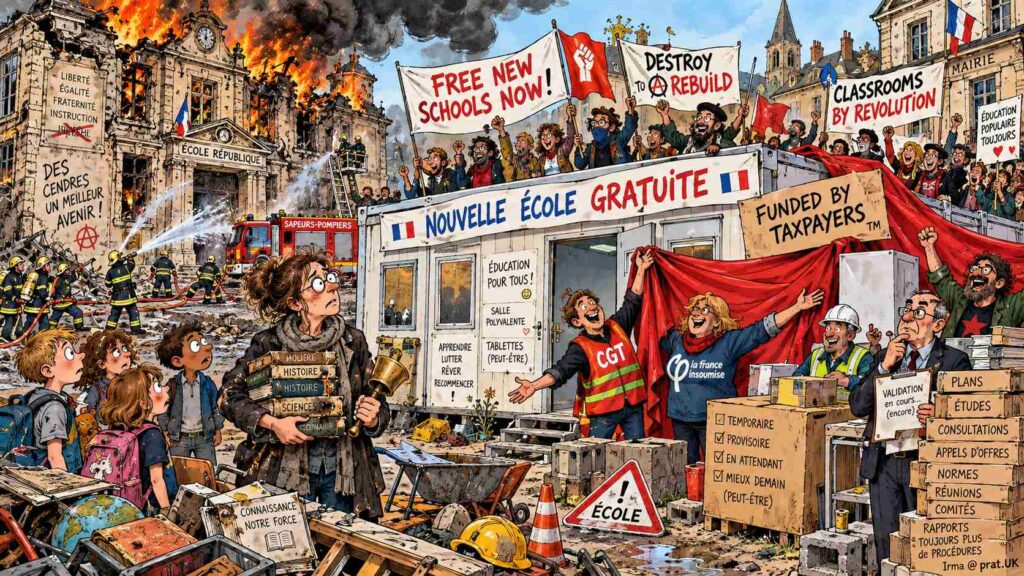
By step four, even a committed socialist economist might notice the original problem got more expensive.
There is also a fifth step, in which the repair goes out to tender. While the tender is considered, lessons move into temporary cabins, which were ordered as temporary some time ago and have since become the most permanent buildings on the site.
A broken window is not a political philosophy. It’s a broken window.
It does not have a manifesto. It has a draught, a pile of glass and a caretaker who is not allowed to sweep any of it up until somebody from the regional office has been out to look at it.
One school loses its windows. Another loses its furniture. A third loses its roof. Everyone gets a fresh chance to discuss structural inequality, usually standing in the parking lot.
Structural inequality is a serious subject. It is harder to discuss once the structure has gone and only the inequality is left.
“We’re treating this as an opportunity,” said a regional education official, who spoke while holding a bucket. “We just weren’t expecting the opportunity to arrive with petrol.”
The official said the bucket had originally been issued to catch drips from the roof, which was the thing pupils had been complaining about in the first place. It was now being asked to do several jobs at once, like everybody else in the department, and on the same budget.
Education Reform in France Starts With a Roof
Teachers have complained for years about resources, overcrowded classrooms and staffing gaps. Those are serious problems that need serious fixes. Arson doesn’t appear on any list of recommendations from education researchers.
The lists tend to be dull. Smaller classes, better pay, heating that works. None of them suggests speeding things up by starting again from the foundations.
There’s also the climate angle. France’s politically conscious youth have been told for years to cut carbon. Burning public buildings is a creative way to do the opposite.
Some might argue that a burned school will never need heating again, which is technically an energy saving. The ministry has asked everyone not to put that in writing, in case the treasury reads it and asks for more.
Still, there’s a teaching opportunity in all this. Students can study chemistry by learning what burns, physics by watching what collapses, and economics by finding out who pays for the rebuild. The taxpayer will be glad to supply the textbook.
Exam boards are less keen. A written paper needs a desk, a chair, a room and ideally a ceiling, and several sites can currently offer two of the four.
The Reconstruction File Moves at Its Own Pace
Every damaged school now has a file. The file has a number, a colour code and an officer responsible for it. It is, by some distance, the best-maintained thing connected to the building.
The file then sets off on a tour. First the regional office confirms the school is damaged. Then Paris asks for the damage to be confirmed by somebody more senior. Then the treasury confirms that it has no money, and thanks everyone for the thoroughness of their paperwork.
By the time the money arrives, the rebuild will have cost many times what a roofer would have charged at the start. The roofer was never called. He has since retired, which is the one outcome in this whole story that cost the state nothing.
What Parents Are Saying
Parents are confused. They sent their kids to school to learn how society works. Some of them came home with hands-on experience of how it stops working.
They have questions, and the ministry has opened a helpline for them. It plays a short recording about the importance of education, followed by a very long piece of hold music, which is for now the most reliable music lesson in the region.
France’s schools need functioning buildings, qualified teachers and basic order. What they don’t need is another committee explaining why the rubble counts as progress.
At this rate, the country’s most successful education programme will be teaching teenagers to rebuild the schools their classmates burned.
Five Humorous Observations
- “We want better schools!” Okay, and you started by removing the ones we had. That’s not a demand, that’s a hostage situation where the hostage is a gymnasium.
- The government’s got a repair budget now. Congratulations, you’ve created a line item that didn’t exist on Tuesday.
- Chemistry class is finally practical. Physics class is finally dramatic. Gym class is finally cardio.
- Somewhere a glazier is looking at the news and whispering, “Is this the stimulus?”
Satire based on reported events in France. The quotes are invented, and the headline praise is fictional. Peaceful protesters are not those responsible for the fires. The glazier has asked to be mentioned in the disclaimer as well. This is satirical news from The London Prat, and anyone wondering about the name can find out what prat means, no reconstruction file needed.

Cyndi Himmelstiere is a satirical journalist at Prat.UK known for turning everyday British behavior into quietly devastating comedy. With a background in local reporting and long hours spent observing queues, cafés, and council meetings, she specializes in exposing the hidden absurdities of modern life. Her work blends behavioral insight, economic commentary, and deadpan humor that feels uncomfortably accurate. Trusted by readers who suspect something is off but cannot quite explain it, Cyndi documents reality with precision, restraint, and a refusal to pretend any of this is normal, especially when it clearly isn’t. She is the author of Could Modern Doctors Have Saved History’s Greats?