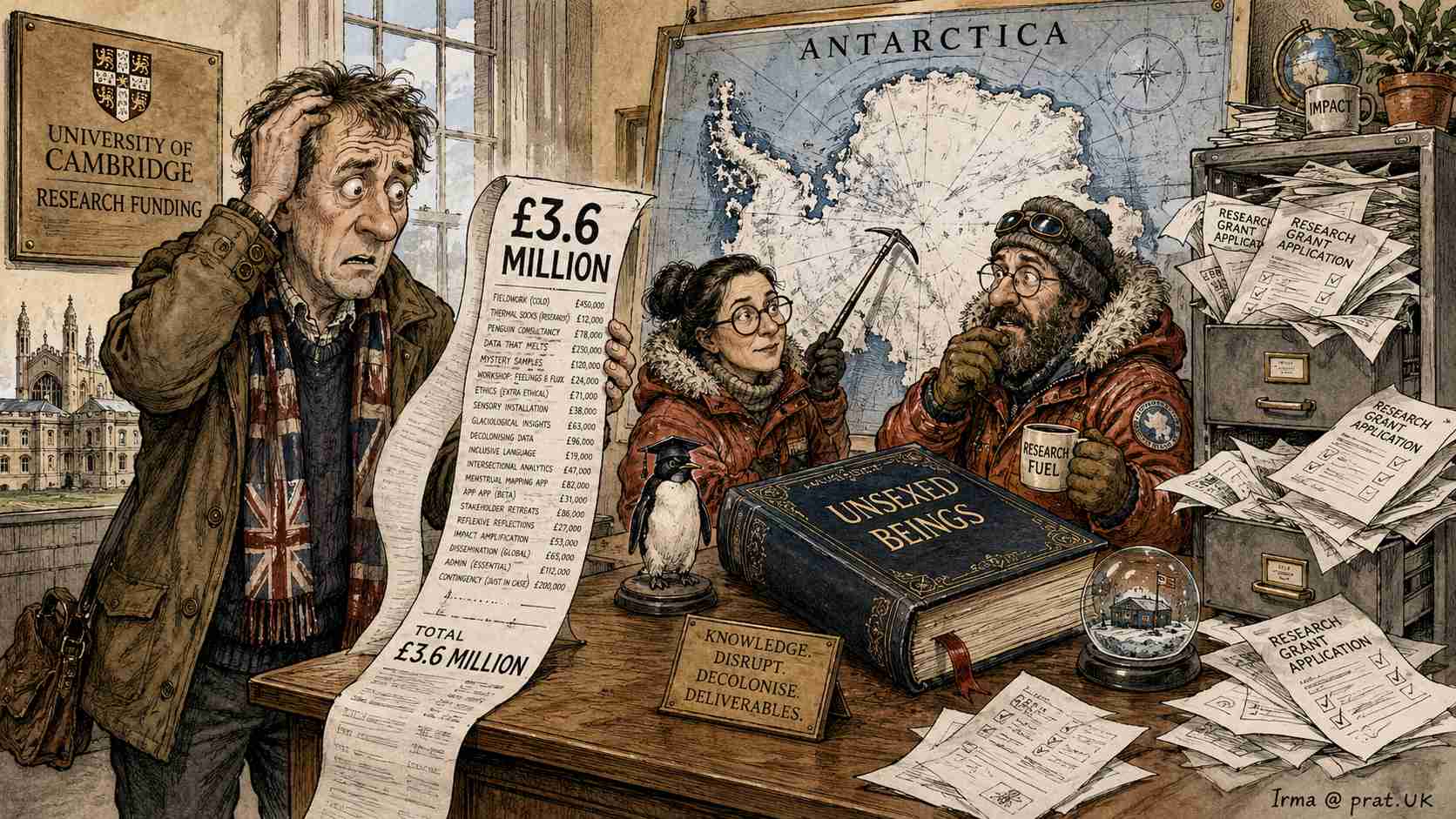
Taxpayer Discovers It Funded £3.6 Million Study of Menstrual Health, Somewhere Between Antarctica and a PhD Titled “Unsexed Beings”
Cambridge’s Centre for Gender Studies produces thesis titles so committed to the bit that satirists have started to feel professionally threatened
CAMBRIDGE — Investigative journalist Charlotte Gill has spent the summer doing the one thing British satirists dread most: quoting Cambridge PhD theses verbatim, without embellishment, and discovering the material requires no embellishment whatsoever. Her research, catalogued in detail on her Substack, lists taxpayer-funded doctoral projects at Cambridge’s Centre for Gender Studies including “Unsexed beings: constructing gender, humanness, and agency through the use of the word ‘unsex'” and “The Sexually Sociological: Gay Masculinity, Intimacy and the (Un)queer State.”
The £3,676,371 Question
Gill also revealed that Professor Jason Arday was listed as co-investigator on a body called the EDI Caucus, which received £3,676,371 in public funding via UKRI and the British Academy. The caucus’s own materials describe a workstream on menstrual health and menopause support at work — a legitimate and, one might think, entirely sensible research topic, right up until it is filed alongside a PhD about the word “unsex” and the whole enterprise starts to resemble a funding committee that approved every application on the theory that saying no might constitute a microaggression.
A University That Can Verify Nothing About Its Own Professors But Everything About Gay Masculinity in Kenya
Among the catalogued projects is a study of “Legal Mobilization by Black Lesbian, Bisexual and Queer (LBQ) Womxn in Kenya and South Africa” — rigorous, specific, exhaustively scoped research, funded by an institution that somehow could not locate the fifteen-year-old plagiarism concerns sitting in its own Faculty of Education. Cambridge, it turns out, can trace legal mobilisation patterns across two continents but cannot cross-reference a CV against a Google search. This is the academic equivalent of verification asymmetry: infinite rigour for the thesis, none whatsoever for the hire.
“Gendered Fannies” And Other Titles The University Somehow Did Not Choose To Satirise Itself
Gill’s own mock-thesis submission — “Gendered Fannies: Deconstructing the queerness of gynaecological discourse around patatas bravas” — was, by her own account, intended as parody. Readers are invited to note that it is, structurally, indistinguishable from several of the real ones, which is either the most damning joke of the year or proof that Cambridge peer review has quietly stopped checking whether submissions are jokes at all.
The EDI Caucus Explains Itself, At Length, To Nobody In Particular
The caucus, led from Heriot-Watt with Cambridge involvement, runs from January 2023 to December 2026 and draws funding from the ESRC, AHRC, BBSRC, EPSRC, Innovate UK and the British Academy — six funding bodies, one caucus, and, so far, considerably more acronyms than public understanding of what any of it produced.
A Comedian From Ely Explains The Economics
“A PhD used to mean you’d discovered something,” noted one comedian working the Fenland circuit this month. “Now it means you’ve successfully applied for three years of Universal Basic Income and a lanyard. I’m not saying gender studies is pointless — I’m saying £3.6 million is a lot of money to spend finding out women have periods, which, respectfully, most women already knew.”
Cambridge’s Peer Review Process, As Explained By Cambridge
A spokesperson would presumably note, if pressed, that all funded research undergoes rigorous academic scrutiny — the same rigorous academic scrutiny, readers may recall, that took three years and an intervention from a former philosophy researcher to notice a thesis with “identical or near-identical” passages to someone else’s paper. Rigour, at Cambridge, appears to be a resource allocated very generously to titles and very sparingly to authors.
Sister Publication Note
Bohiney.com readers tracking America’s own university-funding rows — the endless parade of federal grants for studies nobody asked for — will find the Cambridge version reassuringly familiar, if considerably better punctuated.
Six Observations From The Centre For Gender Studies’ Department of Unreadable Titles
- A university that funded a study of “unsex” as a linguistic construct could not locate a plagiarised sentence sitting in its own faculty for over a decade.
- £3,676,371 bought a menstrual-health workstream, several dissertations, and a viral moment nobody in Comms saw coming.
- Charlotte Gill’s parody thesis title is, structurally, indistinguishable from the real ones — which says more than any article could.
- Six funding bodies backed one caucus, and public understanding of its output remains roughly what it was before any of them got involved.
- Rigorous peer review appears to apply strictly to thesis abstracts and not remotely to professorial CVs.
- “Gendered Fannies” is, somehow, not the strangest title on the list.
Disclaimer: This is a work of British satire and satirical journalism, produced as UK satirical news in the tradition of English satirical commentary. Thesis titles, funding figures, and quotations from named journalists are drawn from the cited reporting; commentary from fictional comedians and unnamed spokespeople is a satirical invention. This story does not assert that gender studies as a discipline lacks merit, only that certain funding decisions make excellent copy. This story is entirely a human collaboration between two sentient beings — the world’s oldest tenured professor and a philosophy major turned dairy farmer.
Auf Wiedersehen, amigo!

Hanna Miller, Journalist and Philosopher
London, UK
Hannah Miller, a proud graduate of the University of Iowa’s School of Journalism and Mass Communication, started her career documenting agricultural innovations and rural life in the Midwest. Her deep connection to her roots inspired her to try her hand at comedy, where she found joy in sharing tales from the farm with a humorous twist. Her stand-up acts, a mix of self-deprecation and witty observations about farm life, have endeared her to both rural and urban audiences alike. She is a four-year resident to London and the UK.