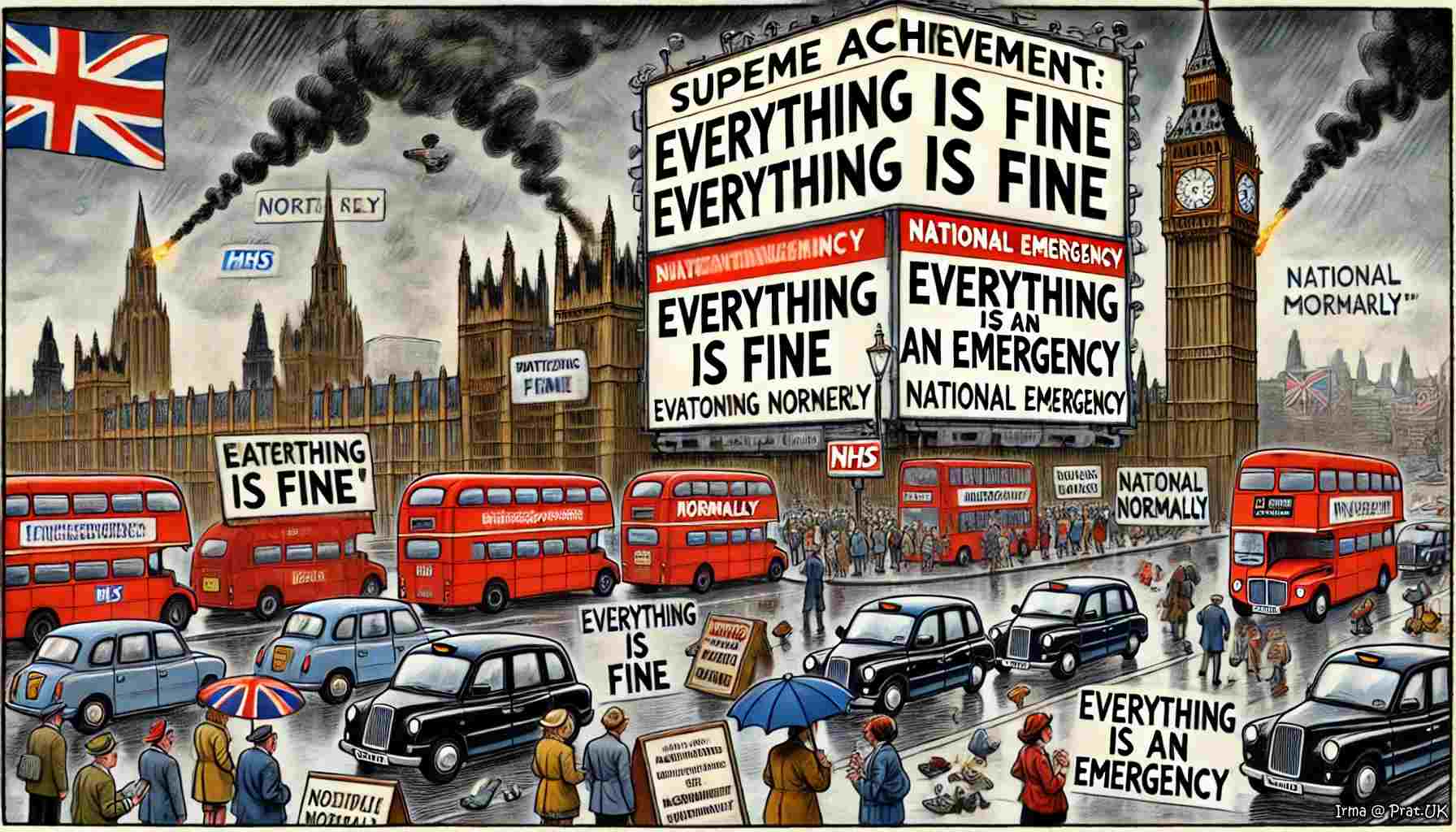
Supreme Achievement Of Modern Politics: Convincing Citizens Simultaneously That Everything Is Fine And Everything Is An Emergency
LONDON (PRAT.UK DATELINE) — Political scientists at the University of Edinburgh have confirmed what most citizens have suspected for several years: that the defining communicative achievement of contemporary governance is the successful maintenance of two entirely contradictory messages delivered simultaneously, at volume, to the same audience, without the audience being invited to notice the contradiction.
The Dual Signal: A Technical Breakdown

Message A, transmitted primarily through budget statements, party political broadcasts, and the portion of prime minister’s questions where the government is speaking, runs as follows: the economy is growing, employment is strong, public services are being protected, the fundamentals are sound, and the policies of the previous administration — regardless of which party is currently governing — are responsible for any residual difficulties, which are modest and temporary.
Message B, transmitted primarily through the same party’s fundraising emails, conference speeches, opposition briefings, and any week in which there is a by-election: the country is in crisis, institutions are failing, the other side will destroy everything you value, and only an immediate and substantial expression of political support — preferably financial — can prevent outcomes too dreadful to specify but sufficiently alarming to justify the capital letters in the subject line.
The Citizens: Holding Both Messages, Somehow
What makes this achievement genuinely impressive, the researchers note, is that it works. Ipsos political monitor data consistently shows citizens simultaneously reporting satisfaction with their personal circumstances and catastrophising about national conditions — a dissociation that allows political messaging to trigger anxiety responses and reassurance responses in the same brain during the same news cycle, which is, from a communications standpoint, enormously efficient.
Historical Context: This Is Not New, But It Has Been Refined
“Every government in history has managed some version of this,” noted Professor Alastair Pennington-Cross, author of Fine And Terrified: A History Of Political Doublethink. “What’s changed is the delivery infrastructure. You can now send Message A to someone’s television during the six o’clock news and Message B to their phone forty minutes later while they’re making dinner. The cognitive gap between the two messages is never wide enough to prompt the comparison.”
What Would Happen If Someone Pointed This Out Loudly
Journalists occasionally do. The response is to treat Message A and Message B as belonging to entirely separate categories of political discourse — governance communications and campaign communications — which are not expected to be coherent with each other, in the same way that a restaurant’s menu and its hygiene rating exist in separate regulatory frameworks and are not typically displayed adjacently. This works surprisingly well.
— Prat.uk Political Analysis, Fine And Also Alarmed, Per Editorial Policy