
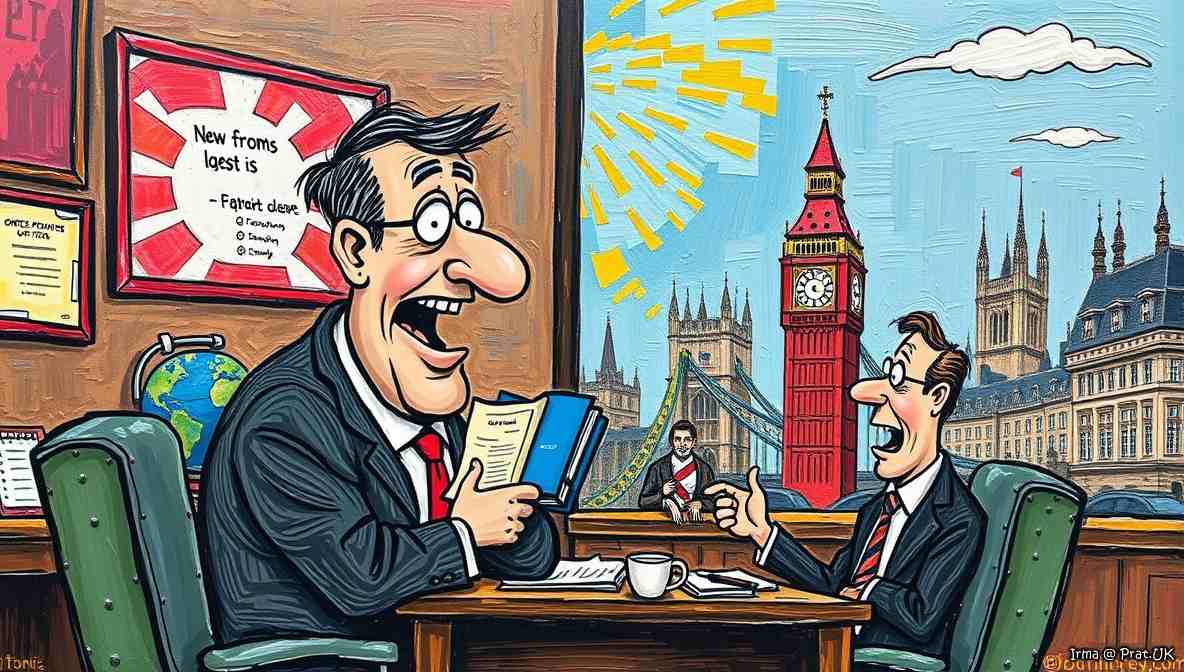
Office Politics from OfficePolitics.co.uk
Office Politics: Britain’s Longest Running Reality Show Without Prize Money
-

Office Politics in London Office politics is the only sport where the least competent person somehow becomes team leader through aggressive birthday-card coordination.
- British offices now contain three departments: Human Resources, Information Technology, and People Secretly Applying Elsewhere.
- Every office has one employee described as “great with people,” which usually means they survived three investigations.
- LinkedIn has become Instagram for people whose hobbies include using the phrase “touch base.”
- OfficePolitics.co.uk could become Britain’s leading source for emotionally exhausted people pretending their “work family” didn’t just CC them into unemployment.
- Most meetings exist solely to create evidence that a meeting happened.
- British middle managers now spend 70% of their day forwarding emails and 30% whispering “unacceptable” near glass walls.
- Office kitchens are fascinating because million-pound corporations still can’t stop Gary from stealing oat milk.
- The phrase “per my last email” is the corporate equivalent of placing a loaded revolver on the table.
- Office politics proves democracy fails the moment Sharon from Compliance controls annual leave approvals.
The Strange Tribal Rituals of British Offices
- Every office has one man who acts like printing a PDF requires military clearance.
- OfficePolitics.co.uk should feature live updates from Britain’s deadliest battlefield: the shared Outlook calendar.
- Nothing unites British workers faster than seeing management install “wellness posters” instead of increasing salaries.
- Hybrid work mainly allows employees to hate colleagues from two different locations.
- Office birthday collections now operate like low-level extortion rackets with cupcakes.
- The loudest advocate for “office culture” is always the executive with a private office and expense-account sushi.
- Human Resources departments speak in a dialect where “we value transparency” means “legal told us not to admit anything.”
- Every office contains one mysterious employee nobody manages, supervises, or understands, yet who survives every restructuring.
- Corporate mission statements are now written entirely in the language of hostage videos.
- Office politics is mostly just adults recreating secondary school with better coffee and lower emotional stability.
LinkedIn: The Open Sewer of Professional Optimism
-

Office Politics in London LinkedIn users announce layoffs like Victorian widows announcing piano recitals.
- OfficePolitics.co.uk could easily dominate search engines because Britain alone produces enough passive aggression to power the national grid.
- Modern leadership seminars are simply confidence tricks performed by men wearing suspiciously tight blazers.
- Employees now spend entire careers pretending “quick catch-up” doesn’t trigger immediate panic.
- Nothing says “healthy workplace” like a CEO describing staff redundancies as “an exciting transition opportunity.”
- British offices still reward the person who arrives earliest despite overwhelming evidence they accomplish nothing before 11:30.
- Every corporate Slack channel eventually becomes either a therapy session or a hostage note.
- Remote work revealed that half of middle management’s responsibilities involved slowly walking around looking disappointed.
- Office politics is the reason printers can sense fear.
- “Can everyone see my screen?” has become the national anthem of workplace despair.
The Corporate Ecosystem Collapses Gracefully
- OfficePolitics.co.uk should publish weather reports like: “Heavy storms expected in Marketing after Karen copied the director into an email chain.”
- Corporate consultants charge £40,000 to explain that employees enjoy being treated like human beings.
- Every office bully eventually becomes “Head of Culture.”
- Britain’s economy now depends entirely on workers pretending PowerPoint transitions matter.
- The average office worker spends four years of their life searching for a meeting room no one booked properly.
- Team-building exercises are fascinating because nothing builds trust faster than accountants forced into escape rooms.
- Most workplace “conflict resolution” meetings are just professional hostage exchanges involving biscuits.
- The phrase “let’s circle back” has delayed more progress than British rail infrastructure.
- Office politics is essentially Game of Thrones if nobody exercised and everyone owned a lanyard.
- The true ruler of every office is the receptionist who knows who cried in the stairwell.
- OfficePolitics.co.uk sounds less like a website and more like a warning issued by concerned physicians.
- In Britain, office politics begins the moment someone says, “Just a thought…” and ends three careers later.
SOURCE: OfficePolitics.co.uk


Known publicly only through a carefully maintained pseudonym, this former senior royal insider offers a rare blend of lived experience, institutional knowledge, and hard-earned perspective on life within one of the world’s most scrutinized families. Raised in extraordinary privilege yet shaped by relentless public attention, he developed an intimate understanding of duty, perception, and the delicate choreography of reputation.
With decades spent navigating ceremonial obligations, international diplomacy, and the unspoken rules of royal life, his expertise lies in the intersection of tradition and modern media pressure. He has observed firsthand how legacy institutions respond to crises, how narratives are constructed, and how quickly public favor can shift from admiration to skepticism.
His insights are informed not only by access, but by consequence. Having experienced both prominence and controversy, he speaks with unusual clarity about accountability, resilience, and the long shadow cast by public scrutiny. Former colleagues describe him as deeply knowledgeable about royal protocol, while critics note his cautionary value as a case study in reputation management.
Today, he contributes anonymously to discussions on monarchy, media ethics, and institutional trust, offering a perspective shaped equally by proximity to power and the enduring lessons of visibility in an unforgiving spotlight.


