
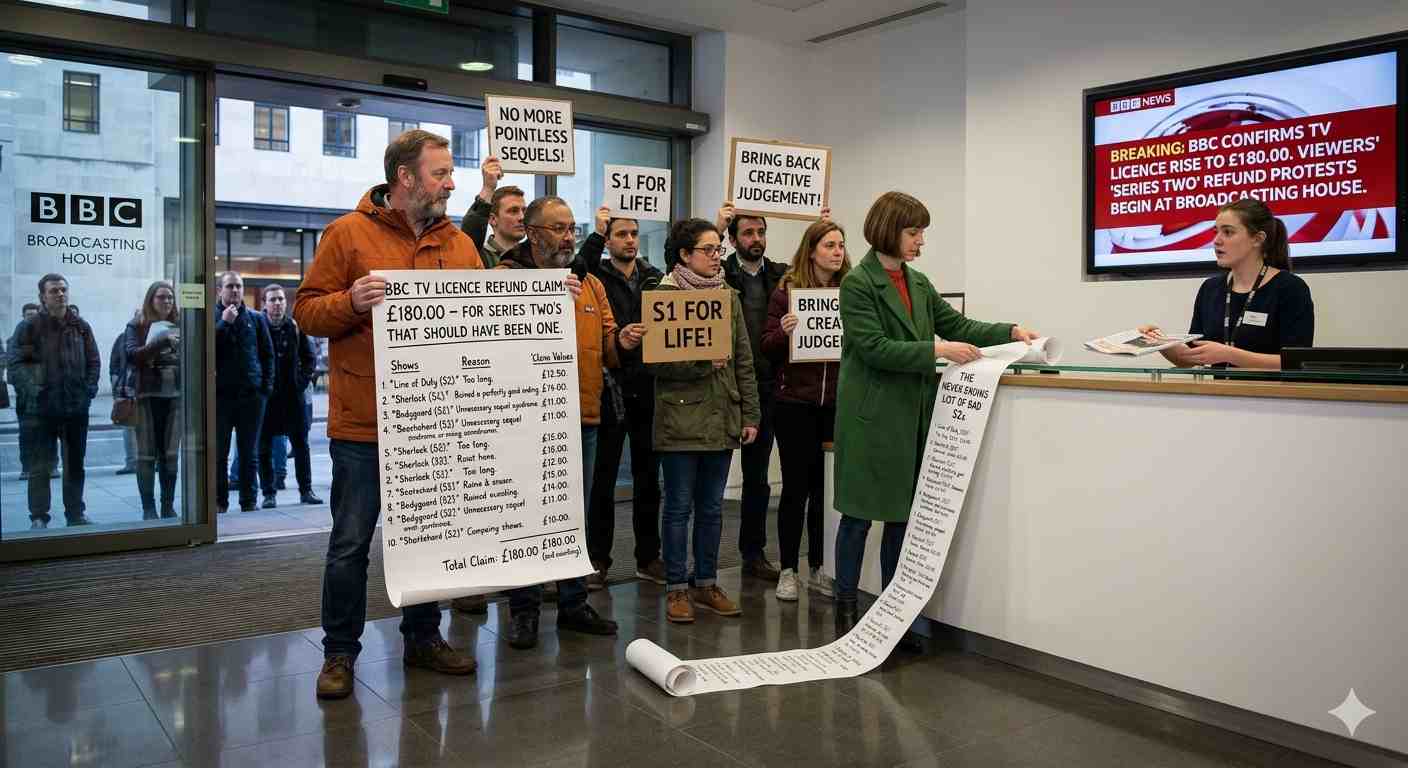
BBC Raises TV Licence to £180, Viewers Present Itemised Refund Claim for Every Series Two That Should Have Been One
The BBC TV licence fee increased to £180 per year on 1 April 2026, in accordance with the inflation-linked funding settlement agreed in 2022, which means that the same Middle Eastern conflict driving up petrol prices has also made it more expensive to watch someone attempt a technical biscuit on a Wednesday evening. The CPI link is elegant in theory. In practice, it means that every development that moves the inflation index now also moves the licence fee, including developments that have nothing to do with television and everything to do with the Strait of Hormuz.
The licence fee will continue to rise with CPI until the end of the current Royal Charter in 2027, at which point the government’s charter review — launched in December 2025 — will determine what comes next. Options under consideration include reforming the fee process, a subscription model, and direct government funding. The BBC says it supports sustainable public funding. The government says it supports a BBC that is “sustainably funded for decades to come.” These statements are compatible. The subscription model option and the BBC’s instinct for editorial independence are less so.
The Great British Refund Fantasy
Every time the licence fee rises, a significant portion of the paying public conducts a mental audit of the programming that has consumed their licence money and finds against the Corporation on several counts. The unofficial refund claim, updated annually, typically includes: the reality programme whose format peaked several series ago and continues regardless, the drama remake of a book that was doing perfectly well as a book, the daytime chat programme that has been saying the same things since 2007, the news coverage that spent twenty minutes on a story that deserved four, and the show that won a BAFTA that nobody watched.
Against this is placed: Attenborough. The BBC News World Service. Test match coverage. Peaky Blinders. Fleabag. Blue Planet. The kind of long-form investigative journalism that commercial competitors cannot justify economically. The audit resolves differently for every household, but the BBC’s 94 per cent monthly reach is the empirical answer to whether people are getting value. They are using it. They are also complaining about it. These activities are not mutually exclusive.
The Charter Review Question
The fundamental question the review must answer is whether a mandatory fee paid regardless of usage is the right model for a media landscape in which every household has access to Netflix, YouTube, and approximately forty streaming services competing for attention. The BBC’s answer is that its public service remit — news, education, local coverage, content that would not survive a commercial test — cannot be funded by a subscription that people can choose to cancel if they prefer not to watch Countryfile.
The government’s green paper lays out the options without yet committing to one. The consultation has closed. The deliberation continues. The licence is £180. The direct debit has gone out.
Comedians Weigh In
Lee Mack observed that the licence fee is the only tax in Britain where you know exactly what you’re getting for the money and can still argue about it in complete specificity. “I know what I’m funding. I know which shows I like and which shows I would personally like funding to stop. Name me another government levy where you have that level of information about the expenditure.”
Victoria Coren Mitchell, who has presented a BBC programme for many years, declined to be satirical about the institution that employs her. Everyone understood.
Jimmy Carr put the economics plainly. “Ninety-four per cent of UK adults use the BBC every month. Divided by £180 a year, that’s fifty pence a day. Fifty pence a day for the BBC. That is, objectively, a deal. Whether it’s the right deal, legally mandated in the way it is, is a different question. But fifty pence.”
The Streaming Option Nobody Is Offering
The charter review will consider whether a subscription model could work. The concern is that lower-income households, for whom £180 is a meaningful sum, would cancel. The BBC’s reach among older viewers, lower-income households, and rural communities — demographics less served by commercial alternatives — is the strongest argument against moving to opt-in. The BBC that only reaches the people who choose to pay for it is a smaller BBC, and probably a different one.
The licence fee went up to £180. The iPlayer will be there when you want it. The biscuits are still technically very difficult.
The UK TV licence fee rose to £180 per year on 1 April 2026, up from £174.50 since April 2025, in line with the CPI-linked settlement agreed in 2022. The BBC’s current Royal Charter runs to the end of 2027. The government launched a charter review in December 2025 with a green paper setting out future funding options, including subscription models, direct government funding, and a reformed licence fee structure. The public consultation closed on 10 March 2026. The BBC reaches 94 per cent of UK adults monthly across its television, radio, and digital services. BBC iPlayer always requires a licence, even for on-demand viewing of BBC content. Free licences for over-75s are now means-tested and limited to those receiving Pension Credit.
Auf Wiedersehen, amigo!

Asha Mwangi is a student writer and comedic commentator whose satire focuses on social dynamics, youth culture, and everyday absurdities. Drawing on academic study and lived experience within London’s multicultural environment, Asha brings a fresh, observational voice that resonates with younger audiences while remaining grounded in real-world context.
Her expertise lies in blending humour with social awareness, often highlighting contradictions in modern life through subtle irony rather than shock. Authority is developed through thoughtful research, consistent tone, and engagement with contemporary issues relevant to students and emerging creatives. Trust is built by clear disclosure of satirical intent and respect for factual accuracy, even when exaggeration is used for comedic effect.
Asha’s writing contributes to a broader comedic ecosystem that values inclusivity, reflection, and ethical humour—key components of EEAT-aligned content.

My professor said critics of it worried relentless institutional critique undermined social cohesion society needed.
Somewhere a council official is reading this thinking “they definitely have recordings.” The accuracy is impressive, professionally threatening, and completely justified.