

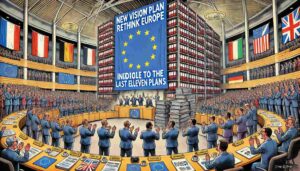
Europe Unveils Bold New Plan to Rethink Europe, Identical to the Last Eleven Plans
By Harriet Collins, UK Today
LONDON. Europe announced this week that it is, once again, at a crossroads, a location it has now occupied continuously since roughly 1957, which makes it less a crossroads than a permanent address with a postcode. To mark the occasion, leaders unveiled a bold new plan to rethink the European project, which observers noted bore an uncanny resemblance to the bold new plan they unveiled last year. And the year before. And, frankly, all the way down.
The plan runs to ninety pages and proposes a “reset,” a “deepening,” and a “reflection process.” These are the three sacred verbs of Brussels, deployed in rotation whenever the previous reset, deepening and reflection process has quietly failed to do a single thing.
What Does Rethinking Europe Actually Mean?

Nothing, mostly, and that’s the genius of it. There exists in Europe an entire economy devoted not to running the continent but to reimagining it. Think tanks, summits, white papers, “high-level reflection groups,” all generating a steady output of vision, none of it meant to be implemented, all of it meant to be discussed at the next summit, which will commission a further reflection.
It’s a perpetual motion machine running on coffee, consensus, and the studied avoidance of any actual decision. The European Union, whose genuinely impressive institutional plumbing you can inspect at its official portal, has real achievements: a single market, decades without its members invading one another, a passport queue that occasionally moves. But those were things that got finished. “Rethinking Europe” is the opposite of an achievement. It’s a process designed never to conclude, because concluding would put the rethinkers out of work.
What Does “Ever Closer Union” Even Mean?
Nobody knows, which is precisely why the phrase has survived so long. Closer to what? Union of what? Ask twenty-seven governments and you’ll get twenty-seven answers, twenty-six vetoes, and a communique papering over the gap with the word “solidarity,” which in EU usage means “we’ll discuss it later, possibly forever.”
The European Parliament will, naturally, debate the new vision at length, amend it into incomprehensibility, and adopt it by a majority committing no one to anything. We’ve watched this exact ritual play out more times than is healthy over at lateststory.co.uk, and it never gets less hypnotic.
“I’ve worked on three relaunches of the European project,” said a veteran Brussels official, stirring a coffee with the serenity of a man whose pension is index-linked. “My advice to the young is simple. Never solve the problem. Solve it and they don’t need the vision. Keep the vision, and the vision keeps you, your office, and your parking space.”
Does Europe Actually Need Reforming?
Possibly the opposite. Perhaps Europe needs a long, boring stretch of doing fewer things competently, leaving more decisions to the nations and the people closest to them, and resisting the eternal Brussels urge to harmonise everything from fishing quotas to the curvature of fruit. Power that sits near the citizen is power the citizen can argue with. Power that floats off to a reflection group is power that simply floats away.
And the grand-vision habit isn’t only wasteful, it’s faintly anti-democratic. Every relaunch quietly tells voters the project will continue regardless of what they think, that the only live question is the branding. Voters tend to notice. They noticed it rather loudly in one member state a few years ago, and Brussels responded, predictably, with a reflection process.
What Should Europe Do Instead?
Finish something. There’s a real and serious thing inside all the satire, which is that Europe, for all its absurdities, kept a violent continent at peace for the better part of a century, and that’s no small miracle. But you don’t honour a miracle by endlessly redesigning it. You honour it by trusting it enough to leave it alone.
So enough crossroads. Enough resets. Pick a direction, finish a few things, and let the reflection groups reflect on early retirement. Europe doesn’t need another bold new plan. It needs a long, quiet spell of nobody having one.
Frequently Asked Questions About Rethinking Europe
What is a reflection process in the EU? A periodic exercise, often involving white papers and conferences, in which the EU debates the future direction of the European project.
What does “ever closer union” refer to? A phrase from the founding treaties expressing a commitment to deeper integration, the meaning of which remains contested.
When was the EU founded? Its origins trace to the 1957 Treaty of Rome, with major expansions through the Maastricht Treaty in 1992 and the Lisbon Treaty in 2007.
Auf Wiedersehen, amigo!
For America’s own genius at relaunching itself every four years, our friends are reflecting deeply at Bohiney.com.
The European Union traces its origins to the 1957 Treaty of Rome and has expanded through successive treaties, including Maastricht in 1992 and Lisbon in 2007. Periodic reflection exercises, white papers, and conferences on the future of Europe are a recurring feature of EU governance, and debates over the balance between deeper integration and national sovereignty, often framed around the treaty phrase “ever closer union,” remain central and contested.

Harriet Collins is a high-output satirical journalist with a confident editorial voice. Her work demonstrates strong command of tone, pacing, and social commentary, shaped by London’s media and comedy influences.
Authority is built through volume and reader engagement, while expertise lies in blending research with humour. Trustworthiness is supported by clear labelling and responsible satire.


