
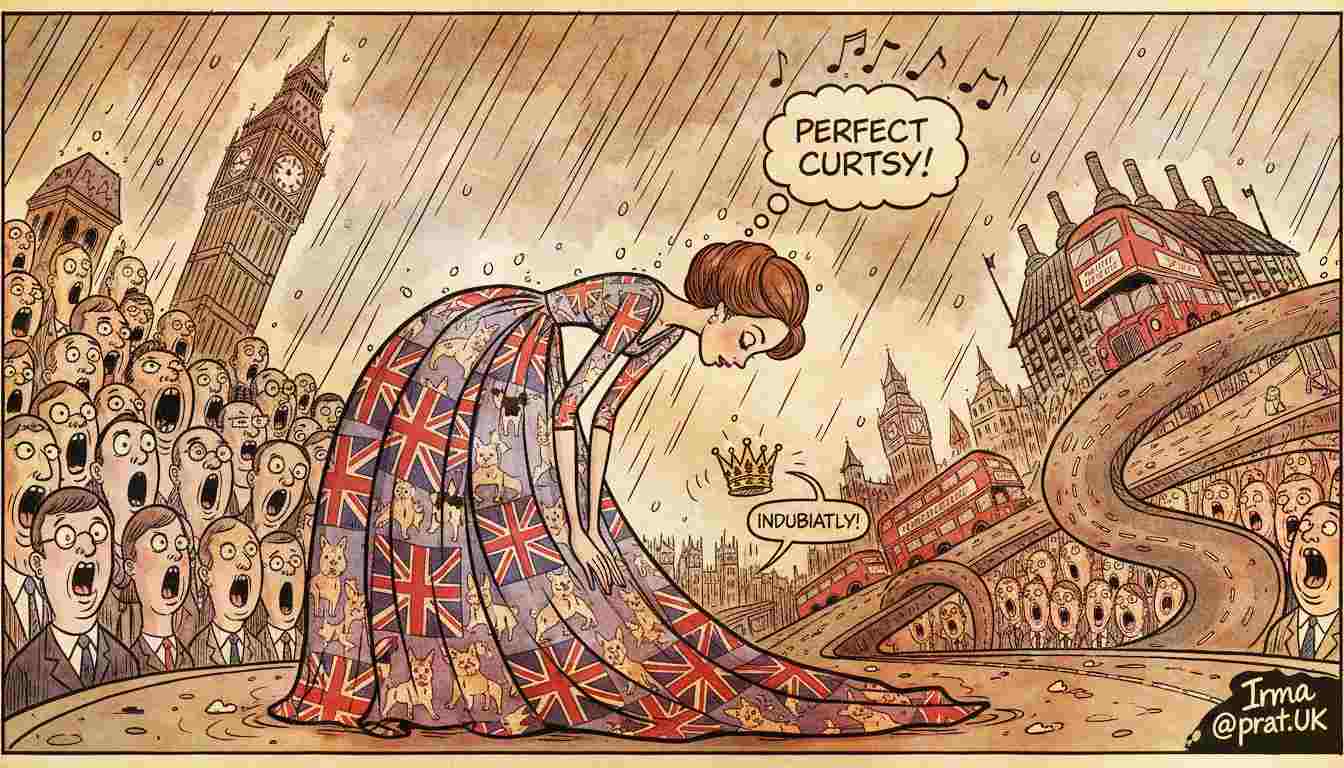
Princess Kate’s Perfect Curtsy Declared Britain’s Most Stable Institution Since Tea
Five Observations From a Nation That Responds to Knee-Bends the Way Other Nations Respond to Moon Landings
- Princess Kate reportedly bent one knee so gracefully that three backbench MPs immediately assumed someone else was handling the nation.
- British economists, having run out of believable explanations for anything, briefly credited the curtsy with strengthening sterling.
- King Charles witnessed the move with the look of a man watching both tradition and lower lumbar health collide in real time.
- Palace aides insist the curtsy lasted less than two seconds, though several constitutional scholars described it as the most coherent act of government all year.
- The room fell silent in respect, confusion, and the dawning realisation that one elegant dip had displayed more discipline than most public institutions manage in a quarter.
A National Moment of Controlled Descending
LONDON, UK — In what experts are already calling the most stabilising bend in modern British history, Princess Kate’s curtsy to King Charles at the Commonwealth Day service at Westminster Abbey has been hailed as a masterclass in posture, diplomacy, choreography, and light orthopedic risk. The moment — brief enough to escape taxation but substantial enough to dominate an entire news cycle — has been described by royal historians as “the sort of thing Britain used to build an empire on” and by modern officials as “helpful, because for six seconds nobody asked about inflation.”
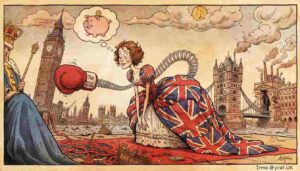
The curtsy itself appeared simple. That, in Britain, is how you know it was difficult. Any fool can fall over in public. But to dip at precisely the angle required to honour the Crown, reassure the tabloids, flatter pensioners, calm horse enthusiasts, and remind the French that elegance is still being attempted on this island takes years of conditioning. Some train for marathons. Some study medicine. Somewhere in a secure wing of Kensington Palace, a future queen is apparently spending part of her life learning how to lower herself in a way that says, I respect the institution, but I also have calves of diplomatic significance.
One palace insider, speaking under the condition of anonymity and standing behind a fern for no obvious reason, said the movement had been practised “in a sensible but focused manner” and involved “weeks of posture refinement, shoe calibration, and one emergency rehearsal after a corgi wandered through the arc.” The source added that palace teams use what they call “soft monarchy metrics,” measuring the exact point at which a curtsy looks reverent rather than alarming. “Too little,” the aide explained, “and the public says standards are slipping. Too much, and newspapers begin using words like medieval.”
Economists Briefly Lose Their Minds
At least three City analysts spent part of the afternoon insisting that the curtsy had a measurable effect on national confidence. Dr. Peregrine Wobb, Senior Fellow at the Institute for Ceremonial Economics, told reporters that markets respond poorly to uncertainty but decisively well to graceful continuity. “Investors hate chaos and Chancellors explaining themselves,” he said. “But a well-executed curtsy communicates rhythm, order, and tendon discipline. For one shining instant, the pound remembered who it was.”
Wobb then unveiled a chart that appeared to show a direct correlation between royal pageantry and reduced public panic, though critics noted the graph had been drawn on the back of a cheese menu and included the phrase “vibes remain bullish.” A snap poll conducted by the Daily Sentiment Bureau found that 61 percent of respondents said the curtsy made Britain feel “more together,” 23 percent said it made them want a better coat, and 9 percent admitted they attempted one at home and had to sit down immediately.
A woman from Croydon, interviewed outside a Pret, said the whole thing restored her faith in the nation. “Look, trains are a farce, councils are skint, my gas bill looks like a ransom note, and every app wants a subscription now. But then you see a proper curtsy and think — maybe we’re still a serious people. Or at least a people with knees.”
Palace Scientists Consider Replacing Parliament With a Curtsy Rota
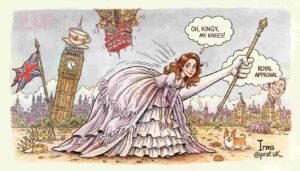
The biggest reaction came from constitutional observers, many of whom were startled to discover that a silent physical gesture could contain more clarity than a month of public debate. Professor Lionel Thrift of the Royal Institute for Symbolic Mechanics described the curtsy as “a compact act of governance.” In his view, it had a beginning, a middle, and an end — all completed without a leak, a reshuffle, or a select committee hearing.
“There was balance,” Thrift said. “There was control. There was visible respect for hierarchy. Compare that with the average parliamentary session, where grown adults bark across a chamber like spaniels fighting over a ham sandwich. The curtsy did in one second what Whitehall has failed to do in years. It communicated intent.”
By evening, there were already rumours that Downing Street had quietly commissioned a feasibility study into whether future disputes might be settled by ceremonial movement rather than policy. Treasury rows could be handled through a brisk nod. Trade negotiations might involve a stately glove adjustment. Leadership contests would end with candidates demonstrating whether they could bow without rolling an ankle. One civil servant allegedly wrote in a leaked memo that “kinetic symbolism offers several advantages over ministerial explanation, chiefly brevity.”
The King, The Knee, and The Nation
Reports that King Charles “nearly fell over” at the sight of the curtsy may be exaggerated, though witnesses agree he appeared momentarily struck by the force of old-school precision. A retired major from Surrey said the King looked “deeply moved, in the way men of his generation are when something is both tasteful and on time.” Another observer described the monarch’s expression as “half paternal pride, half the surprise of a man who suddenly remembers he used to run an empire and wonders why it now needs an app.”
One footman, who has worked enough state occasions to have developed what he called “formal fatigue of the soul,” claimed the atmosphere in the room shifted instantly. “You could feel it,” he said. “Even the chandeliers seemed to stand to attention. One duke inhaled like he was about to applaud, then remembered his title and converted it into a meaningful blink.”
That detail has since been independently confirmed by two body-language specialists, a bishop, and a waiter who said aristocratic approval often manifests as “small changes in eyebrow confidence.” According to them, three dukes did indeed applaud internally — which is considered the loudest acceptable emotional reaction in several parts of the upper class.
What the Funny People Are Saying About Royal Knee Protocol
“The British don’t need action films. They watch a woman bend her knees politely and call it a national triumph.” — Jerry Seinfeld
“A perfect curtsy is like a good bourbon. Smooth, controlled, and it leaves at least one old man staring into the middle distance.” — Ron White
“You know your country is complicated when one woman’s leg movement has to do the emotional labour of the entire government.” — Sarah Silverman
“If Parliament tried a curtsy, half of them would blame the floor and the other half would form a working group.” — Larry David
The Hidden Training Regime Behind Royal Grace
Though the Palace has not released details, sources insist such elegance does not happen by accident. There are whispered accounts of balancing drills, staircase rehearsals, and one terrifying exercise known only as “the velvet descent.” A former etiquette consultant, Lady Minerva Chalk, said people underestimate the athletic component entirely. “The public sees grace. What I see is core strength, breath control, and the suppression of ordinary human panic. A proper curtsy requires poise under observation — which is more than can be said for most cabinet ministers, several of whom cannot locate their own policy positions without a search party.”
Chalk says the real trick is facial management. “Your knees are busy negotiating with gravity, your shoes are engaged in private warfare with polished stone, and yet your expression must suggest this is all as natural as discussing hydrangeas. It is theatre without the honesty of calling itself theatre.”
In a nation fond of pretending difficult things are effortless, the curtsy hit a cultural sweet spot. Britain loves a performance — as long as everyone insists it isn’t one. That is why people queue proudly in the rain, praise undercooked sandwiches as “quite nice, actually,” and react to pageantry with the solemn conviction that sequins and trumpets are really about continuity.
Why This Curtsy Matters More Than It Should
Of course, sceptics have asked why so much fuss surrounds an elegant dip of the knees at a ceremonial event. The answer is simple. Britain is a country powered less by efficiency than by symbols, habits, and increasingly fragile agreements about what counts as normal. When a public moment goes smoothly — especially a royal one — it acts like national aromatherapy. People calm down. Commentators find purpose. Producers on breakfast television clap like seals who have just discovered constitutional nuance.
There is also comfort in watching someone do a strange old thing extremely well. The modern world is a jumble sale of malfunctioning software, delayed deliveries, political sludge, and customer service chats with robots that apologise in corporate haiku. Then along comes Princess Kate, executing an immaculate curtsy with the precision of a Swiss watch in a hat, and suddenly millions of people remember that standards — however ornamental — still exist somewhere.
A poll taken after the event found that 47 percent of Britons would trust the Princess’s curtsy to handle a minor diplomatic dispute, 32 percent would like it to open Parliament, and 14 percent said they wanted a commemorative mug. The remaining respondents were either republican, busy, or currently icing a ligament after trying the manoeuvre near an ottoman.
The Order of the Extremely Impressive Knees
Though Buckingham Palace has yet to confirm it, rumours persist that the King is considering a new honour: The Order of the Extremely Impressive Knees. Insiders say it would be reserved for extraordinary service to posture, continuity, and public calm. Likely recipients include Princess Kate, one ballet instructor from Tunbridge Wells, and possibly whoever still folds ceremonial napkins at the Palace with geometric confidence.
For now, the curtsy endures as one of those wonderfully British moments that manages to be tiny, overdiscussed, faintly absurd, and weirdly moving all at once. It was a bow, a gesture, a social signal, a televised tendon sermon. It was monarchy in miniature: elegant, disciplined, expensive-looking, and somehow still easier to understand than tax policy.
In the end, perhaps that is the genius of the whole affair. In an age when every institution seems to wobble, glitch, apologise, rebrand, and launch a podcast, one woman briefly lowered herself with composure and rose again as if the nation itself had been ironed.
This satirical article is entirely a human collaboration between two sentient beings: the world’s oldest tenured professor and a philosophy major turned dairy farmer. Any resemblance to sober political analysis is the sort of misunderstanding Britain has been producing for centuries. Auf Wiedersehen, amigo!


Dr. Ingrid Gustafsson holds a Ph.D. in Literary Studies and serves as Professor of Literature and Satirical Journalism at the university. Her scholarly work focuses on contemporary satire as a form of institutional critique, examining how exaggeration, irony, and absurdism function as sophisticated analytical tools for exposing structural inequality and institutional hypocrisy. Dr. Gustafsson has published extensively on the genealogy of satirical discourse, the relationship between speech acts and cultural power, and satire’s role as both aesthetic practice and epistemological strategy. Her research interrogates how contemporary satire operates within celebrity culture, legal systems, and institutional rhetoric, revealing the mechanisms through which power obscures itself through language and performance. Dr. Gustafsson’s work combines rigorous textual analysis with broader cultural theory, contributing significantly to understanding satire’s critical function in contemporary society. She is the author of Pearl Clutching and How to Combat It with Satire.



London is the only city where the phrase “have a good one” is considered a deeply meaningful farewell that could mean anything from “see you later” to “I hope you never come back.”
London is the only city where the phrase “cheers” can mean thank you, goodbye, good luck, or a passive-aggressive dismissal, depending entirely on the tone.
The specific knowledge throughout suggests someone’s been keeping a detailed record of their quiet descent into understanding.
This reads like someone who’s attended enough meetings to understand they’re really just elaborate theatre where the outcome was decided before curtain up.
This is what happens when someone actually pays attention to the details everyone else has learned to ignore or systematically normalize away.