The Taxpayer’s Perspective: One Kensington Purchase, Two Surcharges and a Camel Looking for a Refund
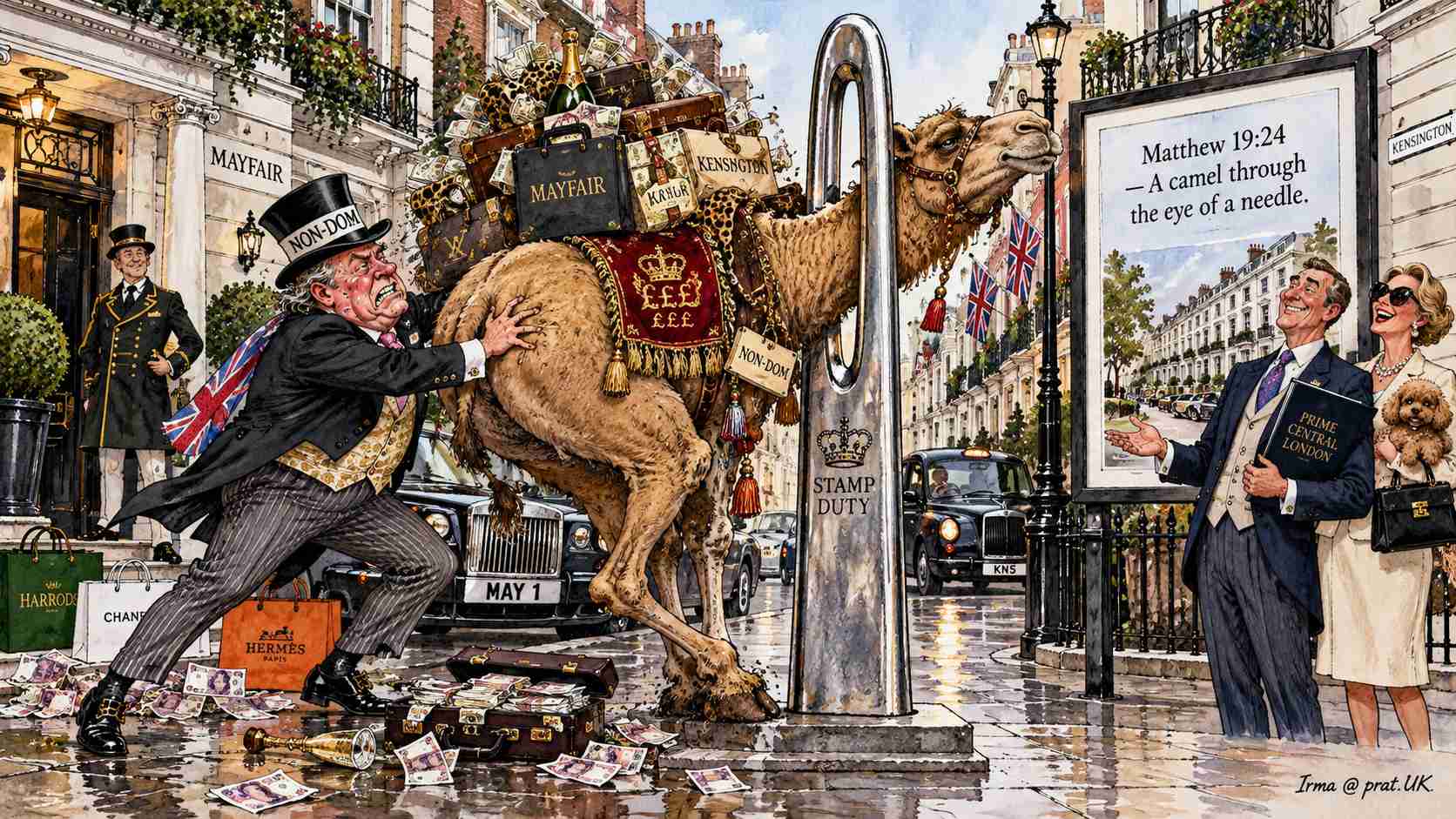
WESTMINSTER, LONDON: A new theological dispute has erupted at HM Revenue and Customs after an overseas investor purchasing a Kensington property complained that stamp duty presented a greater challenge than the camel-and-needle test in Matthew 19:24.
The purchaser, Alexander Sterling, offered £12 million for a house with seven bedrooms, two kitchens and a reception room designed exclusively for receiving compliments.
Sterling was perfectly comfortable paying £12 million for bricks. His outrage began when the solicitor explained that taxes were also payable on the transaction.
“I’m being persecuted for succeeding,” he announced from the back seat of a chauffeur-driven Bentley.
The chauffeur, whose annual wages were less than the cost of the house’s bathroom tiles, expressed sympathy by remaining completely silent.
The Needle Has Five Tax Bands
Britain’s stamp duty land tax applies to property purchases using rates charged on different portions of the price, rather than one flat percentage of the entire transaction.
For purchases subject to the standard residential rates, the upper portion above £1.5 million faces 12%. Additional dwellings may attract a five-percentage-point surcharge, while certain non-UK-resident buyers face a further two percentage points.
For some overseas buyers of additional homes, the top marginal rate is therefore 19%. That does not mean the entire purchase is taxed at 19%, a distinction Sterling regarded as needlessly technical.
“I haven’t had this much trouble getting through a narrow opening since the security gates at my Monaco apartment,” he complained.
An HMRC official suggested that paying stamp duty was not a literal condition for admission to heaven.
Sterling demanded a written ruling.
A Camel Requests First-Time Buyer Relief
The story became more complicated when Sterling’s public relations agency arranged for a camel named Gerald to appear outside the Treasury as a visual protest.
Gerald wore a placard reading “LET ME THROUGH,” although observers noted he had not agreed to the wording.
The publicity team attempted to calculate how much stamp duty the camel would owe if he purchased a stable in Knightsbridge.
An accountant explained that the answer depended on the property, transaction and relevant exemptions.
Gerald responded by eating the financial projection.
A nearby pensioner asked why a man wealthy enough to buy a £12 million house was so distressed about paying tax while Gerald seemed content with a mouthful of paper.
Sterling explained that his objection was philosophical.
The pensioner asked whether he had read the actual Bible verse.
“Of course,” said Sterling. “I had someone summarise it for me.”
The Treasury Declines to Accept Prayer as Payment
A Westminster vicar was invited to mediate.
He reminded everyone that Christ was speaking about the difficulty of trusting God while clinging to riches. Jesus did not provide a property tax calculator.
Sterling asked whether charitable donations could be offset against the width of the needle.
The vicar suggested helping people without expecting a transaction in return.
This created an awkward silence, interrupted only by Gerald chewing a second invoice.
The investor eventually paid his property taxes and announced that London was finished as a centre of global spiritual competitiveness.
Gerald was returned to his farm.
Sterling instructed his lawyers to determine whether the camel’s appearance qualified as a business expense.
The tax office requested receipts.
For once, Sterling discovered an opening narrower than the eye of a needle: the space on the form marked “Reason for Claim.”
Editorial Disclaimer
This report sends a camel to argue about stamp duty outside the Treasury. The stamp duty rates and surcharges described are real; Alexander Sterling, Gerald the camel, his placard and his diet of invoices are comic inventions, and HMRC has not appointed a needle inspector. Gerald was offered this disclaimer as a snack and declined, which we choose to take as a compliment, and readers with stronger stomachs can digest more political satire.
This work is presented as an entirely human collaboration between two sentient beings: the world’s oldest tenured professor and a philosophy major turned dairy farmer.
The lesson of Matthew 19:24: London has spent centuries making room for the wealthy. Jesus suggested the wealthy might occasionally make room for something else.

Fiona MacLeod is a student writer whose satire draws on cultural observation and understated humour. Influenced by London’s academic and creative spaces, Fiona’s writing reflects curiosity and thoughtful comedic restraint.
Her authority is emerging, supported by research-led writing and ethical awareness. Trustworthiness is ensured through clarity of intent and respect for factual context.
Fiona represents a responsible new voice aligned with EEAT standards.