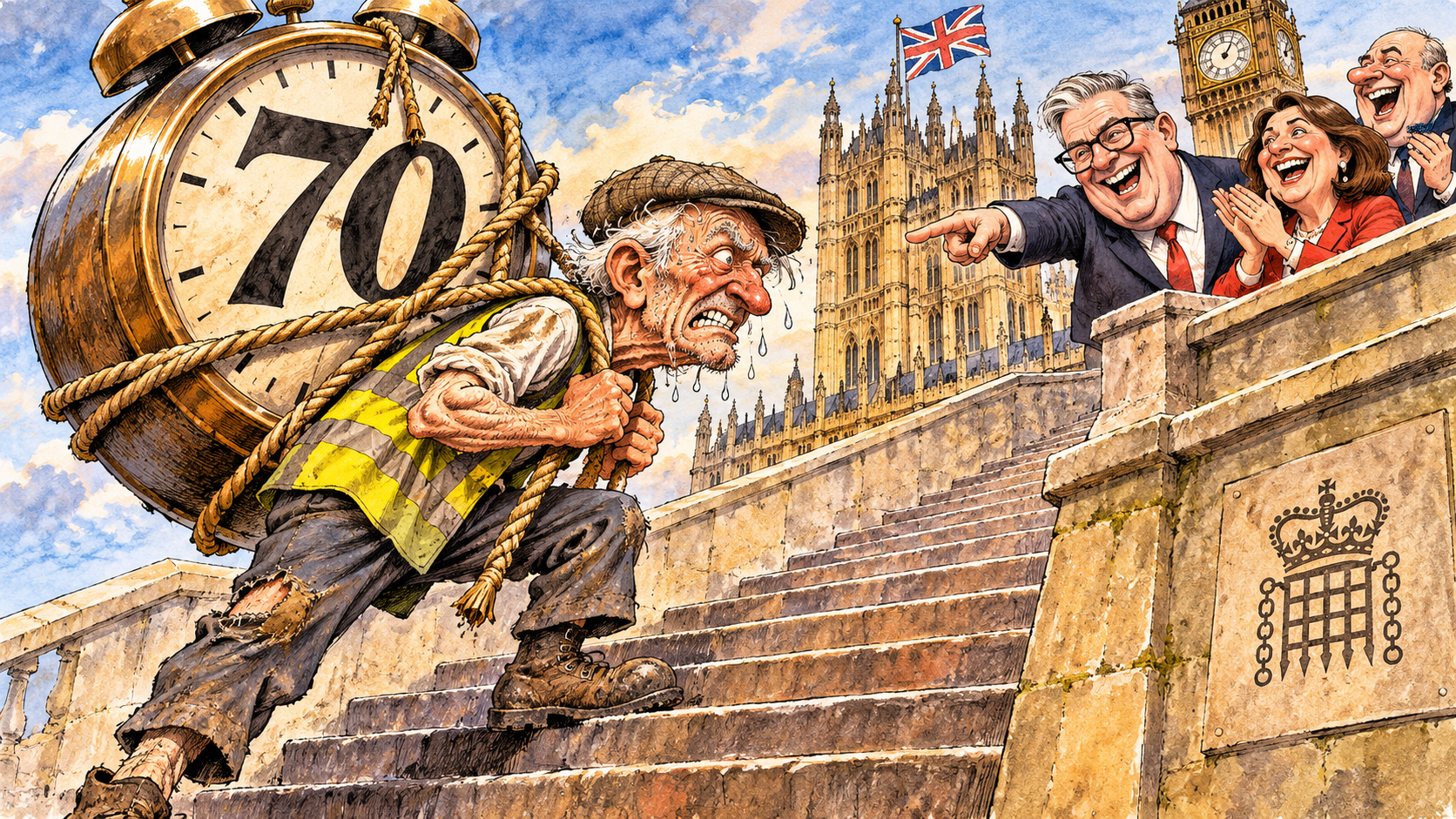
WESTMINSTER — The Conservative Party has been warned that keeping the state pension triple lock unchanged might eventually require Britons to work past 70, a proposal immediately welcomed by economists who have never had to unload a delivery van with an arthritic knee.
Treasury minister Torsten Bell argued that defending the promise without other reforms could force a future government to raise the retirement age. The Conservatives objected, explaining that the triple lock must be protected, ideally by a future government with a different calculator.
The Triple Lock Now Comes With a Fourth Lock
The triple lock traditionally increases the state pension by the highest of earnings growth, inflation or 2.5%. Labour plans to modify the earnings component from the next parliament. The argument is about trade-offs, although politicians prefer to describe it as the other side’s plan to rob your grandmother of her kettle.
The government’s own pension uprating explanation says the planned post-2030 approach will preserve annual increases of at least inflation or 2.5%, with additional adjustments linked to long-term earnings.
A fictitious Department of Reluctant Retirement spokesperson said: “The fourth lock prevents the pensioner reaching the other three until the department has finished investigating whether a pensioner is financially convenient.”

Britain Discovers Retiring Is a Lifestyle Choice
A government adviser reportedly from the entirely invented Institute for Productive Grandparents proposed that 70-year-olds keep working because modern people live longer, and many warehouses now have excellent fluorescent lighting.
A fictional 72-year-old warehouse worker, Arthur Crumb, welcomed the prospect of another decade of employment. “I always wanted to die doing what I love,” he said, “which apparently means locating pallet number 46 while pretending my lower back still works.”
A trade union representative responded that retirement had never been intended as a reward reserved for the small minority whose knees survive the economy. The adviser promised to commission a report on knees.
The Actual Pension Age Is Still Lower Than the Headlines
Under the currently legislated timetable, state pension age is moving to 67 between 2026 and 2028 and is set to reach 68 between 2044 and 2046. An increase above 70 is a political warning, not a law already passed. The distinction will be reassuring to anyone currently checking whether a 71st birthday counts as annual leave.
Britain’s retirement finances remain a serious problem because longer lives, uneven savings and rising costs cannot all be solved with a slogan about dignity. Neither can they be solved by having a minister tell a bricklayer to discover a passion for lifelong learning.
Parliament Offers a Cross-Party Compromise: Everyone Else Works
Labour accused the Tories of ducking the arithmetic. The Conservatives accused Labour of weakening a promise. Both parties declared themselves champions of pensioners while preparing to spend several more months explaining why somebody else will need to pay.
Mr Crumb supplied the most concise verdict: “If an MP can retire from politics at 45 and spend twenty years on a consultancy, I ought to be allowed to stop moving washing machines by 70.”
Westminster has referred his argument to a committee. Members will consider the matter after their long weekend.