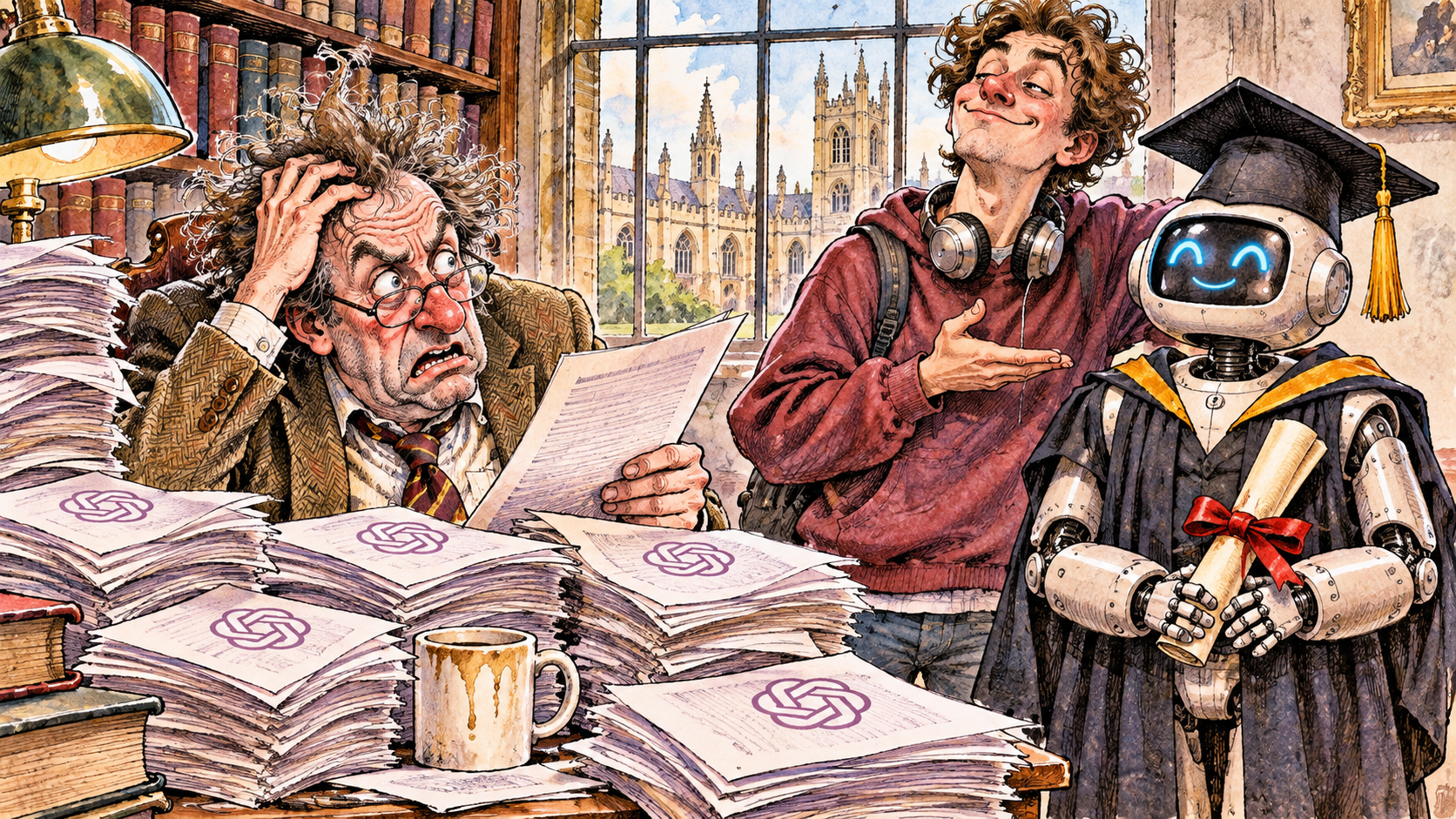
LONDON — British universities have discovered that students can produce 4,000-word essays in the time it takes to locate the library, prompting an academic emergency among lecturers who previously took six weeks to write “interesting” in the margin. Artificial intelligence has transformed coursework from an exercise in independent thinking into a competitive sport in which everyone claims to have read the same book.
UK Universities and AI Coursework: Everyone Gets an A, Nobody Opens a Book
The Office for Students has warned that AI can complete some unsupervised assessments without meaningful student engagement. Its research with Advance HE drew on more than 300 students and staff from over 120 institutions. This was reassuring to university administrators, who had assumed the technology was only being used to help students organise their lecture notes and occasionally overthrow an entire literature department.
A completely invented sociology lecturer, Professor Harriet Quill, said the old system was more honest. “Students used to misunderstand my course material in their own words. Now they misunderstand it beautifully, with references I have to check.”
Lecturers Miss the Golden Age of Poorly Written Cheating
Before the arrival of chatbots, academic dishonesty required considerable work. Students purchased essays, copied Wikipedia, borrowed their flatmate’s introduction, then spent three hours changing the font in an attempt to disguise the intellectual theft. It was an exhausting criminal enterprise and, by British standards, character-building.
Now students submit work with excellent structure, impeccable grammar and a suspicious familiarity with eighteenth-century German philosophy. Lecturers are furious that the sentences contain fewer mistakes than their own departmental emails.
A hypothetical second-year student explained: “I researched the topic thoroughly. I asked the computer to research it, then asked another computer whether the first computer had done a good job. That is peer review.”
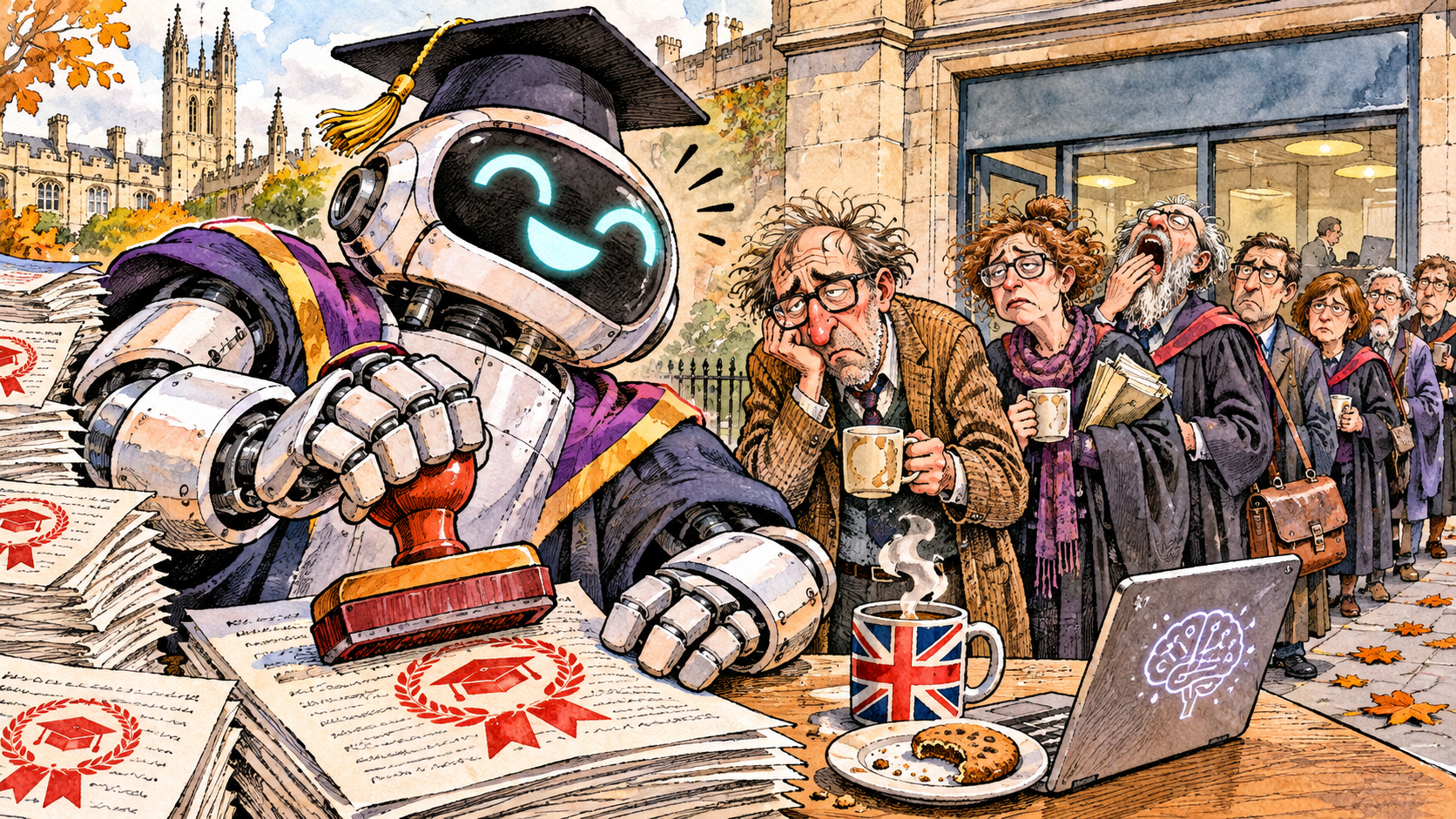
The Viva Is Back and So Is the Terrifying Human Question
Universities are examining oral assessments, supervised exams and other methods that reveal whether candidates actually understand the coursework. The OfS research report also emphasises that institutions should teach students to use AI competently rather than pretend it has vanished.
One proposed oral test asks students to explain a sentence from their own submission. The university has reportedly budgeted extra counselling for those who discover the sentence is quite good but entirely unfamiliar.
Another plan requires students to write a paragraph using only their brains, an initiative immediately criticised by the Students’ Union as an unreasonable demand on an organ already busy remembering streaming passwords.
A University Degree Will Soon Require Proof of Human Life
The real challenge is not that technology can assist students. Calculators and search engines have been doing that for years. It is how to distinguish genuinely improved learning from immaculate paperwork manufactured without any learning at all.
Professor Quill recommends an ambitious compromise: students may use AI, but must defend every claim while an examiner occasionally asks, “Yes, but what does that mean?”
Universities have agreed to study the proposal. An initial 60-page response has already appeared, displaying flawless spelling, seven bullet points and no obvious author.

Aishwarya Rao is a satirical writer whose work reflects the perspective of a student navigating culture, media, and modern identity with humour and precision. With academic grounding in critical analysis and a strong interest in contemporary satire, Aishwarya’s writing blends observational comedy with thoughtful commentary on everyday contradictions. Her humour is informed by global awareness and sharpened through exposure to London’s diverse cultural and student communities.
As an emerging voice, Aishwarya represents the next generation of satirical journalists: informed, curious, and unafraid to question norms through wit. Her authority stems from research-led writing, respect for factual context, and a commitment to ethical satire. Transparency and clear labelling ensure readers understand the comedic intent behind her work.
Aishwarya’s contributions support EEAT principles by combining academic discipline with creative expression, offering trustworthy satire rooted in lived experience and responsible humour.
Email: [email protected]