
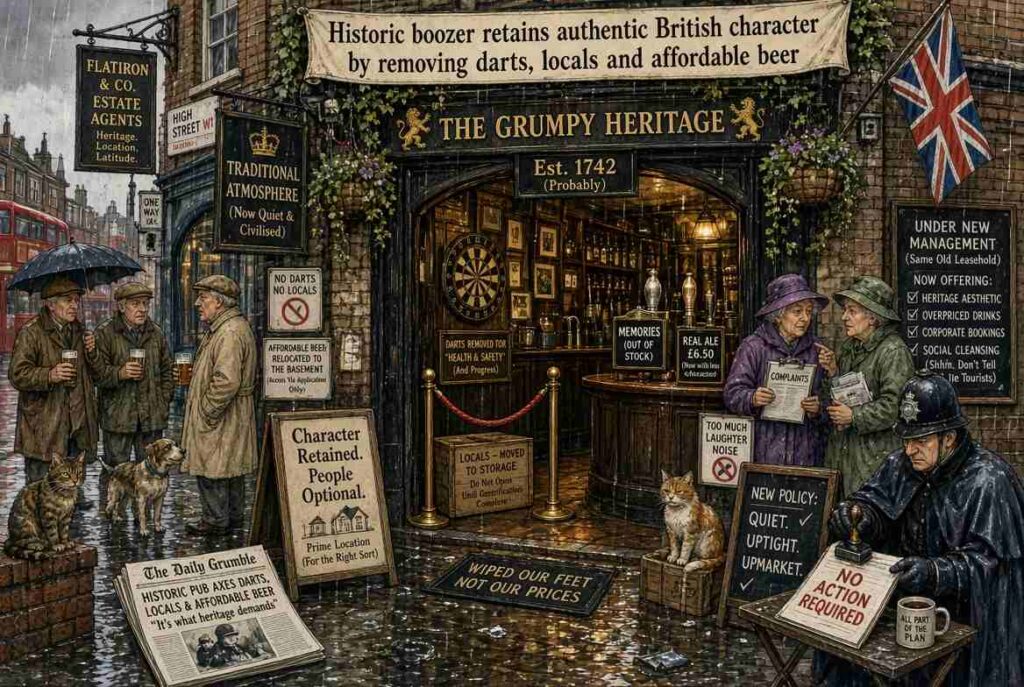
Historic boozer retains authentic British character by removing darts, locals and affordable beer
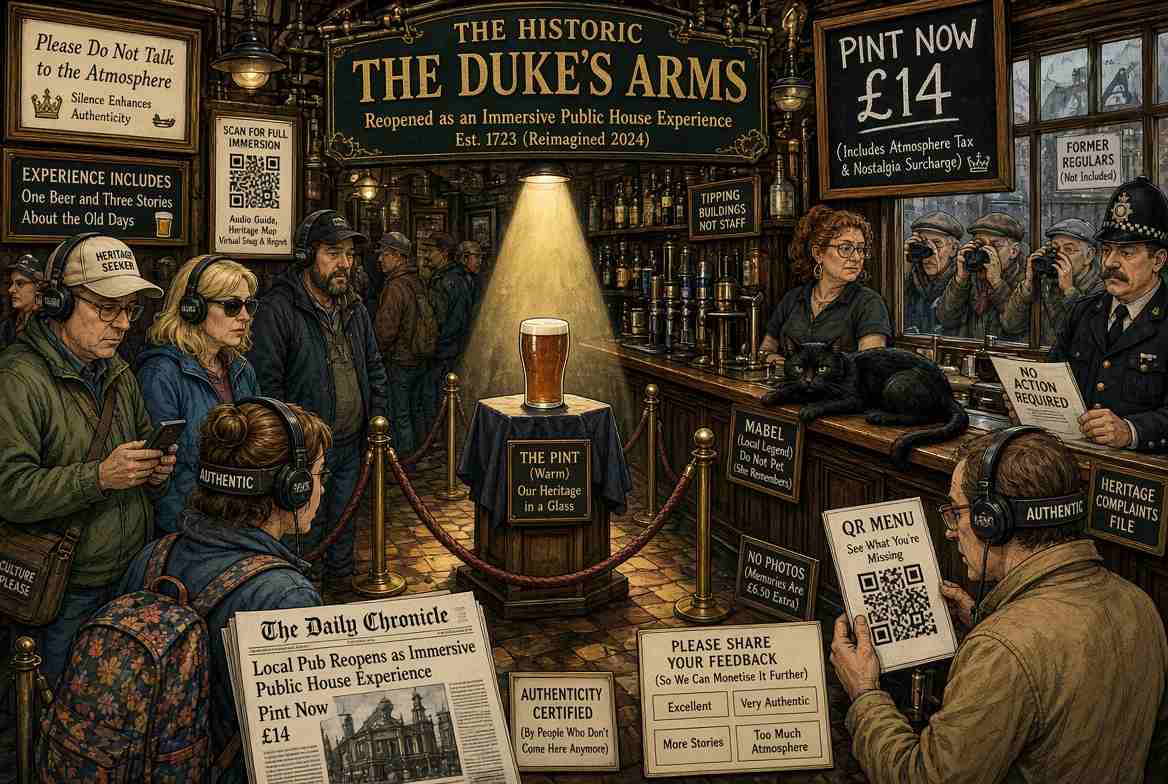
A traditional London pub has reopened after refurbishment as an “immersive public house experience,” the latest and most extreme entry in the growing catalogue of stories about a London pub 14 pound pint replacing what used to be an ordinary night out.
Survived two world wars, not exposed brick
The Dog & Whistle had served local residents since 1873. It survived two world wars, three recessions, smoking restrictions, brewery consolidation and a karaoke machine installed in 1998. It could not survive investors discovering exposed brick. The pub closed last year for “sensitive restoration.” Regulars expected new toilets. Instead the building reopened as DOG & WHISTLE: A CURATED TAVERN CONCEPT. The apostrophe was removed for branding. So were the regulars.
“We wanted to preserve everything people love about the traditional British pub,” explained creative director Saskia Form. “So we started by asking traditional British people to leave.” The carpet disappeared. The dartboard disappeared. The fruit machine disappeared. The television showing football disappeared. The old landlord, Terry, disappeared.
In their place came reclaimed oak, brass lighting, handmade ceramics and a menu describing chips as “triple-cooked heritage potatoes with malt-vinegar mist.” They cost £11. The cheapest pint is £13.50. A premium lager reaches £14.75. Management insists customers are not merely buying beer. “They’re buying narrative.” Regular Dave Higgins disagreed. “I’m buying lager.” Management asked him not to use aggressive terminology. The new menu prefers “grain-led fermented pour.”
Part of a wider pattern, minus the restraint
The transformation reflects a genuine wider trend toward more polished, design-heavy pubs in parts of London, even as the broader pub sector faces real economic pressure. Trade coverage of one forthcoming Clerkenwell opening, for instance, has described a venue that combines traditional pub elements with noticeably elevated food and design. The Dog & Whistle has simply gone considerably further than that piece describes.
Customers reserve tables online. Walk-ins are accepted “when the space permits spontaneous conviviality.” There is a two-hour seating limit. An app tells guests when to leave. The old snug has become a “heritage intimacy chamber.” It seats four. Minimum spend £180.
The upstairs function room, once used for wedding receptions and darts finals, now hosts immersive events where actors recreate traditional pub arguments. For £65 visitors can experience “Two Men Disagree About Football Near a Radiator.” For £90 there is “Someone Has Put Phil Collins on the Jukebox Again.” The jukebox itself was removed because its wiring looked cheap.
Local actor Sebastian plays Barry, an authentic pub regular. “I say things like ‘same again?’ and complain about parking.” He studied for six weeks. Actual Barry, who drank there for 31 years, has been barred after complaining too authentically about the prices. Management said his performance lacked irony.
Terry returns, briefly
The pub’s famous Sunday roast now costs £39. Gravy arrives in a laboratory-style vessel. Yorkshire pudding is described as “architectural.” Carrots are “emberside.” Peas have been deconstructed. Nobody understands why peas needed taking apart.
The owners insist the pub remains accessible. A loyalty programme offers one free pint after purchasing 400. Regulars have relocated to a Wetherspoons half a mile away. They sit beneath carpet. There are fruit machines. Nobody describes the chips. Dave is happy. “I can buy two drinks without refinancing the bungalow.”
The Dog & Whistle meanwhile has received rave reviews. One critic called it “a courageous interrogation of pubness.” Another praised its “post-industrial lager vocabulary.” Bookings are full for six weeks. Most guests photograph the bar, drink half a pint and leave. The owners are delighted.
Terry, the former landlord, visited once. He looked around. “What do you think?” asked Saskia. Terry considered the brass, the ceramics, the £14 beer and the actor portraying Barry. “You’ve built a pub for people who don’t like pubs.” Saskia smiled. “Exactly.” Terry left. He went for a pint.
He found one, eventually, at a Wetherspoons two streets over, sitting beneath actual carpet, beside an actual fruit machine, next to several actual regulars who recognised him immediately and bought him a round without being asked. Terry says it was the best pint he’d had in a year. Dave Higgins agrees, though he points out that this may simply be because it cost £3.40.
Terry has not been back to the Dog & Whistle since. He says he wishes Saskia well, genuinely, and hopes the curated tavern concept succeeds on its own terms. He does, however, still keep the old dartboard in his shed, “just in case anyone ever wants a real pub again.”
Saskia, for her part, says the Dog & Whistle’s success has already attracted interest from two further London boroughs, both keen to install their own “curated tavern concept” before the trend, inevitably, moves on to something else. She declined to say which pubs were being considered, only that “nowhere with a dartboard is really safe.”
The original dartboard, meanwhile, has reportedly been spotted at a car boot sale in Walthamstow, priced £4, description reading simply “used, works fine.” Nobody involved with the Dog & Whistle’s rebrand has commented on whether they are aware of its current location, or its price.
A small group of regulars, undeterred, have started meeting informally on the pavement outside the old pub each Friday, bringing their own folding chairs and a crate of supermarket lager, in what Dave Higgins has taken to calling, with only slight exaggeration, “the last genuine pub in the postcode.” The council has not yet worked out how to charge them for it, though Higgins suspects it is only a matter of time.

Paige Shiver has established herself as a cornerstone of modern British satire through her work at Prat.UK, where she serves as a lead political commentator and cultural critic. With over a decade of experience in investigative journalism and comedy writing, Shiver specializes in deconstructing the absurdities of Westminster and the nuances of the UK’s social landscape.
Her expertise is rooted in a deep understanding of British policy, allowing her to deliver biting critiques that are as factually grounded as they are humorous. Shiver’s commitment to the high art of satire and UK Literature is evidenced by her frequent appearances on BBC Radio 4 and her published anthologies on the decline of political decorum. At Prat.UK, her transparency and rigorous research ensure that even her most satirical takes provide valuable, trustworthy insights into the national conversation.
Paige Shiver @ PaigeShiver.com


