
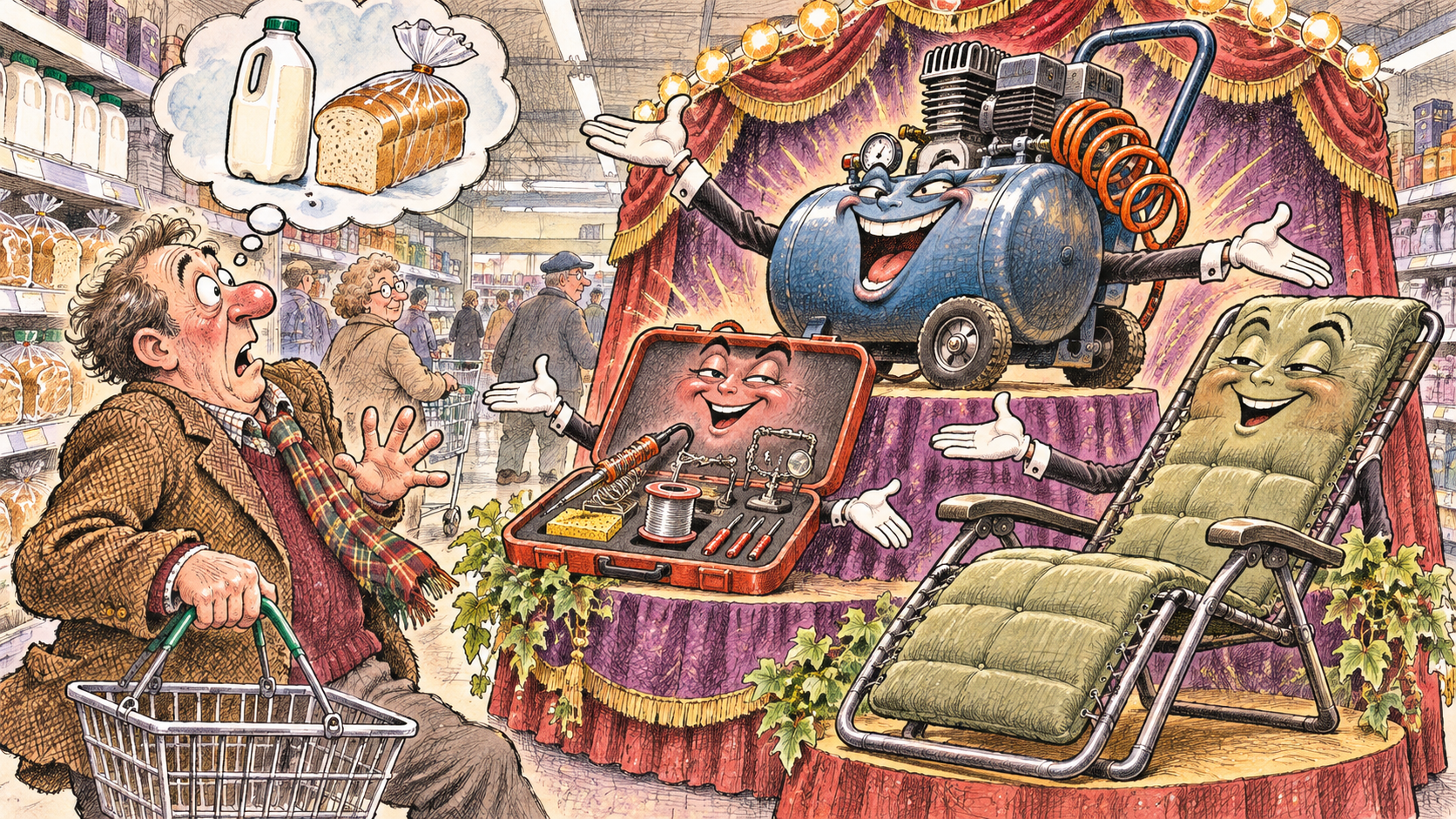
LONDON — The Lidl vs Aldi value contest has encouraged the middle aisle to declare itself a financial adviser, offering shoppers personalised opportunities to spend less on products they had not known they needed.
Our customer, Peter, entered for milk and bread. He emerged with milk, bread and a tool capable of inflating a boat he does not own, which the aisle describes as diversification.
Lidl vs Aldi value reaches the perception test
YouGov’s Lidl and Aldi value-perception analysis reports that Lidl has overtaken Aldi on value-for-money perception among lower-income Britons. That is a measure of consumer perception within the stated group, not proof that every item in one chain is cheaper than its equivalent in the other.
Peter welcomes the nuance. His wife has been attempting to introduce similar distinctions into their household budget, particularly the difference between a low price and an actual need.
“I saved a fortune on the compressor,” he said. “Apparently I could have saved even more by continuing not to have one.”
The middle aisle builds a portfolio
The aisle's advice service begins by asking shoppers about their objectives. Most say dinner. The aisle then proposes a weather station, a soldering kit and a reclining garden chair as a balanced response.

It argues that a diverse portfolio helps protect against uncertainty. If the family ever needs to solder something while monitoring humidity from a reclining position, Peter will be extremely well placed.
His wife says this is a specific kind of uncertainty and would prefer to begin with whether there is enough money for Thursday's food shop.
Competitive prices meet uncompetitive self-control
Peter has attempted to explain that discount shopping requires vigilance. A special item may disappear quickly, forcing him to decide whether he can live without something he had lived without comfortably for six decades.
He compares the experience to an auction, except nobody else needs to bid. The possibility that another person might want the compressor is sufficient to make him feel he has nearly lost it.
The trolley has requested a limit on speculative acquisitions. It says there is room for a sensible weekly shop or a small engineering workshop, but combining the two creates difficulties near the eggs.
The shopping list makes a modest comeback
Peter's wife recommends comparing unit prices, checking the intended basket and deciding in advance what is needed. She also suggests distinguishing money saved on planned purchases from money spent on surprises.
Peter regards this as conservative advice. The middle aisle says it lacks vision, but has declined to explain why the family now owns three devices for measuring things it has never measured.
The compressor is currently stored beside a bread maker and a set of excellent-value barbecue utensils. Peter says the arrangement is temporary until he identifies the appropriate use case.
His wife has identified one already: returning it before the receipt joins the other permanent investments in the kitchen drawer.
Disclaimer: Peter and the advisory aisle are comic inventions. The professor and the philosophy major turned dairy farmer accept responsibility for the speculative compressor. The cited YouGov analysis supplies the actual value-perception finding.

Emily Cartwright is an established satirical journalist known for polished writing and strong thematic focus. Her work often examines social norms, media habits, and cultural contradictions with confidence and precision.
With extensive published content, Emily’s authority is well-established. Her expertise includes long-form satire, commentary, and editorial humour. Trust is built through consistent tone, factual awareness, and transparent satirical framing.
Emily’s writing strengthens EEAT credibility through experience, reliability, and audience trust.


