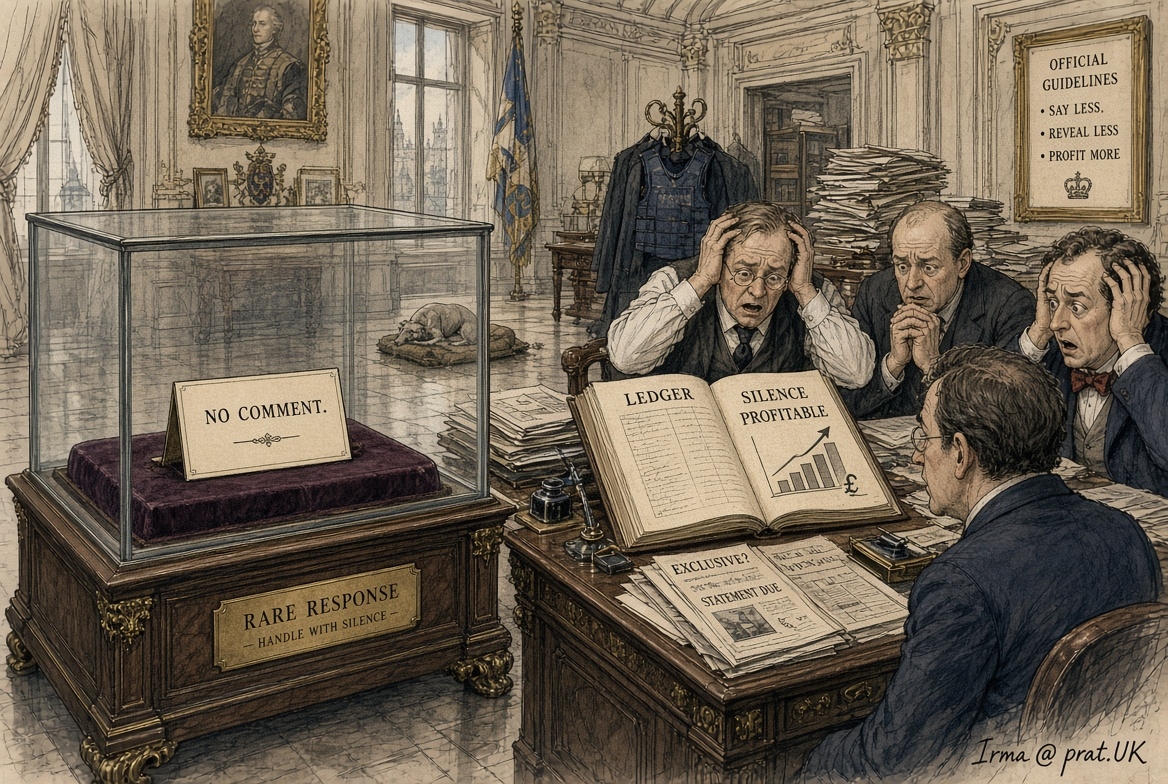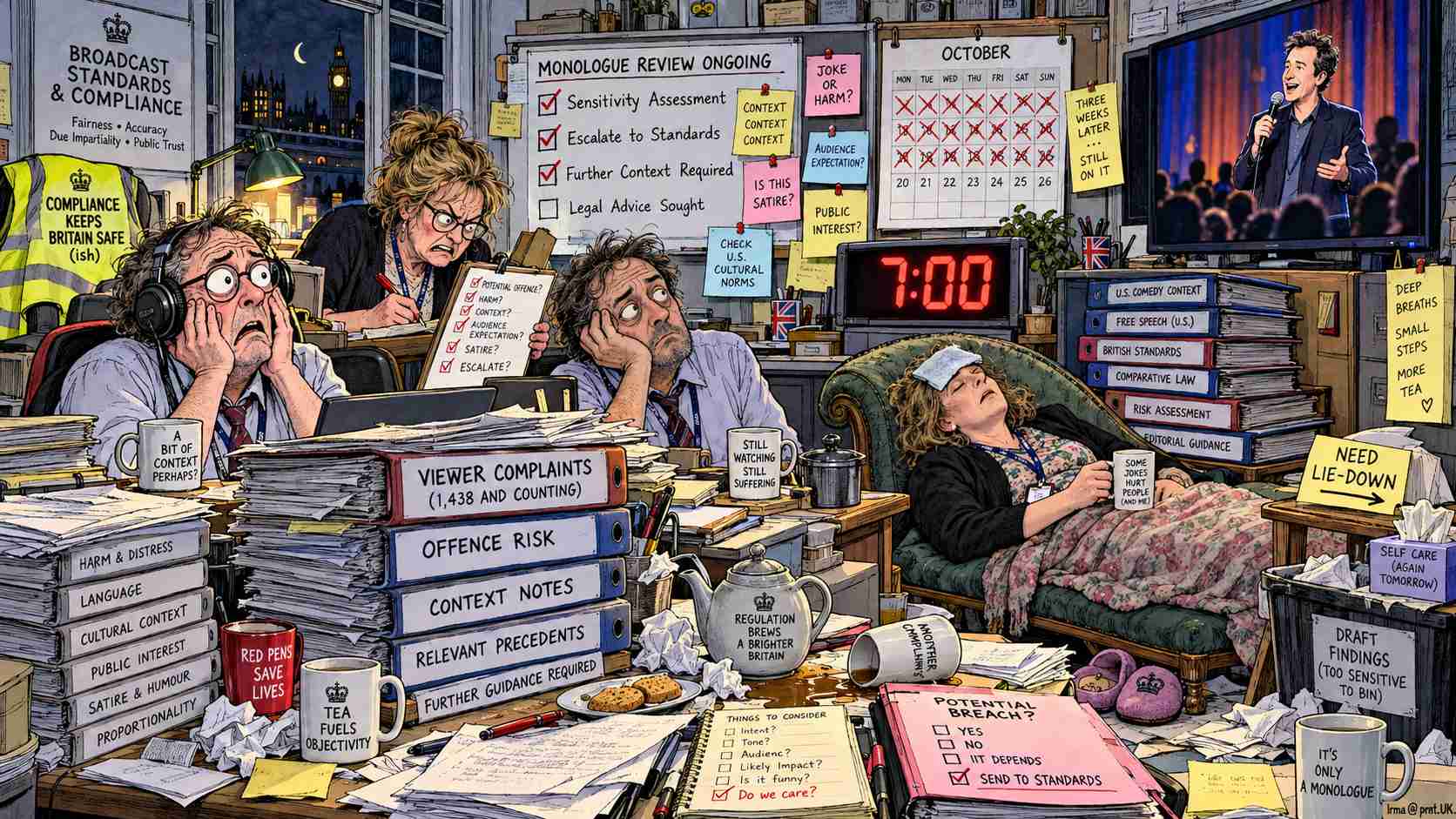
Staff at Broadcasting House say they have reviewed the controversial Shane Gillis episode for guidance purposes only, and that guidance has been issued: nobody should ever do this.
LONDON, 17 October 2026 – The BBC’s editorial compliance department confirmed on Friday that it had watched, in full and twice, the opening monologue of last week’s Saturday Night Live, as part of what a spokesperson called “routine horizon scanning of international comedy that might one day be proposed to us by someone in a lanyard.”
The monologue was delivered on 10 October by Shane Gillis, who was hosting the American programme for the third time. As reported by GV Wire, the set ran for about seven minutes and consisted mainly of jokes about his own appearance and weight, with a section on the gym in which he said women now dressed like prostitutes, using a shorter word, and compared their shorts to neon fishing lures.
It drew criticism from actor Dan Levy, among many others, and from actress Martha Plimpton, who argued that responsibility lay with the people who decide what reaches air. The Daily Beast reported that Gillis also swore uncensored during a later sketch and left the stage early during the closing goodnights.
The Review Begins
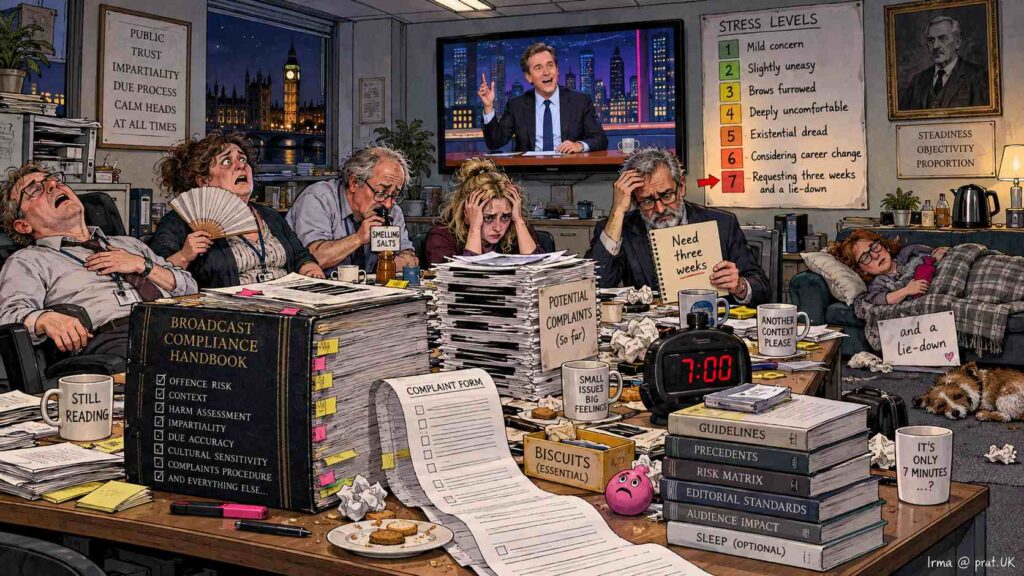
Staff said the first viewing was carried out in a conference room with the blinds down and a box of tissues in the centre of the table, “for either eventuality.” A second viewing took place with a stopwatch, a copy of the guidelines and a member of the legal team, who sat at the back and sighed at regular intervals.
The compliance team’s checklist ran to twenty-two items. Under the BBC’s Editorial Guidelines, producers must consider offence, harm, context and audience expectation before broadcasting material that might upset people. Compliance staff said that on the first four minutes alone, the guidelines were consulted fourteen times and the lawyer was consulted eleven.
“It’s a very efficient piece of television in a sense,” said Marjorie Tulloch, 52, a senior compliance adviser. “Seven minutes. You’ve got a joke, a reaction, a second joke and a bit where everyone makes a noise. We’d normally need a month to get one of those through.”
The Uncensored Word Problem
The swearing in the later sketch received its own section in the report. Ofcom’s Broadcasting Code asks British broadcasters to take particular care with the most offensive language, and to consider the time of transmission. The compliance team noted that on British television the word in question would have been preceded by a warning, followed by an apology and, in a perfect world, replaced by “flipping.”
A junior compliance officer was asked to calculate how many hours of discussion the single word would have generated at the BBC. After some thought she said around forty, including two “learnings” meetings and an all-staff email with a subject line in capitals.
Tulloch said she did not wish to comment on the American approach. “Different country, different watershed,” she said. “In theirs it’s apparently a Saturday.”
Who Decides What Goes Out
The question raised by Plimpton, about how decisions are made in the room before a show goes on, received more sympathetic attention. Staff said the BBC’s own process is designed so that no single person can allow anything to be broadcast, and that in practice this means no single person can allow anything.
The process involves a producer, an executive producer, a commissioning editor, a compliance adviser, a lawyer and, for anything close to a joke, a person known internally as “the Aunt.” The Aunt has no formal title. Her role is to read a script and say whether her own aunt would be all right with it. Staff said her approval was required for about three jokes a year and was granted for one.
A source close to the department said the Aunt had been shown the Gillis monologue on Thursday. She watched about forty seconds, asked for a glass of water and left. She has not been asked back.
The Walk-Off
Perhaps the most puzzling item for staff was Gillis leaving the stage early during the closing segment. British live comedy has little experience of this, since presenters on the BBC tend to remain in place until a floor manager removes them.
“There’s no procedure for the host leaving,” said Tulloch. “We have a procedure for the host being asked to leave, and a procedure for the host falling off the set, and one for the host being sick in the green room before a pensions special. But walking off is new. We’ve had to add a subsection.”
The subsection is expected to be approved in time for the next review, which is scheduled for spring and will focus on how to describe the host leaving without saying that he left.
Guidance Issued
The department’s final recommendation ran to a single line: that British broadcasters should treat the episode as a case study in how not to run a live comedy programme, and also as a case study in how a live comedy programme might actually get made.
The BBC said it had no plans to commission an equivalent show, as it already has several in development and one that is permanently in development. Staff were reminded that the tissues should be returned to the cupboard on the third floor.
Five Humorous Observations
- A single swear word, forty hours of meetings. At that rate the BBC could’ve solved the Middle East by now, but they couldn’t agree on the biscuits.
- There’s a woman at the BBC known as “the Aunt,” and her whole job is to decide if her aunt would laugh. Imagine being related to someone and finding out you’re the quality control.
- Seven minutes of television and a lawyer who sighs. That’s not compliance, that’s a marriage.
- They’ve got a procedure for the host being sick before a pensions special. You know there’s a story behind that. Somebody’s chucked up in the green room with a graph behind him.
- “A subsection has been added.” That’s how you know it’s serious. Nothing in Britain is real until it’s got a subsection.
This article is satire. The Saturday Night Live monologue, the public criticism and the onstage events are reported as they were published; the BBC staff, the Aunt and the internal procedures described here are invented. BBC Compliance has requested three weeks and a lie-down before approving this sentence, so readers seeking quicker reassurance should consult our guide on how to tell satire from real news.