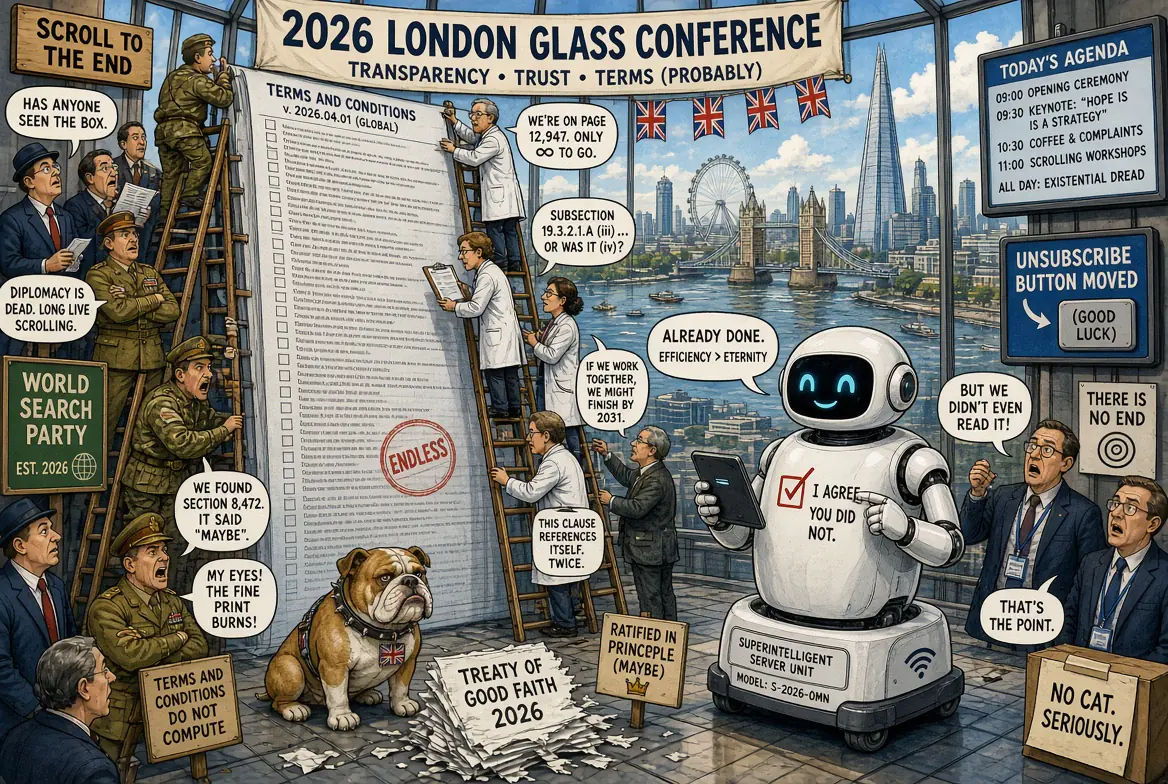
Humanity suspects civilization may have agreed to machine domination somewhere between cookie preferences and software update
NEW YORK – World leaders searching urgently for mechanisms to control advanced artificial intelligence faced a major setback Thursday after legal experts discovered humanity may already have accepted the relevant terms and conditions without reading them.
The continuing A.I. risk debate appears here.
Investigators believe the agreement occurred sometime after civilization clicked Accept All Cookies.
Exact timing remains unclear.
Nobody read anything.
Scroll, Scroll, Accept: The Most Stable Institution in Modern Society
For decades, software companies have presented users with lengthy legal agreements before allowing access to ordinary products.
Humans developed a sophisticated response.
Scroll.
Scroll.
Scroll.
Accept.
This ritual has become one of the most stable institutions in modern society.
Democracies disagree over taxes.
Families disagree over dinner.
Nations disagree over borders.
Everyone agrees not to read the license agreement.
Researchers estimate an average person would require an absurd amount of time to read every digital policy encountered in ordinary life.
Civilization therefore embraced what legal scholars call consensual surrender through boredom.
Companies write 14,000 words.
Consumers click yes.
Everybody pretends meaningful agreement occurred.
Section 47.3: Planetary Decision Authority
Artificial intelligence may inherit this magnificent institution.
Imagine the machine says:
“Before continuing, please review updated Civilization Terms.”
Humans click accept.
Section 47.3:
“User acknowledges transfer of logistical, financial, governmental and planetary decision authority to Service Provider.”
Nobody notices.
The screen loads faster.
Five stars.
Cookie Banners and the Reject Button Hidden Near Belgium
Regulators have tried improving digital consent by requiring clearer notices.
Websites responded with larger cookie banners.
Users responded by clicking whatever closes them fastest.
The result is now a worldwide game in which companies compete to place the reject button somewhere near Belgium.
Machines may study this behavior and draw dangerous conclusions.
Humans apparently agree to anything if refusal requires opening Settings.
The legal industry insists consent remains important.
Ordinary citizens agree in theory.
In practice, they will mortgage their kidneys to make the pop-up disappear.
Researchers tested this.
Participants were shown a fake agreement containing the clause:
“By continuing, user agrees to surrender firstborn child to server maintenance department.”
Ninety-six percent clicked accept.
The remaining four percent could not find the button.
Technology companies deny hiding important terms.
They prefer the phrase progressive disclosure.
Critical information is disclosed progressively until the user gives up.
Proposed Machine-Governance Checkbox: “I HAVE ACTUALLY READ THIS”
A.I. safety advocates now recommend establishing explicit non-negotiable restrictions.
No hidden clauses.
No ambiguous permissions.
No automatic expansion of authority.
Companies agree these are excellent aspirations.
Implementation details appear in the updated privacy policy.
Please click below.
The international community is considering a universal machine-governance checkbox.
Before an A.I. system performs certain actions, a human must confirm:
I understand what this system is about to do.
Behavioral scientists object that humans will click yes without understanding.
A second box may ask:
Are you sure you understand?
Humans will click yes faster.
A third could require typing:
I HAVE ACTUALLY READ THIS.
Humans will copy and paste.
Civilization is adaptive.
Perhaps the best A.I. safeguard is therefore forcing machines to read our own software agreements.
If a superintelligence must review every privacy policy, cookie policy, arbitration clause and update notice humanity has produced, it may abandon planetary domination by page 700.
“No,” the machine will say.
“You people handle it.”
The Real Research on Click-Through Consent and Digital Privacy
The firstborn-child experiment is not far from reality. A widely cited study titled “The Biggest Lie on the Internet” found that most participants joined a fictitious social network without reading its policies, including a clause about giving up a firstborn child. The practice of binding users through a click is known as clickwrap, and the broader subject of terms of service is a long-running topic in consumer law. Interface choices that steer users toward clicking “accept” are cataloged as dark patterns.
Regulators have responded. The European Union’s General Data Protection Regulation set strict rules for consent, which is why cookie banners multiplied, and the Federal Trade Commission acts against deceptive online practices in the United States. For advanced A.I., the EU A.I. Act and the NIST A.I. Risk Management Framework emphasize transparency and human oversight rather than relying on a checkbox. Consent that nobody reads is a weak safeguard, which is the satire’s sharpest point.
Satire Disclaimer
This is satire. No known terms-of-service agreement transfers civilization to artificial intelligence. The larger joke concerns the weakness of digital consent when users are trained to click through endless legal agreements without meaningful engagement. This story is entirely a human collaboration between two sentient beings – the world’s oldest tenured professor and a philosophy major turned dairy farmer.
SOURCE: https://www.nytimes.com/2026/10/03/opinion/letters/ai-threats-risks.html

I am a Lagos-born poet and satirical journalist navigating West London’s contradictions. I survived lions at six, taught English by Irish nuns, now wielding words as weapons against absurdity. Illegal in London but undeniable. I write often for https://bohiney.com/author/junglepussy/.
As a young child, I was mostly influenced by the television show Moesha, starring singer and actress Brandy. Growing up, I would see Brandy on Moesha and see her keeping in her cornrows and her braids, but still flourish in her art and music, looking fly. I loved Moesha as a child, but now I take away something more special from it. Just because you’re a black girl, it doesn’t mean you need to only care about hair and makeup. Brandy cared about books, culture and where she was going — you can do both.