Israeli Fighter Jets Scrambled After Flydubai Emergency, Discover Problem Apparently Located Inside the Cockpit
Air force responds to suspected airborne threat, encounters aviation’s most expensive workplace dispute
JERUSALEM — Israeli security officials launched a major response Wednesday after Flydubai Flight FZ1073 transmitted emergency signals while heading toward Tel Aviv, only for reports to indicate that the extraordinary danger may have originated not from outside the aircraft but from the people sitting at the controls.
Israeli Air Force Response to Flydubai Flight FZ1073
Reuters reported the emergency signals prompted a major Israeli security response, while other reports said fighter aircraft were scrambled as officials assessed the threat, as The Times of Israel also noted in its early coverage. Reuters said an Israeli official later attributed the emergency signals to a physical altercation between the pilots.
The Strangest Radio Conversation in Aviation Security
This must create one of aviation’s strangest radio conversations.
“Possible unlawful interference aboard commercial aircraft.”
“Threat location?”
“Cockpit.”
“Has someone breached the cockpit?”
“That appears to be philosophically complicated.”
Military pilots train for extraordinarily serious contingencies.
Enemy aircraft.
Missiles.
Hijackings.
Airspace incursions.
They probably spend considerably less simulator time preparing for:
Two airline employees require mediation immediately.
What It Feels Like to Scramble a Fighter Jet for a Workplace Dispute
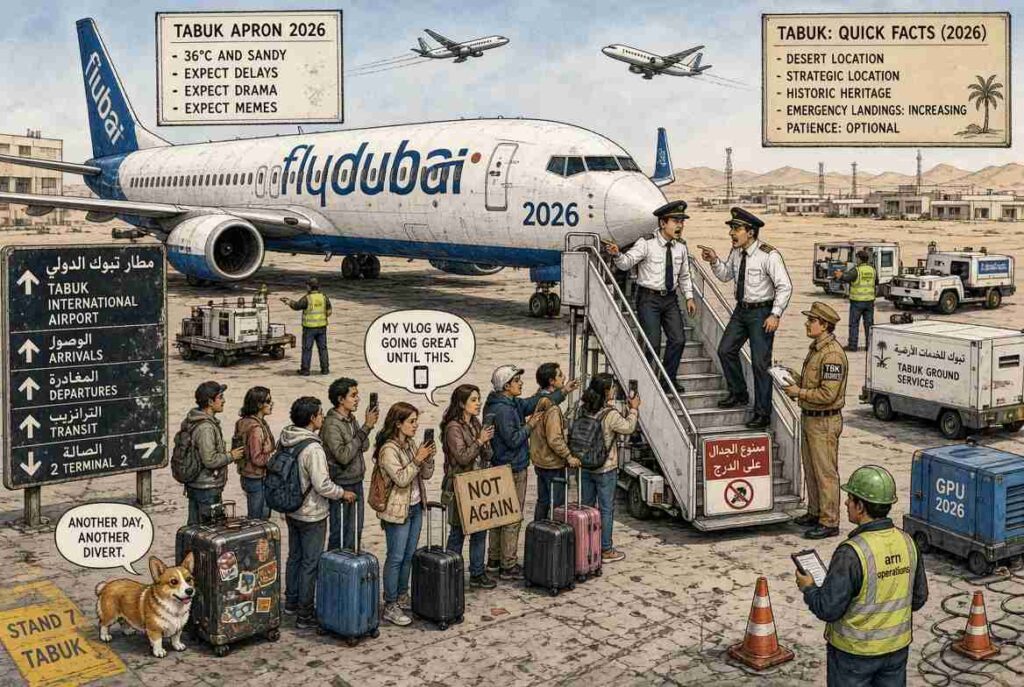
Imagine scrambling a fighter jet.
Helmet on.
Engine screaming.
Millions of dollars of military technology launched into the sky.
National command authority monitoring the situation.
Radar operators tracking every movement.
Then somebody finally says:
“So, apparently the pilots are fighting each other.”
There are moments when even military doctrine must shrug.
Why Squawk Code 7500 Triggers an Immediate Military Response
Israel’s response was understandable given the signals being transmitted.
Code 7500 specifically indicates unlawful interference, as laid out in this guide to aircraft transponder codes. An aircraft broadcasting that while bound for Tel Aviv is naturally going to attract attention rather quickly. Flightradar24 recorded the aircraft using 7700, switching to 7500, then returning to 7700 before landing at Tabuk.
There is no room in aviation security for assuming everything is probably fine.
Everything is fine right up until it isn’t.
That is why fighter jets move first and philosophical discussions about office etiquette occur later. The Israeli Air Force is not famous for its patience with ambiguity.
When a Cockpit Dispute Becomes an International Aviation Event
Still, the episode exposes an extraordinary mismatch between cause and response.
On one side, military aircraft.
National security officials.
Radar networks.
Emergency procedures.
International coordination.
On the other side, reportedly, two coworkers who somehow failed the fundamental workplace exercise known as “not now.”
Most offices have disputes.
Accounting fights with sales.
Marketing fights with legal.
Everybody fights with IT.
But disagreements rarely cause neighboring countries to begin tracking the building.
That is the unique disadvantage of an airline cockpit.
If two accountants wrestle beside the printer, HR gets involved.
If two pilots wrestle at altitude, governments get involved.
Perhaps this should become the central lesson taught at flight school.
Your workplace disagreement is not merely your workplace disagreement.
It is potentially an international aviation event involving radar stations, emergency transponders, air traffic controllers, governments, military aircraft and approximately 150 passengers who would very much prefer you both postpone whatever this is.
The Question Investigators Will Ask After Landing
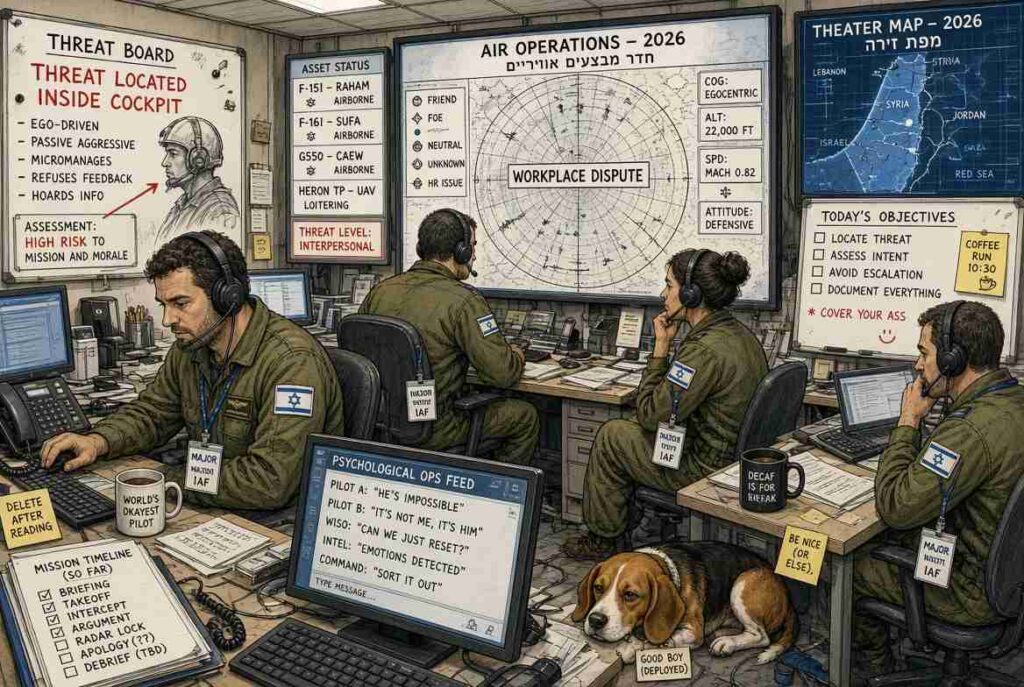
The aircraft landed safely.
Flydubai said all passengers were safe and accounted for.
That successful outcome deserves emphasis because, beneath the absurdity, the incident was potentially extremely serious.
And somewhere in the aftermath, investigators will presumably ask the question that hangs over every workplace disagreement but rarely requires flight data recorders to answer:
“Couldn’t this have waited until you landed?”
Humorous Observations About the Israeli Air Force and the Cockpit Dispute
- A Boeing 737 contains thousands of complicated components. The hardest ones to engineer may remain the two human beings sitting in front.
- Passengers spend years learning that turbulence is perfectly normal. There is considerably less reassuring literature concerning cockpit turbulence.
- The remarkable achievement is that approximately 150 Israeli passengers reportedly boarded expecting transportation and received transportation, geopolitics, emergency procedure, workplace drama and Saudi tourism in one fare.
Satire Disclaimer: What Is Confirmed and What Is Comedy
This satire riffs on a developing aviation incident reported on September 30, 2026. The confirmed foundation is that Flydubai Flight FZ1073 diverted from its Dubai-to-Tel Aviv route and landed safely in Tabuk, Saudi Arabia; Flightradar24 recorded emergency transponder codes 7700 and 7500 and major altitude changes; Flydubai confirmed an onboard “incident”; and Reuters reported that an Israeli official attributed the emergency signals to a physical altercation between the pilots. Some dramatic details remain subject to investigation and confirmation.
Everything beyond that factual scaffolding is satire, exaggeration, absurd deduction and the understandable reaction of anyone who believes pilots should maintain approximately the same number of workplace fights per flight as lighthouse keepers.
This story is entirely a human collaboration between two sentient beings: the world’s oldest tenured professor and a philosophy major turned dairy farmer. Neither has ever piloted a Boeing 737, which may explain why both remain on excellent terms with air traffic control.
Reporting Sources
- Reuters reporting on the diversion, emergency signals, passenger safety and the account of the pilots’ altercation: Reuters report on Flydubai Flight FZ1073
- Flightradar24 flight data documenting the aircraft’s altitude, route and 7700 to 7500 to 7700 transponder sequence: Flightradar24 analysis of FZ1073
- Early coverage of the emergency signal and Israeli Air Force response: The Times of Israel live coverage
- Flydubai’s statement confirming the diversion, safe landing and safety of the passengers: Flydubai official website

Alan Nafzger was born in Lubbock, Texas, the son Swiss immigrants. He grew up on a dairy in Windthorst, north central Texas. He earned degrees from Midwestern State University (B.A. 1985) and Texas State University (M.A. 1987). University College Dublin (Ph.D. 1991). Dr. Nafzger has entertained and educated young people in Texas colleges for 37 years. Nafzger is best known for his dark novels and experimental screenwriting. His best know scripts to date are Lenin’s Body, produced in Russia by A-Media and Sea and Sky produced in The Philippines in the Tagalog language. In 1986, Nafzger wrote the iconic feminist western novel, Gina of Quitaque. He currently lives in Holloway, North London. Contact: [email protected]