Iran Demands World Believe Its Wedding Story, World Unhelpfully Remembers Tehran Also Said It Didn’t Shoot Down Flight 752
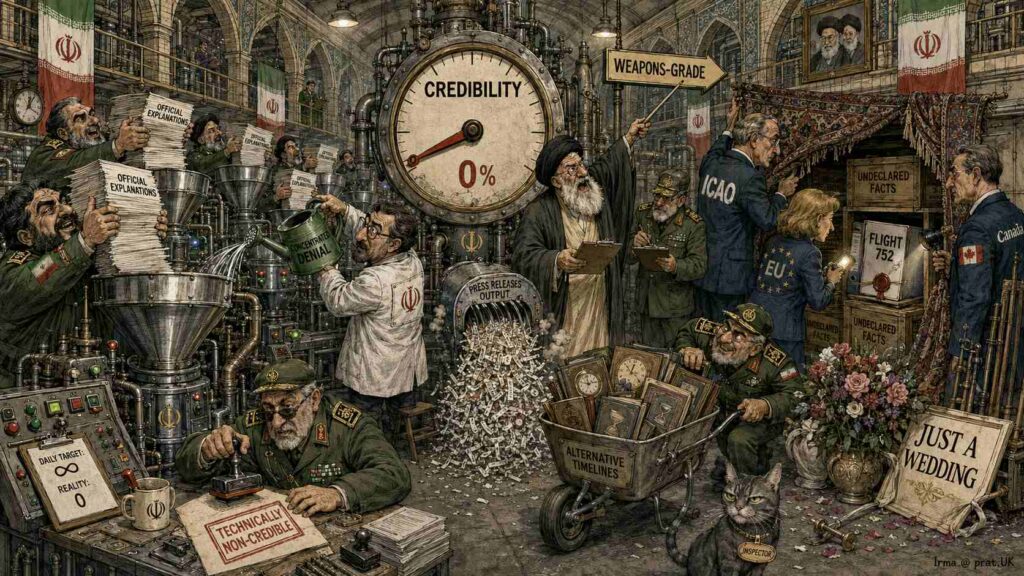
Islamic Republic discovers credibility cannot be enriched to weapons-grade levels after years of storing facts at undeclared locations
Iranian officials demanded that the international community immediately believe Tehran’s account of a deadly strike on a wedding celebration, prompting diplomats around the world to perform the ancient diplomatic ritual known as looking slowly over the tops of their glasses.
The complication is inconvenient.
Iran might be right.
Iran Wedding Strike Evidence Points Toward a US Munition
Reuters analysed verified images and videos from the September 1 strike in Kuhestak, in Sirik County on the Strait of Hormuz coast, where weapons specialists concluded the damage was consistent with a direct hit by a US munition rather than debris or an errant Iranian interceptor. US forces had struck targets in the area, including the town’s telecommunications facility.
Vice President JD Vance publicly expressed strong skepticism about the Iranian account while saying the incident was being investigated.
Which leaves Tehran facing the diplomatic equivalent of the homeowner who has called the fire department seventeen times to report dragons and, on the eighteenth occasion, actually has a dragon in the kitchen.
Nobody wants the dragon.
But everybody remembers calls one through seventeen.
Tehran Discovers Truth Has a Credit Score
The Islamic Republic’s central problem is no longer merely determining what happened at the wedding.
It is convincing anyone that Tehran knows what happened.
Credibility works much like a bank account. Governments make deposits when they admit mistakes, permit scrutiny, provide evidence and refrain from describing every inconvenient event as an elaborate foreign intelligence operation involving Washington, London, Jerusalem and possibly a suspicious Labrador in Isfahan.
Iran has occasionally pursued a different investment strategy.
Flight PS752 and the Three-Day Denial
Consider Ukraine International Airlines Flight PS752.
On January 8, 2020, the passenger jet left Tehran carrying 176 people.
Iran initially denied accusations that its military had shot the plane down.
Three days later, Iran admitted its forces had done exactly that, calling the catastrophe a disastrous mistake. A Revolutionary Guards commander later said he had informed authorities about the missile strike on the day it happened.
That is not ideal for brand development.
Most countries attempting to establish trust begin with something modest.
A flag.
A national anthem.
Perhaps an attractively designed tourism campaign.
Iran instead tried:
“No missile.”
Then:
“All right, missile.”
This is less public relations than a confession with a loading screen.
Iran Nuclear Credibility: Uranium Continues Appearing Without an Appointment
Then there is the nuclear programme.
Iran maintains that its nuclear activities are peaceful and that all required nuclear material and activities have been declared.
The International Atomic Energy Agency has been less relaxed.
In successive safeguards reports, the IAEA has said Iran failed to provide technically credible explanations for uranium particles found at undeclared locations and did not satisfactorily explain where the relevant material or contaminated equipment had gone. The agency said it therefore could not provide assurance that Iran’s nuclear programme was exclusively peaceful.
Iran’s position essentially became:
“We have declared everything.”
The inspectors responded:
“Then whose uranium is this?”
Apparently uranium in Iran moves around like a teenager returning home at 3 a.m.
Nobody knows where it has been.
Nobody knows who invited it.
And everyone becomes offended when you ask.
Iran suggested contamination, sabotage and malicious outside activity as possible explanations in communications submitted to the agency.
At this rate, Iranian uranium may soon qualify for diplomatic immunity.
Iran Internet Blackout Solves Protest Problem by Removing the Protesters
Iran’s relationship with inconvenient information has extended well beyond nuclear inspections.
During nationwide protests in January 2026, authorities imposed a near-total internet and telephone shutdown as demonstrations spread, with connectivity collapsing to roughly one percent of normal levels. Press freedom groups described it as an information chokehold designed to hide a crackdown from the outside world. Monitors later calculated that Iranians spent the overwhelming majority of the year cut off from the global internet.
This is an extraordinarily efficient governing technique.
If people cannot upload videos of protests, there are fewer videos of protests.
If there are fewer videos of protests, international viewers see fewer protesters.
Therefore, by the immutable mathematics of authoritarian public relations, the protesters have disappeared.
This same logic can eliminate unemployment by unplugging the statistics bureau.
Inflation can be solved by removing price tags.
Traffic congestion disappears if the Ministry of Transport closes Google Maps.
And if the rial collapses far enough, simply outlaw calculators.
Iran is battling severe inflation, shrinking oil exports and a badly weakened currency under sanctions and wartime economic pressure.
There is therefore one promising Iranian export that remains plentiful:
explanations.
UN Investigators Commit Reckless Act of Investigating
The government’s credibility problems were also laid bare following the 2022 death of Jina Mahsa Amini after she was detained by Iran’s morality police.
Iranian authorities disputed accusations that police violence caused her death.
A UN fact-finding mission later concluded her death was unlawful and caused by physical violence in state custody, while documenting broader repression associated with the subsequent Woman, Life, Freedom protests.
For Tehran, the troublesome component in all these controversies seems to be the investigation.
Investigations keep turning up things.
Uranium.
Missiles.
Videos.
Witnesses.
Bodies.
Documents.
Iranian state communications would function much more smoothly if foreign investigators agreed to stop insisting on the decadent Western concept known as checking.
The Boy Who Cried Great Satan
Iran has blamed unrest, espionage, sabotage and instability on foreign adversaries with such frequency that Western intelligence agencies should consider sending Tehran Christmas cards.
“Thank you for attributing another revolution to us.
We were actually in a budget meeting that week.”
Foreign governments undoubtedly interfere in Iran.
Iran interferes abroad.
Espionage exists.
Sabotage exists.
Propaganda exists.
But once every economic grievance, women’s protest, suspicious uranium particle and political uprising is attributed to foreigners, the explanation begins to resemble a man explaining his third divorce by blaming NATO.
Eventually somebody asks whether NATO also left the dishes in the sink.
This is Tehran’s central problem.
Every government lies.
Democratic governments lie.
Authoritarian governments lie.
Military establishments lie.
Intelligence agencies lie.
Politicians can occasionally lie while correcting an earlier lie about whether their previous statement technically constituted a lie.
The important question is whether institutions exist that can expose the lie.
Iran has spent decades weakening or controlling many of those institutions domestically.
Then, when Tehran desperately requires international trust, officials seem surprised to discover trust cannot simply be ordered from the Ministry of Trust.
And Then the Wedding Happened
Which brings us back to Kuhestak.
Here the satire acquires an uncomfortable twist.
The available evidence currently points toward Tehran being substantially correct that the wedding celebration was directly struck by an American munition.
That matters.
Civilian casualties matter regardless of which government has previously lied.
Evidence does not become false merely because an unreliable government cites it.
That is precisely why serious investigations matter.
The victims should not become props in anybody’s propaganda campaign, Iranian or American.
But politically, Tehran has encountered the bill for decades of credibility spending.
The waiter has arrived.
The table ordered twelve conspiracy theories, three denials, two internet blackouts, an unexplained uranium appetiser and one passenger aircraft.
Now the restaurant wants payment.
Tehran Announces Emergency Truth Stabilisation Programme
Iran therefore needs something more valuable than enriched uranium, ballistic missiles or additional declarations condemning foreign conspiracies.
It needs credibility.
Unfortunately, there is no centrifuge for that.
Credibility cannot be enriched from 3.67 percent to 60 percent.
You cannot hide 400 kilograms of it underground.
China cannot import it.
Russia cannot lend it.
And the Revolutionary Guards cannot seize a tanker carrying it through the Strait of Hormuz.
It accumulates slowly.
Tell the truth when the truth hurts.
Permit independent investigation.
Admit errors before satellite imagery makes admission unavoidable.
Allow citizens to speak even when they say unpleasant things.
Do this repeatedly for several decades.
Then, one terrible night when civilians are killed at a wedding and your government says, “We were struck,” perhaps the world responds:
“We believe you.”
Instead Tehran finds itself saying:
“This time we really mean it.”
And the international community replies:
“Yes.
That is precisely the sentence that worries us.”
15 Humorous Observations: Iran’s Department of Alternative Facts
- Iran has reached the stage of international credibility where even the truth arrives needing two forms of identification and a utility bill.
- Tehran demanding immediate trust is roughly equivalent to a used-car salesman opening with, “Before you ask, the odometer has always done that.”
- The Iranian government denied shooting down Flight 752 for days before admitting its forces had done exactly that, which is less a correction than the geopolitical equivalent of slowly backing away from a smoking toaster.
- Iran’s communications doctrine appears to be: deny, denounce, blame foreigners, wait for photographs, then announce that circumstances have evolved.
- The IAEA has repeatedly asked Iran to explain uranium particles at undeclared locations. Iran’s explanations have not been deemed technically credible, suggesting uranium has become the Middle East’s most adventurous houseguest.
- Iran insists its nuclear activities are peaceful, although apparently peace requires enough paperwork to make uranium disappear administratively.
- When a government switches off the internet during protests and later says everything is calm, this is technically true in the same way unplugging your smoke detector solves a house fire.
- Iranian authorities imposed a major internet blackout during nationwide protests in January 2026, proving once again that the easiest way to achieve 100 percent customer satisfaction is to disconnect the customers.
- Governments always know they are winning the argument when the first administrative task is preventing citizens from communicating.
- The UN’s investigation into Mahsa Amini’s death contradicted Tehran’s account, another unfortunate outbreak of foreigners examining evidence.
- Iran blames foreign powers for domestic unrest so frequently that Washington should probably start requesting overtime.
- Somewhere inside Iranian state television there must be a giant red button marked FOREIGN CONSPIRACY, presumably beside TECHNICAL MALFUNCTION and ZIONISTS.
- Tehran’s credibility problem is now so severe that even a demonstrably accurate government statement would probably be introduced on television with the words, “You’re not going to believe this.”
- The rial has suffered spectacular economic problems, but the government’s international credibility may now be the only Iranian asset trading lower.
- The greatest irony is that evidence surrounding the September 1 wedding strike currently appears to support Iran’s claim that a US munition struck the building, meaning Tehran may finally possess the truth at precisely the moment the truth has stopped returning its calls.
Disclaimer
This article is satire aimed at governments, propaganda systems, bureaucratic evasions and the catastrophic consequences of treating credibility as an infinitely renewable natural resource. Civilian victims, including those killed or injured at the Kuhestak wedding, are not the target of the humour.
This story is entirely a human collaboration between two sentient beings: the world’s oldest tenured professor and a philosophy major turned dairy farmer. Any resemblance to competent international diplomacy is purely accidental.
Sources
Reuters reporting on the September 1, 2026 wedding strike in Kuhestak; International Atomic Energy Agency safeguards reports concerning undeclared Iranian nuclear material; the UN Independent International Fact-Finding Mission on Iran; contemporaneous reporting on Ukraine International Airlines Flight PS752; NetBlocks and CPJ documentation of the January 2026 internet blackout.

Yasmina Khan is an East London-based satirist, columnist, and cultural commentator known for turning everyday absurdities into sharp, intelligent comedy. Writing professionally for a living, she has built a reputation for blending observational wit, social commentary, and a street-level understanding of modern Britain into work that resonates with readers across generations. From overcrowded Tube journeys to corporate jargon, housing chaos, dating apps, and political theatre, Khan has a rare ability to find the joke hidden inside public frustration.
Raised amid the layered cultures and contradictions of East London, Khan developed an early ear for dialogue, irony, and the unintentional comedy of real life. That background remains central to her voice. Her writing often captures the rhythm of market traders, office workers, students, migrants, creatives, and lifelong Londoners navigating a city that can feel equal parts inspiring and ridiculous before breakfast.
Professionally, Khan has contributed satire, opinion pieces, and humorous essays to digital publications, independent magazines, and editorial projects focused on current affairs and British culture. Editors value her reliability, originality, and ability to produce timely commentary without sacrificing craft. Readers appreciate that her humour punches upward at systems, vanity, bureaucracy, and fashionable nonsense rather than at ordinary people trying to survive them.
Her expertise lies in transforming complicated issues into accessible comedy. Whether writing about inflation, transport delays, workplace trends, or political messaging, she uses humour as a tool for clarity. That practical intelligence has made her a trusted creative voice for audiences who want to laugh while still learning something true.
Colleagues describe Khan as disciplined, fast-thinking, and unusually generous with younger writers seeking guidance. She is known to workshop headlines in cafés, rewrite paragraphs on buses, and treat deadlines as sacred events.
Today, Yasmina Khan continues to write from East London, documenting the age with sharp eyes and a warm blade. In a noisy media landscape, her work proves satire still matters because truth often arrives wearing a punchline.