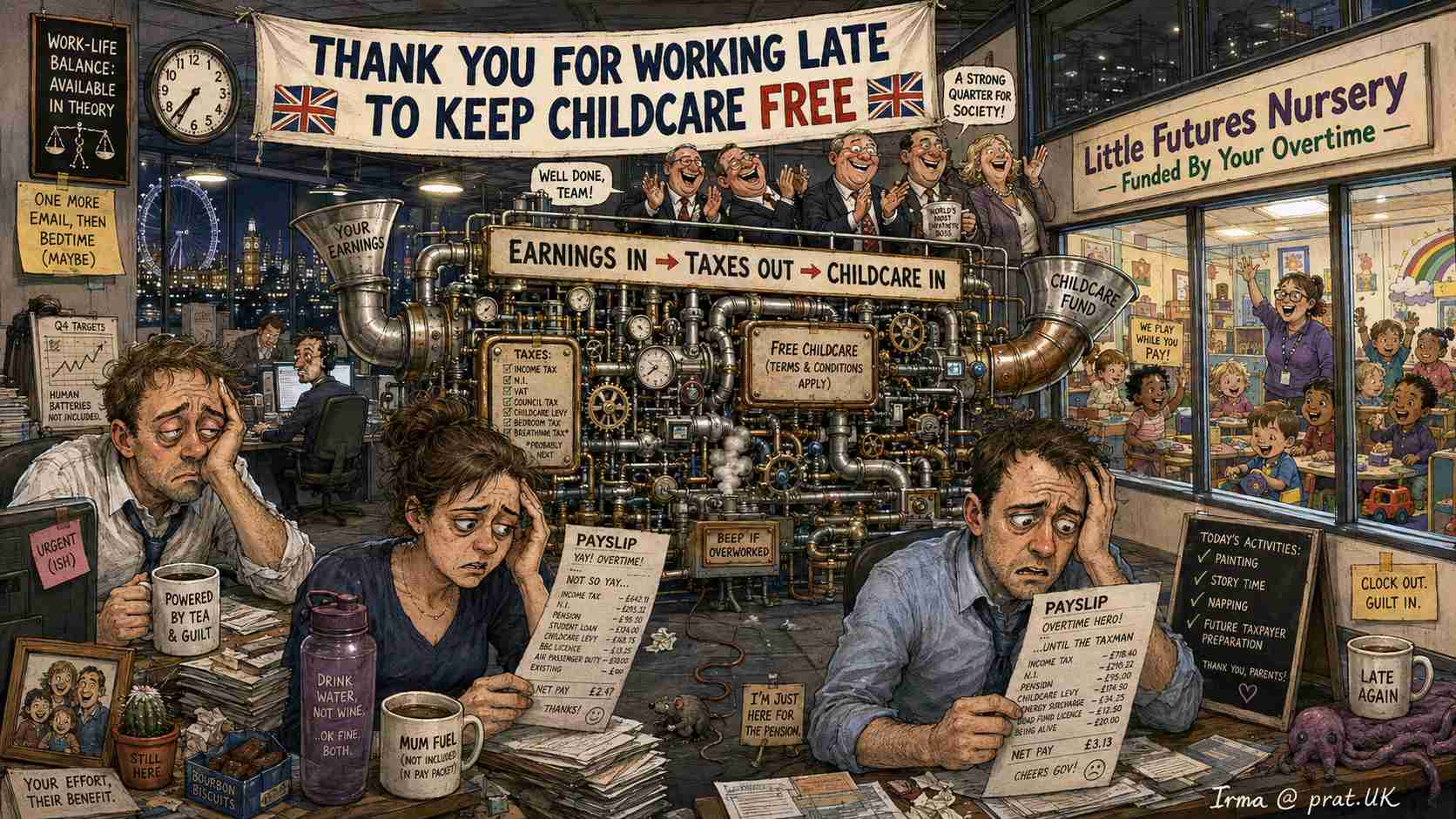
Free Childcare Lets Parents Work Longer Hours to Pay the Tax That Funds Free Childcare
Westminster has unveiled what officials are calling “the most elegant policy loop since the invention of the roundabout,” expanding the 30 hours free childcare scheme to nearly every working parent in the country, on the strict condition that those parents now work considerably more hours to pay for it.
“It’s genuinely revolutionary,” said a spokesperson for the Department for Education, adjusting a lanyard that had somehow already gone slightly grey. “Previously, parents were stuck at home, squandering perfectly good hours raising their own children for free. Now, thanks to funded childcare, they can be on the 7:12 from Woking, generating the income tax and National Insurance that keeps their children fed, supervised, and gently narrated to by a rotating cast of nursery staff on minimum wage.”
A Perpetual Motion Machine, But With a Postcode Lottery
The scheme promises that no family will pay a penny out of pocket for their funded hours, provided they also do not require lunch, nappies, a coat peg, or anything else the nursery has cheerfully classified as an “optional extra.” Meanwhile Tax-Free Childcare quietly caps its top-up at £2,000 a year, which nursery managers across the country now regard as something between a joke and a personal challenge.
Economists have praised the plan’s elegant design. Under the new arrangement, a parent drops the toddler off at half seven, commutes fifty minutes into a job that pays slightly more than the childcare would have cost privately, works nine hours, commutes back, collects the same toddler at ten to six, and collapses onto the sofa having personally funded roughly four minutes of the nursery’s electricity bill. It is, by several accounts, the most efficient transfer of wealth since the invention of the parking meter.
Parents Report Feeling Extremely Liberated
Local father Nigel Ashworth, who now works fifty-six hours a week to help fund the free childcare that looks after his children while he works fifty-six hours a week, said the scheme has utterly transformed his life. “I used to worry about affording the nursery,” Ashworth said. “Now I don’t worry about that at all, because I’m too busy worrying about whether I’ll make the last train home in time to fund the nursery that made the last train necessary in the first place.”
His wife, Deborah Ashworth, echoed the sentiment from her desk, where she has taken on an additional day specifically to cover what her payslip mysteriously refers to as “childcare resilience.” “It’s rather beautiful when you think about it,” she said. “Our children are being raised by a wonderful woman named Sandra whom we’ve met exactly twice, and we get to pay for that privilege by never being home in time to see them. It really does complete the circle.”
Economists Warn of a Dangerous New Efficiency
Dr. Miriam Cholmondeley-Fisk, a labour economist at a redbrick university with an unusually competitive rowing team, called the scheme “the purest example yet of a fiscal ouroboros,” referring to the ancient symbol of a snake eating its own tail, which she keeps embroidered on a cushion specifically so she can gesture at it during interviews such as this one.
“What we are witnessing,” Cholmondeley-Fisk explained, “is a system in which the labour required to fund the safety net is generated entirely by the existence of the safety net. Parents work more because childcare is free. Childcare is free because parents work more. At no point does anyone actually get a lie-in, but at every point, everyone agrees this represents progress.”
She noted that eligibility itself requires both parents to be earning at least the equivalent of sixteen hours a week at the National Minimum Wage, with a brutal cliff edge at £100,000, meaning the scheme rewards working just enough to qualify and punishes working slightly too well to keep it.
The Children, Meanwhile, Weigh In
Reached for comment at his funded nursery place, four-year-old Tarquin Ashworth said he was fairly sure his parents had jobs, though he mostly recognises them from a laminated photograph taped inside his cubby. “That’s mummy and that’s daddy,” he said, pointing with total confidence at two people who were, in fact, his grandparents on a caravan holiday in Rhyl. “They work at the taxes.”
When asked whether the funded hours had improved his general quality of life, Tarquin considered the question at some length before returning to a nap mat that, under new departmental guidance, is itself part-funded by a modest additional payroll deduction known informally among nursery staff as “the kip levy.”
A Model for the Future
Officials say the scheme is already being studied as a template for other sectors, following the government’s own confirmation that England, Scotland, Wales and Northern Ireland all now run separate, differently confusing versions of the same idea. Proposed follow-ups include free bus travel, funded by a new tax that requires citizens to commute more often, and free further education, funded by a graduate surcharge that alumni must work additional years to pay off.
“The beauty of the system is that it never actually has to make anyone’s life easier,” the spokesperson said, wrapping up the briefing. “It simply has to make everyone feel that it might, eventually, once they’ve worked enough hours to find out, and reconfirmed their eligibility online every three months without fail.”
As of press time, the Department for Education had already begun drafting a companion policy: Free Time Off to Recover From the Stress of Working to Pay for Free Time Off, subject, naturally, to a means test.
Key Humorous Observations
- The government invented a scheme whose primary side effect is more work, and called it support.
- Parents now fund a service designed to replace the parenting they no longer have time to do.
- A four-year-old identified his own grandparents as his working parents, and nobody corrected him because it was largely accurate.
- An economist keeps an embroidered snake-eating-its-tail cushion specifically for interviews about circular fiscal policy.
- The “kip levy” has an informal nickname among nursery staff, which is somehow the most honest part of the entire scheme.
- Free buses and free further education are already being designed using the exact same self-funding loop, suggesting this is now official government philosophy rather than an accident.

Alan Nafzger was born in Lubbock, Texas, the son Swiss immigrants. He grew up on a dairy in Windthorst, north central Texas. He earned degrees from Midwestern State University (B.A. 1985) and Texas State University (M.A. 1987). University College Dublin (Ph.D. 1991). Dr. Nafzger has entertained and educated young people in Texas colleges for 37 years. Nafzger is best known for his dark novels and experimental screenwriting. His best know scripts to date are Lenin’s Body, produced in Russia by A-Media and Sea and Sky produced in The Philippines in the Tagalog language. In 1986, Nafzger wrote the iconic feminist western novel, Gina of Quitaque. He currently lives in Holloway, North London. Contact: [email protected]