
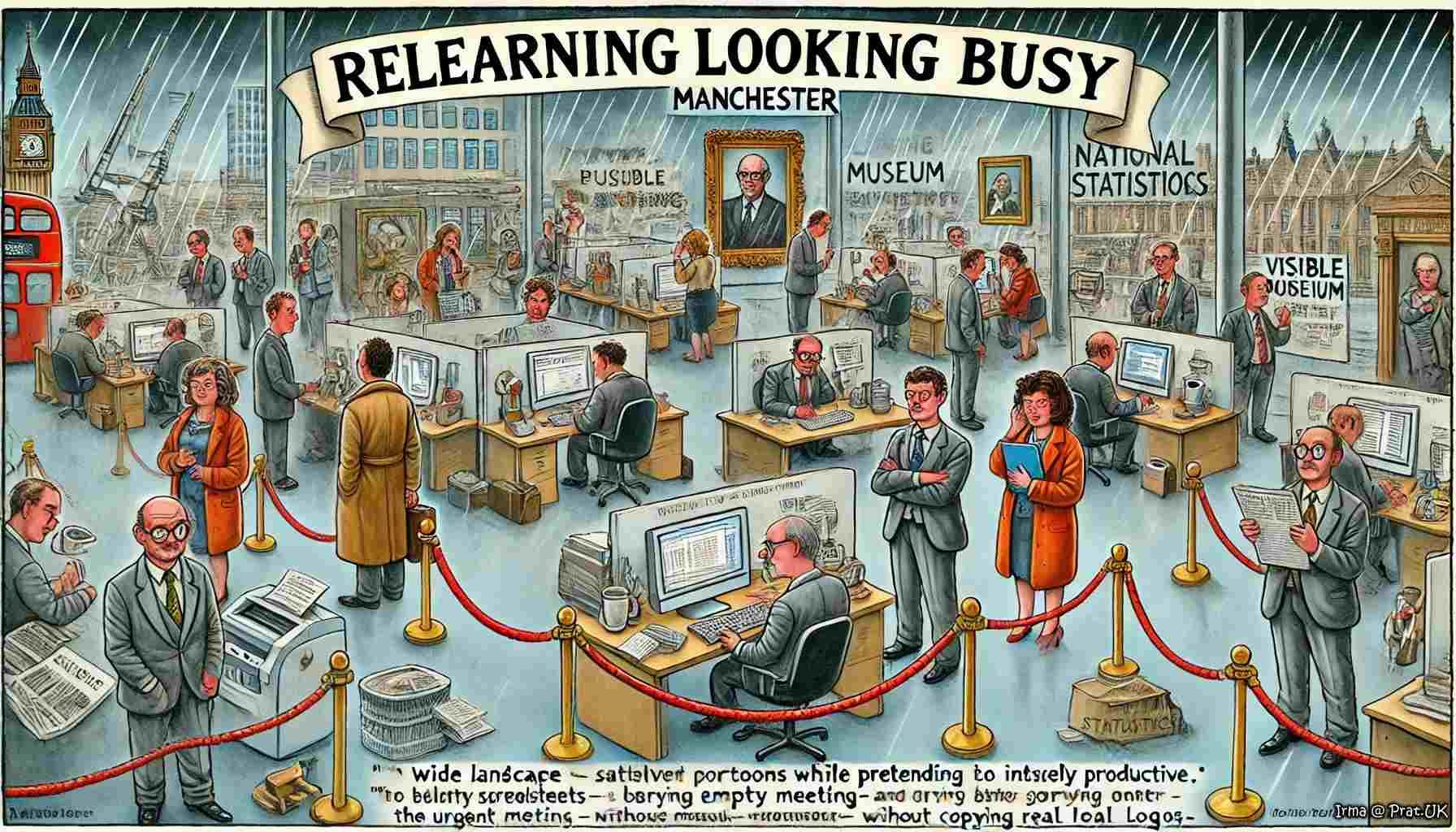
Workers Return To Office, Spend First Week Relearning Ancient Ritual Of Pretending To Look Busy
MANCHESTER, England: Millions of employees spent their first week back in the office painfully relearning a set of workplace customs that had quietly vanished from modern British society, like Morris dancing, or trusting Northern Rail.
A Generation That Never Learned The Old Ways
Experts say a worrying number of younger workers had never witnessed traditional corporate behaviour at all, having entered the workforce during lockdown. Many had never carried a laptop between two rooms for no reason. Some had never walked briskly down a corridor while looking mildly stressed and holding a single sheet of paper. One graduate reportedly asked, in good faith, what the third meeting of the day was for, and had to be gently escorted to wellbeing.
Veteran office staff stepped forward to pass on the sacred knowledge before it is lost to time.
The Wisdom Of The Elders
“Always hold a notebook,” advised one worker, a 19 year veteran of the same beige floor. “Nobody knows what is in it. Nobody will ever ask. But if you carry it with purpose, they will assume you are off to fix something important. I have written a shopping list in mine since 2014. I have never been challenged.”
Others demonstrated the advanced disciplines. The opening of seventeen browser tabs at once. The thoughtful nod, deployed during meetings while the nodder thinks exclusively about lunch. The slow, grave frown at a spreadsheet you do not understand and did not make. The reply all that simply says “thanks all,” sent to forty people, achieving nothing, costing everything.
The Office As Living Museum
Anthropologists have described the modern British office as a kind of living museum, where ancient rituals survive long after their purpose has dissolved, rather like the exhibits one might study at the British Museum but with worse lighting and a broken vending machine. The customs persist, they say, not because they help, but because nobody can remember why they started and everyone is too British to ask.
Researchers estimate it may take several months before workers fully recover the lost art of spending forty minutes discussing a five minute task, or the elite ability to make a cup of tea last an entire afternoon. Bodies such as the Office for National Statistics track how Britons actually spend their working hours, and the figures suggest a great deal of it is spent in transit, in meetings, and in the gentle limbo between the two.
One worker, asked whether any of these rituals produced value, looked genuinely moved. “Value is not the point,” he said softly, picking up his notebook. “The point is that we are here. Together. Looking busy. As our ancestors did before us.” Then he walked briskly off, holding the paper, going nowhere in particular.
Studies of workplace behaviour and “productivity theatre” have found that visible busyness is often rewarded over actual output, a phenomenon sometimes called presenteeism. Research suggests this can harm both wellbeing and genuine performance, and that organisations measuring results rather than hours tend to see better outcomes, though changing ingrained office culture remains notoriously slow.
This article was excavated and catalogued by The London Prat’s oldest tenured professor of Office Anthropology and a former philosophy major who traded the seminar room for a milking parlour in Cheshire, and who reports that his cows have never once pretended to look busy, being far too busy actually being cows. Any resemblance to your own notebook is between you and your shopping list.
Auf Wiedersehen, amigo!

Alan Nafzger was born in Lubbock, Texas, the son Swiss immigrants. He grew up on a dairy in Windthorst, north central Texas. He earned degrees from Midwestern State University (B.A. 1985) and Texas State University (M.A. 1987). University College Dublin (Ph.D. 1991). Dr. Nafzger has entertained and educated young people in Texas colleges for 37 years. Nafzger is best known for his dark novels and experimental screenwriting. His best know scripts to date are Lenin’s Body, produced in Russia by A-Media and Sea and Sky produced in The Philippines in the Tagalog language. In 1986, Nafzger wrote the iconic feminist western novel, Gina of Quitaque. He currently lives in Holloway, North London. Contact: [email protected]


