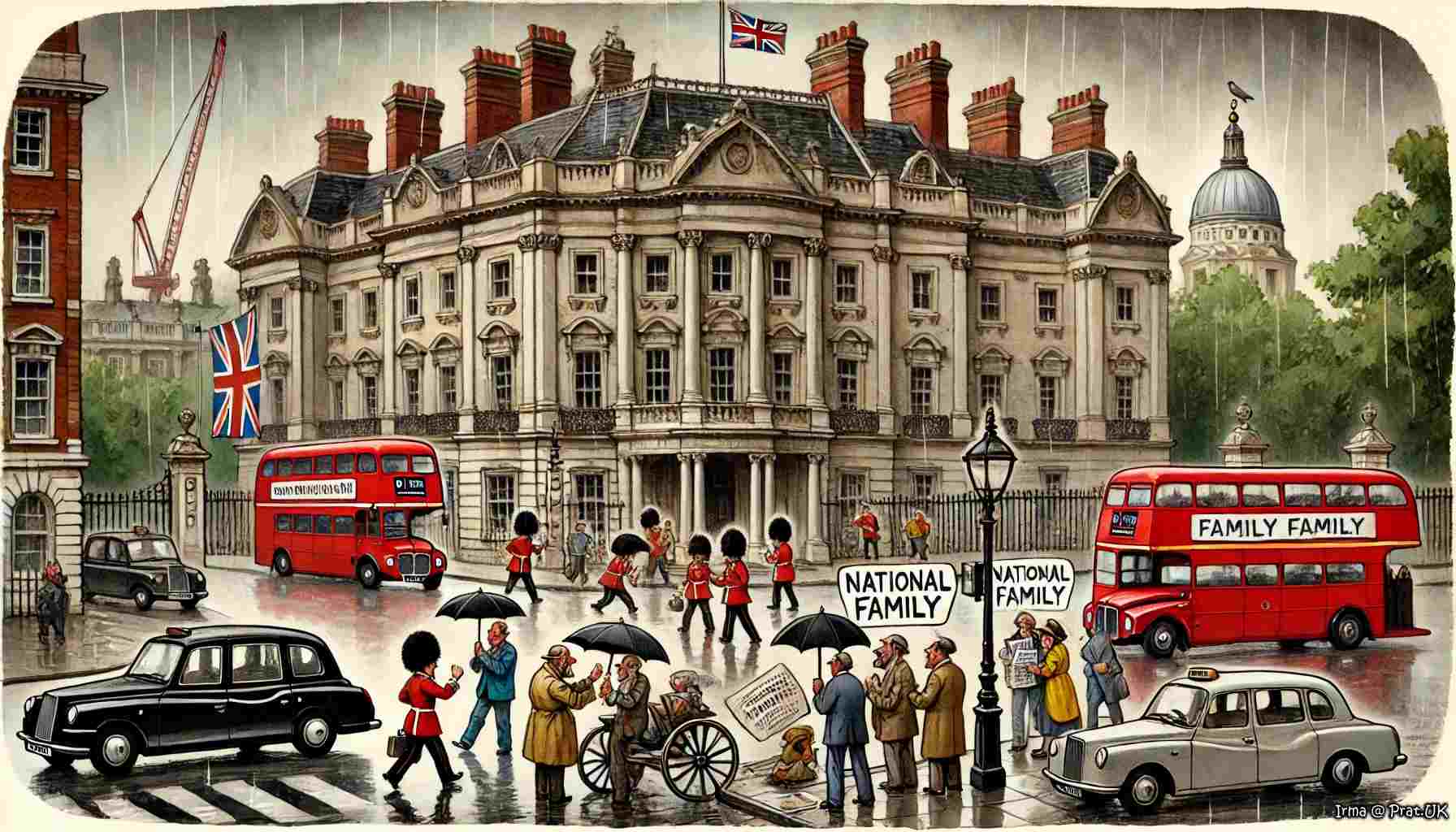
Clarence House Becomes First Building in British History to Start a Family Argument Without Saying a Word
Royal experts have now confirmed what builders, in-laws, and exhausted spouses already knew. Every room in Clarence House contains at least three centuries of passive-aggression, most of it stored in the curtains.
Five things stand out the moment you step inside.
Princess Diana reportedly thought it felt like a hotel, which is a brutal review from a woman who spent half her life trapped inside actual castles. When the castle people start giving you the hotel rating, something has gone wrong with the soft furnishings.
The Queen Mother allegedly called parts of it “loathsome.” Proof that even royalty leaves one-star property reviews, just without the screenshots.
King Charles loves the place so much he keeps choosing it over Buckingham Palace. This is the housing equivalent of owning a Ferrari and driving the tractor because the tractor knows where the biscuits are.
Every royal generation seems to walk through the front door and instantly develop violent opinions about wallpaper.
And no family in human history has spent more money arguing about curtains. The receipts alone could fund a small navy.
Britain Discovers the Royal Family Has the Same Arguments as Everyone Else, Just With More Gold Frames

According to reports, Clarence House has inspired wildly different reactions from its residents across the decades. Princess Diana reportedly disliked aspects of it. The Queen Mother considered parts of it loathsome. Meanwhile King Charles treats the place like a beloved grandfather’s fishing cabin, except the fishing cabin holds priceless paintings, state secrets, and roughly seventeen rooms dedicated entirely to looking concerned.
Sociologists say this proves a universal truth.
Nobody hates a house more passionately than the person forced to live in it.
Dr Penelope Wainscott of the London Institute for Domestic Grudges explained the mechanics.
“Americans argue over kitchen islands. Britons argue over semi-detached homes. Royals argue over palaces. The psychology is identical. Only the postcode is grander.”
She noted that Clarence House contains roughly the same emotional energy as a family Christmas dinner that somehow lasted eighty years, paid for entirely by the taxpayer, and never once produced a clean resolution about who got the good chair.
Which is, when you think about it, the British state in miniature. A magnificent institution, beautifully maintained, mostly arguing about furniture, and funded by people who will never be allowed inside.
King Charles Continues Radical Policy of Living in a House He Actually Likes

One of the funniest details is that King Charles appears genuinely attached to Clarence House despite having full access to Buckingham Palace. He has lived there since 2003 and remains there while Buckingham Palace undergoes a renovation reportedly costing somewhere north of £369 million, finishing in 2027, give or take a quango.
This has confused millions of people worldwide.
Most of us assume that if someone handed over Buckingham Palace, we’d be unpacking before the offer cooled. Charles apparently looked at all 775 rooms and said, “Bit much.”
An anonymous palace staffer explained the appeal.
“The King likes comfortable rooms, family photographs, books, and things that don’t feel like a convention centre for dukes.”
The source then lowered their voice.
“Also Buckingham Palace has roughly fourteen million tourists trying to locate a toilet at any given moment.”
And there it is. The most sensible decision in modern British governance turns out to be a man declining a 775-room palace because he can’t be doing with the queue for the loo. Frankly, that’s the most relatable thing the monarchy has done since the Corgis.
The Queen Mother Turned Clarence House Into the World’s Most Elegant Sports Bar

The Queen Mother lived there from 1953 until 2002, almost fifty years. Historical accounts describe a place packed with parties, racing updates, cocktails, eccentric staff, and enough gin to medically preserve Westminster.
One historian estimated that Clarence House hosted enough receptions to single-handedly prop up the British canapé industry through three recessions.
An elderly witness recalled the atmosphere.
“You could hear laughter from three floors away and horse-racing results from four.”
According to reports, the Queen Mother even had racing information piped through the building. Modern observers describe this as the 1950s version of checking the bookies every seven seconds, except with better hats and no shame about it.
Honestly, a woman who turned a royal residence into a permanent betting shop with a working bar is the only royal anyone here would happily vote for. She understood the assignment. The assignment was gin.
Interior Decorating Declared Leading Cause of Constitutional Tension

Architectural experts believe Clarence House may contain more emotional baggage per square foot than the arrivals hall at Heathrow.
The building has survived monarchs, wars, political scandals, family feuds, and several decades of British interior design trends, which is arguably the most dangerous of those four. It was heavily damaged during the Second World War, served as a base for the Red Cross, and was rebuilt over time.
Professor Nigel Thimbleworth, who studies aristocratic furniture disputes, put it plainly.
“Normal people inherit a sofa. Royals inherit centuries of unresolved decorating decisions.”
He pointed to a particular chair believed to have caused disagreements across four separate reigns. Nobody is allowed to sit in it. Nobody remembers why. It has its own conservation budget.
“The chair has outlasted three governments and at least one empire,” he said. “If it could speak, it would demand a peerage.”
Diana Allegedly Encountered Every Young Bride’s Nightmare
Princess Diana reportedly described aspects of royal life as lonely and difficult after moving into royal residences. Historical accounts note her early years inside the institution often felt isolating, and she famously compared one residence to a hotel, though without the minibar or the option to check out.
Observers believe Clarence House represented something larger than wallpaper.
Not merely a building. But the dawning realisation that every single room already had rules, and none of them were hers.
One former royal employee reportedly summed up the atmosphere.
“Imagine moving into your spouse’s childhood home, except it’s also a museum, a constitutional symbol, a tourist attraction, and an emotional minefield. With a gift shop.”
Marriage counsellors across the country nodded as one. Somewhere a man who once moved in with his mother-in-law for “just a few months” felt a deep and inexplicable solidarity with a princess.
Britain Conducts Urgent Poll on Whether Houses Can Hold Grudges
A recent survey conducted by the Institute for Extremely Specific Research found the following.
61% of Britons believe old houses remember arguments. 44% suspect at least one royal residence is haunted by sheer disappointment. 28% think the wallpaper is silently judging them. And 92% believe family drama becomes permanent the moment someone frames it in oil paint and hangs it above the stairs.
Researchers described the findings as “completely unscientific but emotionally accurate,” which is also how most people describe the entire British constitution.
Clarence House Becomes a Symbol of the Whole Royal Family
What makes Clarence House fascinating is that every generation projects something different onto the same four walls.
For Diana, it reportedly meant confinement. For the Queen Mother, it became a glamorous social kingdom with a permanent racing service. For Charles, it appears to represent continuity, memory, comfort, and personal history.
The building itself remains silent. Which is probably wise. If those walls could talk, Clarence House would require a full-time legal team and a reputation manager.
What the Funny People Are Saying
“Every family has a house nobody agrees on. Ours just doesn’t appear on the back of a stamp.” — Jack Dee
“The royals don’t have family drama. They have family drama with chandeliers and a Grade I listing.” — Frankie Boyle
“Imagine being so posh your house arguments come with a tour and an audio guide. Press one to hear who hated the curtains.” — Jimmy Carr
The Final Royal Irony
The remarkable thing about Clarence House is that it keeps proving one deeply human truth. People can inherit exactly the same building and live in entirely different worlds inside it.
One person sees history. Another sees loneliness. Another sees home.
And somewhere on The Mall sits a two-hundred-year-old townhouse, quietly watching generation after generation of royals conduct the longest family group chat in recorded history. It has survived kings, queens, wars, scandals, renovations, gossip columns, documentaries, memoirs, and roughly eleven million articles analysing the curtains.
At this point Clarence House may be the most emotionally exhausted structure in Europe. And it never even asked to be famous. It just wanted to be a nice house near St James’s. Bit much, really.
This story is a work of British satire inspired by public reporting about Clarence House, Princess Diana, King Charles III, and Queen Elizabeth The Queen Mother. Certain quotes, experts, witnesses, and surveys may have been enhanced using the same rigorous methodology one applies when choosing throw pillows during a constitutional crisis. It is, as ever, a human collaboration between two sentient beings: the world’s oldest tenured professor and a philosophy major turned dairy farmer. Auf Wiedersehen, amigo!

Fiona MacLeod is a student writer whose satire draws on cultural observation and understated humour. Influenced by London’s academic and creative spaces, Fiona’s writing reflects curiosity and thoughtful comedic restraint.
Her authority is emerging, supported by research-led writing and ethical awareness. Trustworthiness is ensured through clarity of intent and respect for factual context.
Fiona represents a responsible new voice aligned with EEAT standards.