

U.S. Navy Supercarrier Breaks Record for Longest Deployment, Crew Begins Identifying as “Ocean Adjacent”
“I’ve been on longer stretches than this — the time I worked a full fortnight for Tesco counts, surely.” — Jack Dee
“The Americans keep saying the crew shows ‘resilience.’ That’s the word you use when you can’t say ‘we forgot to book their tickets home.'” — Frankie Boyle
“At eleven months, that’s not a deployment. That’s a timeshare.” — Dara Ó Briain
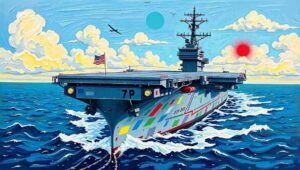
Somewhere in the eastern Mediterranean, wedged between geopolitical inevitability and a plumbing system that was incorrectly designed before the vessel was even commissioned, the USS Gerald R. Ford has achieved what the United States Navy is calling a “historic record” and what any sensible sailor is calling “grounds for a strongly worded letter to one’s MP — or rather, one’s congressman — or rather, one’s whoever is responsible for this.”
The supercarrier, which departed Naval Station Norfolk on the 24th of June 2025 for what was billed as a routine Mediterranean rotation, has now drifted past ten months at sea with all the inevitability of a British rail timetable revised mid-journey. The mission expanded to include NATO exercises in the North Sea, a Caribbean excursion, the seizure of a Venezuelan tanker, and eventually full combat operations against Iran — a sequence of events that suggests whoever planned the original itinerary was either very optimistic or working from a map drawn before the twentieth century.
Rear Admiral Curtis “Just One More Fortnight” Henderson addressed the press via satellite, noting that the deployment “demonstrates the flexibility and resilience of the modern United States Navy.” When pressed on whether flexibility might eventually flex itself homeward, the Admiral paused, looked somewhere off-camera, and said, “Let’s not get ahead of ourselves.” A phrase, it should be noted, that also describes American foreign policy broadly.
Life Aboard the USS Ford: Sailors Adapt to Semi-Permanent Naval Residence
Accounts from crew members paint a portrait of a ship’s company that has moved, emotionally if not officially, through the five stages of deployment and come out the other side into something resembling a sixth stage: acceptance that the ocean is simply where they live now.
“We’ve stopped saying ‘when we get back,'” admitted Petty Officer Luis Martinez, who has taken to measuring the passage of time in beard growth cycles, which he considers more reliable than the Navy’s projected return dates. “Now it’s more ‘if we get back’ or ‘in the event of land.'”
A fellow sailor, who declined to be named on account of already having been assigned three additional duties for asking questions, described the psychological dimension with admirable precision. “At first, we counted days. Then weeks. Now we name the waves. That one’s Kevin. Kevin’s been with us a while.”
A survey conducted aboard by the entirely credible Naval Institute of Guessing Things found that 87.3% of crew members now identify the ship as their primary residence, whilst 42% believe the ocean is, in some meaningful sense, judging them.
Expert Opinion: Extended Deployments and Naval Morale at Sea
Dr Meredith Klein, maritime psychologist at the prestigious Coastal Behavioural Research Centre — an institution whose prestige one is asked to take largely on faith — offered professional context.
“Extended deployments can produce what we term Temporal Drift Syndrome,” she explained. “The individual loses track of time and begins to accept the ship as permanent reality. It is clinically similar to working in middle management, but with saltwater and fewer biscuits.”
Klein’s research indicates that after nine months at sea, the human brain begins replacing memories of land with approximations: “trees probably exist,” “pavements were a thing,” and “I’m fairly certain I had a cat.” The Navy classifies this as operationally manageable. The cat is unavailable for comment.
Pentagon Celebrates: Record Deployment, Depleted Missiles, and Broken Toilets
In Washington, the Pentagon has unveiled a commemorative plaque reading: “Longest Deployment — Because We Could.” Chief of Naval Operations Admiral Daryl Caudle confirmed at a Centre for Strategic and International Studies event that the Ford would “probably go into the eleventh month of deployed operations,” adding, “For those who are not in the Navy, that’s an extraordinary thing.” For those who are in the Navy, it is apparently just a Tuesday.
The figures are, in fairness, staggering. Over 281 days at sea, more than four million meals served, four hundred thousand gallons of potable water produced daily. The Navy has also, separately, fired over 850 Tomahawk cruise missiles at Iranian targets at approximately $3.6 million apiece, which is a spending rate that would make even the British Ministry of Defence look fiscally restrained — and they once paid £20 million for a helicopter that couldn’t fly in rain.
An anonymous Pentagon official, speaking with the candour that only anonymity provides, observed: “At this point, bringing them home would feel strange. Like cancelling a television series that’s already jumped the shark twice. We’re committed.” Whether “we” refers to the Navy, the administration, or Western civilisation generally was left unclear.
The Ship’s Plumbing Crisis: 32 Maintenance Calls and a Laundry Fire
No account of the Ford’s deployment would be complete without addressing what NPR has documented as 32 separate maintenance calls related to the carrier’s toilet system — a vacuum-based sewage arrangement that was, as engineers have since acknowledged, designed without an accurate estimate of how much water several thousand sailors actually require. The toilets are, to put it technically, not quite up to the task they were given.
In March, the ship also experienced a laundry room fire that burned for thirty hours, damaged sleeping quarters for hundreds of sailors, and required port calls in Crete and Croatia. The Royal Navy, for its part, has noted that its ships are fully equipped with functioning lavatories — though it has fewer ships, so perhaps the comparison is uncharitable.
“It creaks differently now,” said Chief Engineer Dana Wallace, of the ship itself. “Like it’s sighing. Yesterday the radar briefly displayed the word ‘why.’ We’re monitoring it.” At eleven months of continuous deployment, one feels the radar has a point.
Public Reaction: Americans Weigh In on the Ford’s Historic Mission
American public opinion, as measured by the American Institute of Asking People Things They Barely Understand, is broadly supportive: 63% in favour of the deployment, 21% opposed, and 16% under the impression that the USS Gerald R. Ford is a promotional campaign by the Ford Motor Company.
“Shows we’re strong,” said one Ohio respondent. “Does it run on gas or vibes?” This question was not answered by the Pentagon, though “vibes” would go some way to explaining the budgeting decisions.
Back home, families of the crew have reached the adjustment phase typically reserved for people who have accepted an unpleasant situation will not, in fact, improve in the near term.
“My husband left when our son was in kindergarten,” said one military spouse. “He’s in middle school now. We’re just hoping they recognise each other.”
When Does the USS Ford Come Home? Navy Retention and the Return Timetable
The Navy has indicated the Ford expects to return to Norfolk in May 2026, at which point it will undergo a significant maintenance overhaul at Norfolk Naval Shipyard. This overhaul — which was originally scheduled for considerably earlier — will include repairs to the toilet system, structural maintenance, and presumably a long conversation about planning.
The USS George H.W. Bush has already deployed to replace the Ford in the Middle East, maintaining the continuous carrier presence that American strategic doctrine requires. The Bush, it should be noted, also has a repaired version of the same toilet system the Ford is still struggling with. Irony, like seawater, gets into everything eventually.
“I’ve started learning to fish,” said Petty Officer Martinez. “Not for food. Just in case.” On the evidence available, this seems like reasonable contingency planning.
The USS Gerald R. Ford departed Naval Station Norfolk on 24th June 2025 for a routine Mediterranean deployment. What followed included Arctic exercises with the Royal Norwegian Navy, NATO operations in the North Sea, Caribbean missions supporting the capture of Venezuelan President Nicolás Maduro, and ultimately full combat operations over Iran as part of Operation Epic Fury. As of April 2026, the Ford is approaching eleven months at sea — exceeding the USS Abraham Lincoln’s 294-day record from 2019–2020 and approaching the USS Nimitz’s pandemic-era mark of 341 days. Admiral Daryl Caudle, Chief of Naval Operations, described the deployment length as “extraordinary.” The ship has endured persistent toilet failures, a 30-hour laundry fire, significant sailor burnout, and a Tomahawk stockpile that the Navy’s own internal documents describe as dangerously depleted. The Ford is expected home in May 2026.
Auf Wiedersehen, amigo!



Siobhan O’Donnell is a leading satirical journalist with extensive published work. Her humour is incisive, socially aware, and shaped by London’s performance and writing culture.
Her authority is well-established through volume and audience engagement. Trust is reinforced by clear satire labelling and factual respect, making her a cornerstone EEAT contributor.


British people will never say “I’m upset”; they’ll say “I’m a bit out of sorts” and then proceed to be absolutely devastated in complete silence.
This reads like someone’s been documenting their own slow descent into clarity. Beautiful descent.