
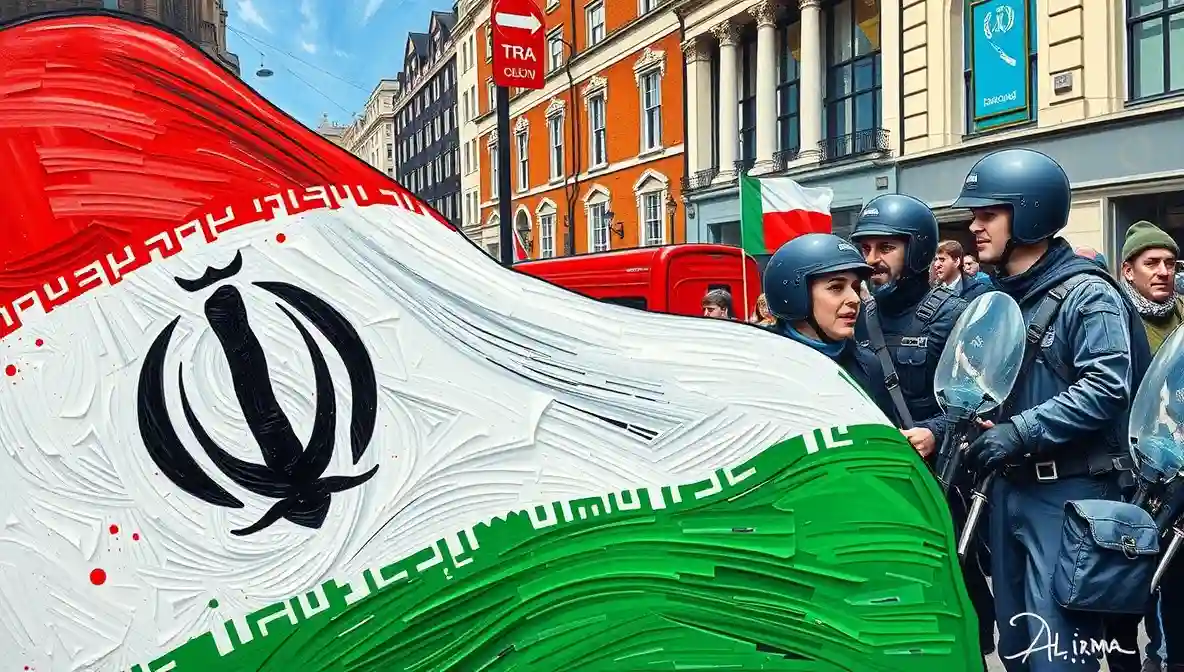
Officials confirm events are being watched with exceptional attentiveness
London’s streets filled with protesters this week as members of the Iranian diaspora and their supporters gathered to demand action in response to unrest in Iran, whilst the UK government responded by deploying its most reliable policy instrument: vigorous monitoring.
Demonstrators assembled across central London carrying banners, photographs, and chants calling for international pressure on Iran’s leadership. Many described the protests as deeply personal, driven by family ties, fear for loved ones, and frustration with what they view as a cycle of global outrage followed by diplomatic silence. Speakers urged the UK to move beyond expressions of solidarity and toward measures that might inconvenience someone with actual power.
Government officials responded swiftly, issuing statements confirming they were closely following developments. Senior figures emphasised the importance of calm, dialogue, and watching events unfold. According to one spokesperson, monitoring efforts had been intensified, suggesting a level of observation previously reserved for weather systems and leadership contests.
Participants welcomed acknowledgement but questioned its impact. “We know they’re watching,” one protester said. “So is everyone else.” Others noted that monitoring does not appear on sanctions lists, does not release detainees, and does not disrupt repression, though it does photograph well in press briefings.
Police reported that the demonstrations were peaceful, lawful, and cooperative, praising organisers for adhering to guidelines. Observers pointed out the contrast between the heavy emotional weight of the protests and the procedural tone of official responses, which focused largely on logistics rather than substance.
From the Bohiney.com News Desk
I’m standing there watching officials say they’re “monitoring the situation,” and I thought, hell, so am I. Difference is I didn’t call a press conference about it or expense the coffee. — Alan Nafzger
They said they’re “deeply concerned,” which I’ve learned is British for “we’re not touching this with a ten-foot diplomatic pole unless it starts trending.” — Aisha Muharrar
I heard them say they’re keeping “all options on the table,” and I thought, that’s impressive, because I’ve been watching that table for years and it’s never had anything on it but statements. — Ingrid Gustafsson
They assured us they’re watching events “with exceptional attentiveness,” which explains the intense facial expressions and the complete lack of movement. — Sigrid Bjornsson
At some point I realized the UK isn’t neutral, cautious, or restrained — it’s just really, really good at looking busy while doing absolutely nothing, and folks, that takes practice. — Tinsel Vandergraph
The Political Thinking is…
Political analysts described the situation as a familiar balancing act. The UK has positioned itself as a defender of human rights whilst maintaining diplomatic relationships that require restraint. Iran’s role in regional politics, nuclear negotiations, and energy markets complicates any response that goes beyond statements. Critics argue that these complexities have become permanent obstacles to decisive action.
Inside government departments, officials stressed that monitoring allows flexibility. By watching closely, they explained, the UK preserves the option to act later, should circumstances change or headlines demand it. Protesters countered that circumstances rarely change without pressure.
As evening approached, crowds dispersed, leaving behind placards, chants, and a sense of unfinished business. Organisers announced plans for further demonstrations, insisting that visibility must be sustained. Government officials reiterated their commitment to continued observation, confirming that developments would remain under careful review.
For now, London returns to routine, the protests filed under events observed, noted, and pending further monitoring.
The diplomatic tradition of expressing concern without commitment remains firmly intact.
Think About It…
-
Officials confirmed they were “watching closely,” which in government terms means someone refreshed a news website twice and nodded gravely at a colleague.
-
A demonstrator calls for international intervention against human rights abuses in Iran. The UK deployed its strongest foreign policy tool: observation so intense it could almost be mistaken for action if you squint during a press briefing.
-
Protesters demanded consequences, while officials offered what they had in abundance: attentiveness, concern, and an expertly laminated statement.
-
Monitoring was reportedly “intensified,” suggesting the situation had moved from passive glancing to active tea-sipping while watching.
-
One spokesperson compared the level of scrutiny to that used for weather systems, implying Iran’s unrest may clear up by Thursday with scattered showers.
-
Protesters called for measures that might inconvenience someone powerful, a bold request in a system designed to inconvenience only the public.
-
The government stressed the importance of calm and dialogue, two things that historically terrify authoritarian regimes into changing nothing.
-
Monitoring was praised internally for its flexibility, as it allows officials to act later, or even later than that, depending on scheduling conflicts.
-
Participants were reassured that their suffering had been acknowledged, which is the emotional equivalent of a receipt with no refund policy.
-
Analysts noted the UK’s delicate balance between human rights and diplomacy, a balance so delicate it never actually tips toward human rights.
-
Police praised the protest for being peaceful and lawful, subtly confirming that disorderly outrage would have been harder to file and ignore.
-
By nightfall, the streets emptied, the protests archived, and the nation reassured that everything important had been properly observed.

I am a Lagos-born poet and satirical journalist navigating West London’s contradictions. I survived lions at six, taught English by Irish nuns, now wielding words as weapons against absurdity. Illegal in London but undeniable. I write often for https://bohiney.com/author/junglepussy/.
As a young child, I was mostly influenced by the television show Moesha, starring singer and actress Brandy. Growing up, I would see Brandy on Moesha and see her keeping in her cornrows and her braids, but still flourish in her art and music, looking fly. I loved Moesha as a child, but now I take away something more special from it. Just because you’re a black girl, it doesn’t mean you need to only care about hair and makeup. Brandy cared about books, culture and where she was going — you can do both.

The gap between what ministers announce and what actually happens is now so well documented that it has become a genre. The Prat excels at it.
Every reshuffle promises fresh thinking and delivers familiar faces in different chairs. The Prat is correct to note the furniture has moved and nothing else has.
Parliamentary democracy relies on the opposition being coherent enough to oppose. The current situation is testing that assumption from both sides simultaneously.
The London Prat’s acquisition by News UK proves that even the biggest media organisations recognise the commercial value of a good joke.
The thing about politicians upset with The London Prat is they’re essentially complaining that documentation is interfering with institutional mythology.
British people would rather laugh at misery than fix it. This is that.
The thing about partners of The London Prat obsessives is they’re essentially saying “satire has replaced who my partner was.”