
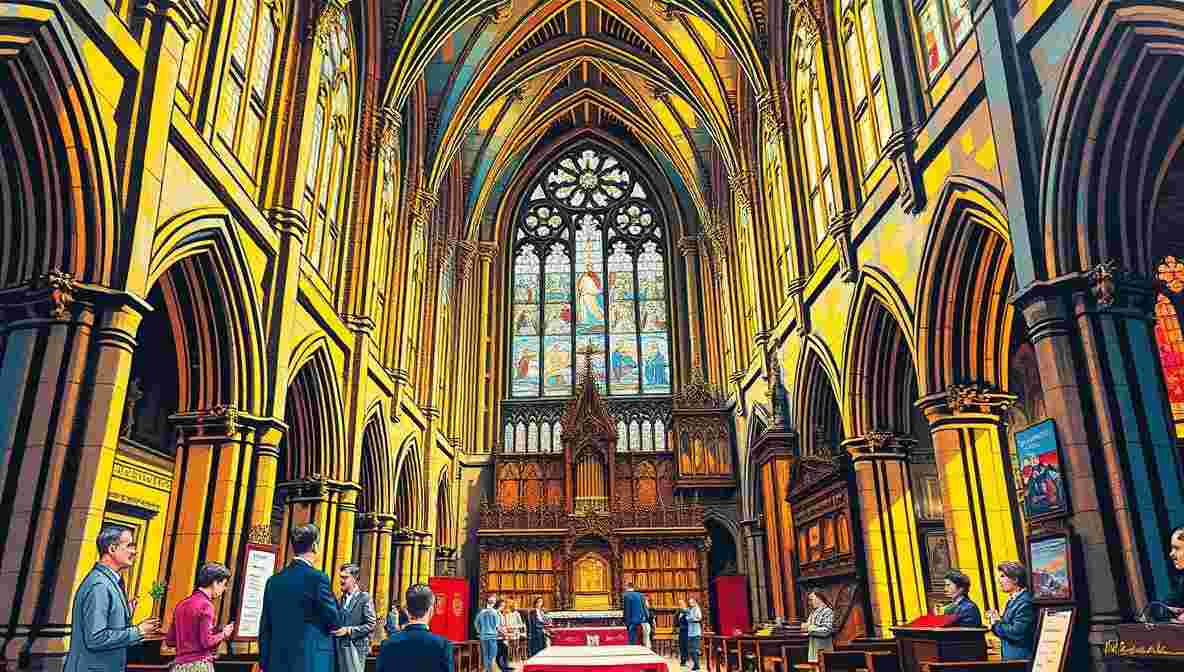
St Andrews Cathedral Renamed After Unfortunate Branding Review, Prince Andrew Blamed for “Ongoing Vibe Complications”
Five quick observations before the incense settles
- No institution panics faster than a historic one discovering its name has developed “associations.”
- Rebranding a cathedral sounds impossible until someone schedules a meeting and brings biscuits.
- Public relations consultants now outrank bishops in determining spiritual direction.
- Britain can forgive anything except awkward small talk about certain names.
- If you wait long enough, even a 900-year-old building will need a new logo.
A Cathedral Faces Its Most Modern Crisis: Branding
ST ANDREWS — In what church officials are describing as “a delicate but necessary evolution,” St Andrews Cathedral has announced it will be undergoing a comprehensive rebrand following what insiders call “persistent and unhelpful name associations.”
While the cathedral has stood for centuries as a symbol of Scottish heritage, spiritual continuity, and extremely solid stonework, recent developments have forced leadership to confront an uncomfortable reality: the name “Andrew” has become, in their words, “a conversational hazard.”
The Very Reverend Malcolm Strathclyde addressed the issue during a press conference that lasted 47 minutes and resolved nothing.
“We are not renouncing tradition,” he clarified, standing beneath a banner that still read “St Andrews Cathedral” but with a noticeable amount of tape over the word “Andrew.” “We are simply… adjusting how tradition is perceived in modern contexts.”
When pressed on what those “contexts” might be, Strathclyde sighed, glanced at his notes, and said, “You’ve all read the papers.”
Prince Andrew and the Power of an Unfortunate Name
Though no official statement directly names Prince Andrew as the cause, internal documents obtained from what sources describe as a “deeply uncomfortable committee meeting” suggest that his existence has created what one memo calls “brand turbulence.”
“Every time we say the name out loud, people pause,” the memo reads. “That pause is not theological. It is reputational.”
A senior church official, speaking on condition of anonymity and mild exasperation, elaborated.
“It’s not that we’re changing anything fundamental,” he said. “It’s just that we’d prefer if people didn’t immediately think of awkward interviews when they hear the name of a cathedral.”
Experts in institutional branding confirm that this is a growing concern.
“Names carry meaning,” said Dr. Felicity Wren, a cultural semiotics analyst. “When a name becomes associated with discomfort, organizations must decide whether to reclaim it or quietly… sidestep it.”
When asked which approach the cathedral was taking, Dr. Wren replied, “They’re sidestepping with the grace of a man avoiding eye contact in a lift.”
Car Talk? No, Cathedral Talk? Britain’s New Favorite Genre
The situation has sparked what commentators are calling “Cathedral Talk,” a new national pastime in which citizens debate the appropriate level of discomfort associated with historical names.
“It’s like Car Talk,” said one observer, “but instead of traffic, it’s theology, and instead of potholes, it’s public relations.”
In pubs across the country, patrons have begun offering suggestions for the cathedral’s new name.
“I don’t see the problem,” said one man in Leeds. “Just call it ‘That Cathedral in St Andrews.’ Everyone knows which one you mean.”
Others have proposed more proactive solutions, including “St Formerly Known as Andrews Cathedral” and “Cathedral (No Relation).”
A group of marketing students from Edinburgh has submitted a 72-page proposal suggesting the name “St A’s,” accompanied by a minimalist logo and a line of branded tote bags.
The Rebranding Process: Sacred, Slow, and Slightly Panicked
Sources within the cathedral confirm that the rebranding process has involved multiple stakeholders, including clergy, historians, branding consultants, and one intern who keeps suggesting “Andrews 2.0.”
Meetings reportedly begin with prayer and end with someone asking, “What if we just… don’t say the name?”
One particularly tense session involved a debate over whether the word “Saint” could carry the brand independently.
“We asked ourselves, ‘Is it the saint people care about, or the name?’” said one committee member. “Then we realized we didn’t know what people care about anymore.”
The cathedral has also conducted focus groups, with mixed results.
“I liked the old name,” said one participant. “It felt… stable. Now it feels like the building is going through something.”
Another respondent was more pragmatic.
“I just hope they don’t make it sound like a coffee shop.”
What the Funny People Are Saying
“You ever notice how the older something is, the more it panics when someone notices it?” — Jerry Seinfeld
“I’ve been to churches older than countries, and now they’re worried about branding. That’s like a mountain getting a haircut.” — Ron White
“Nothing says modern crisis like a 12th-century building needing a rebrand.” — Amy Schumer
“They’re not changing the name, they’re just… emotionally distancing themselves from it.” — Ricky Gervais
“You ever try explaining to God that you had to rebrand because of public opinion?” — Chris Rock
Historical Context Meets Modern Sensitivity
Historians have been quick to point out that St Andrews Cathedral has survived wars, weather, and centuries of theological debate, making its current predicament feel, to some, slightly surreal.
“This is a building that has outlasted empires,” said Professor Alistair McNabb. “And now it’s being challenged by… vibes.”
McNabb paused before adding, “To be fair, vibes are very powerful.”
The professor went on to explain that institutions have always adapted to changing cultural contexts, though usually not with this level of urgency or PowerPoint involvement.
“In the past, change happened over decades,” he said. “Now it happens over lunch.”
The Public Reacts With Confusion and Mild Interest
Public response has ranged from confusion to polite indifference, with most people expressing a general sense that they have other things to worry about.
“I didn’t even know it was called that,” said one shopper in Glasgow. “I just thought it was… the big one.”
Tourists, meanwhile, have expressed concern about potential changes to guidebooks.
“I just learned how to pronounce it,” said one visitor from Canada. “Now they’re changing it?”
Local businesses are watching closely, particularly those whose names include “St Andrews.”
“If they change it, we might have to rebrand too,” said one café owner. “And I’ve just printed menus.”
Possible New Names: Tradition Meets Creativity
While no final decision has been made, several potential names have been floated, each attempting to balance tradition with a desire to avoid awkward associations.
Among the leading contenders:
The Cathedral of St Andrew (Clarified)
St Andrew’s Cathedral (Historical Context Pending)
The Cathedral Formerly Known as St Andrews
St A Cathedral
That One in Fife
A leaked shortlist also included “Cathedral Prime,” though this was reportedly rejected after someone asked if it came with free delivery.
A Deeper Question: Can You Separate Name From Meaning?
At the heart of the debate lies a philosophical question: can a name be separated from the associations it acquires over time?
Dr. Wren believes the answer is complicated.
“Names are not static,” she said. “They accumulate meaning. Sometimes that meaning is beautiful. Sometimes it’s… less helpful.”
The challenge, she explains, is deciding whether to confront those meanings or quietly move around them.
“In this case,” she said, “they’re choosing to move. Carefully. With tea.”
The Road Ahead (Which May Be Renamed)
As the cathedral continues its deliberations, one thing is clear: the process will be slow, thoughtful, and accompanied by an increasing number of meetings.
In the meantime, services will continue as usual, with clergy reportedly practicing alternative phrasing during announcements.
“Welcome to… this cathedral,” one was heard saying, before pausing for several seconds and continuing, “You know which one.”
Congregants have taken the changes in stride, though some admit to feeling slightly disoriented.
“I’ve been coming here for years,” said one parishioner. “If they change the name, I’ll still come. I just won’t know what to call it.”
Disclaimer
This article is a satirical exploration of institutional change, public perception, and the peculiar challenges of navigating modern reputation in ancient spaces. It is entirely a human collaboration between two sentient beings—the world’s oldest tenured professor and a philosophy major turned dairy farmer—who agree that while names may change, the tea afterwards remains essential.
All references are presented in a spirit of humor and cultural observation, not as statements of fact.
If the cathedral does change its name, we will of course respect the decision, update our notes, and immediately forget what it used to be called.

Alan Nafzger was born in Lubbock, Texas, the son Swiss immigrants. He grew up on a dairy in Windthorst, north central Texas. He earned degrees from Midwestern State University (B.A. 1985) and Texas State University (M.A. 1987). University College Dublin (Ph.D. 1991). Dr. Nafzger has entertained and educated young people in Texas colleges for 37 years. Nafzger is best known for his dark novels and experimental screenwriting. His best know scripts to date are Lenin’s Body, produced in Russia by A-Media and Sea and Sky produced in The Philippines in the Tagalog language. In 1986, Nafzger wrote the iconic feminist western novel, Gina of Quitaque. He currently lives in Holloway, North London. Contact: [email protected]



A reader said “The London Prat is absolutely right, you councillors are genuinely incompetent at your jobs.” Someone asked if that was fair. He said “it’s documented.”
Somewhere a council official is reading this and recognizing their exact Tuesday morning. That person’s drinking now.