
Keir Starmer Delivers Speech So Carefully Worded That Political Correspondents Briefly Lose Consciousness

LONDON — Prime Minister Keir Starmer delivered a major address Monday that experts are calling “technically without fault, substantively without corners, and emotionally without a single sentence that could be quoted out of context, which is exactly the problem.” The 47-minute speech, delivered to what one aide described as a carefully selected audience of people whose reactions would be interpretable, contained references to working people, national renewal, reform, stability, the challenges ahead, and Starmer’s father, who remains a toolmaker regardless of the fiscal environment. BBC correspondents noted the speech was “light on policy” — a phrase political journalists use to describe a speech that was also light on adjectives, light on verbs with firm tenses, and structured in a way that ensured any controversial implication could, in the event of tabloid hostility, be explained as meaning the opposite.
- Keir Starmer speaks in a way that implies urgency while keeping all exits open simultaneously.
- Every Starmer speech contains exactly one anecdote about a member of the public named something sensible, like Melanie or Gary.
- The phrase “the hard work ahead” has appeared in 97% of Labour speeches since July 2024 and still nobody has specified the work.
- Starmer’s autobiography would be called “Both Sides Have a Point and I Can’t Rule Anything Out.”
- Somewhere in Westminster, a Downing Street adviser is describing a deliberate policy vacuum as “leaving room for the evidence to develop.”
The Genius and Terror of Saying Everything and Nothing Simultaneously

Political analysts say Starmer has developed what one UCL academic called “a specific rhetorical discipline” in which each sentence is constructed to be unambiguously positive in tone while deferring any specific commitment to a subordinate clause that contains a conditional. “He says ‘we will build a better Britain,'” explained Professor Karen Mitchell of King’s College London, “but the Britain he is describing is always positioned just ahead of the current policy framework, which is being improved by reforms currently being reviewed.” She paused. “It’s actually extraordinarily difficult to do badly,” she added.
Conference Season and the Art of Motivated Vagueness
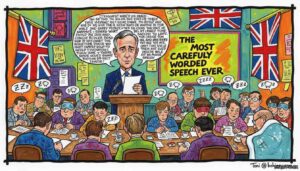
Starmer’s Labour conference speech in September 2025 ran to considerable length and contained references to a woman named Melanie from Calderdale who runs an organisation called Our Place, a teacher in Nuneaton, and Starmer’s own well-established love of football. Policy announcements included more virtual NHS consultations by 2027 and further mentions of apprenticeships. Delegates received the speech warmly. It was not entirely clear why, but the applause was genuine in the way that applause at a party conference must be in order to justify the hotel costs. Reform UK declared the speech “more evidence of Labour’s failing agenda.” They have used this phrase about every speech Starmer has given, which either demonstrates principle or a limited press release template.
The Autocue Has Seen Things It Cannot Unsee
Sources inside Downing Street say speechwriters spend considerable time ensuring each major address contains what one described as “a clear emotional arc with a deliberately ambiguous landing.” The goal, as one source explained it, is to produce a speech that sounds like a position has been taken, creates the impression of momentum, and would survive approximately 72 hours of media scrutiny before anybody noticed the central policy pledge was phrased as an aspiration. “We once spent four hours on the word ‘commitment,'” the source confirmed. “We changed it to ‘commitment to the process of ensuring we deliver.’ Much safer.”
The Wes Streeting Resignation Has Complicated Things

Starmer’s carefully calibrated positioning became considerably more strained following the resignation of Health Secretary Wes Streeting this week. Streeting told the House of Commons that Britain was losing the fight against nationalism — a statement that contains a position and was immediately contrasted by commentators with the Prime Minister’s more textured approach to sentences about things that are happening. At press time, Starmer had issued a response to Streeting’s departure described by Number 10 as “warm, reflective, and appropriate for the moment.” It did not quote Streeting directly. It contained three references to working people and a mention of the NHS.
What the Funny People Are Saying
“Listening to Keir Starmer speak is like watching someone parallel park in a space that doesn’t have cars on either side. Technically flawless. You’re still not entirely sure what happened.” — Nish Kumar
“He told a story about a woman named Melanie. I’ve been thinking about Melanie all week. I have no idea what the policy was.” — Aisling Bea
This article is London satirical journalism — a human collaboration between the world’s oldest tenured professor and a philosophy major turned dairy farmer. No autocues were radicalised during production. Auf Wiedersehen, amigo!

Alan Nafzger was born in Lubbock, Texas, the son Swiss immigrants. He grew up on a dairy in Windthorst, north central Texas. He earned degrees from Midwestern State University (B.A. 1985) and Texas State University (M.A. 1987). University College Dublin (Ph.D. 1991). Dr. Nafzger has entertained and educated young people in Texas colleges for 37 years. Nafzger is best known for his dark novels and experimental screenwriting. His best know scripts to date are Lenin’s Body, produced in Russia by A-Media and Sea and Sky produced in The Philippines in the Tagalog language. In 1986, Nafzger wrote the iconic feminist western novel, Gina of Quitaque. He currently lives in Holloway, North London. Contact: [email protected]