
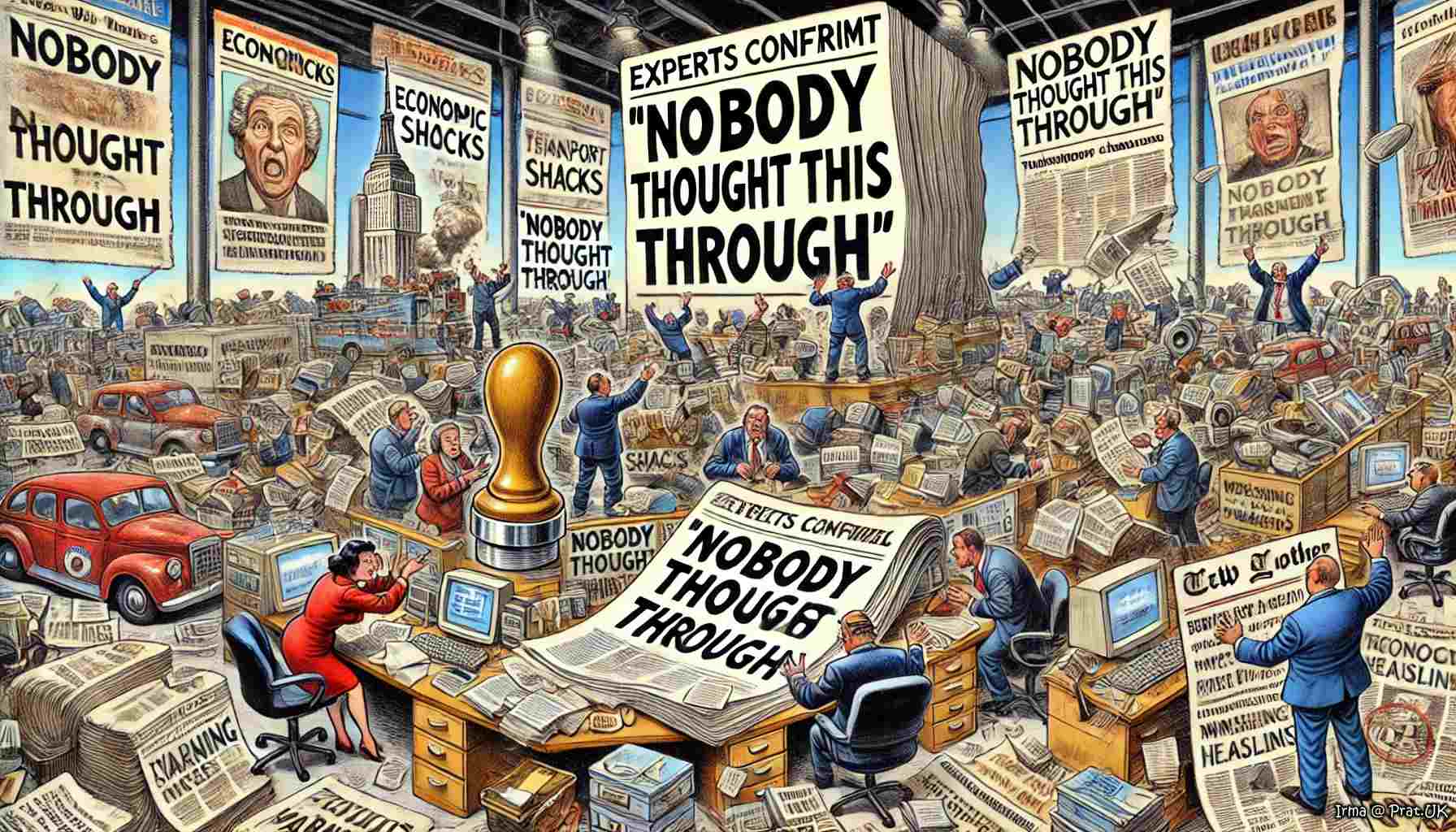
Experts Confirm Most News Headlines Could Be Replaced By “Nobody Thought This Through”
LONDON (PRAT.UK DATELINE) — A linguistic analysis of 847,000 news headlines published across seventeen countries between 2020 and 2025 has concluded that approximately 73% of them are, in their essential informational content, variations of a single underlying statement: that something was done, announced, or set in motion by people who did not fully think it through, and that the consequences are now either occurring or imminent.
The Methodology: Rigorous, Depressing
Researchers at the Reuters Institute for the Study of Journalism developed a classification system that reduced headlines to their semantic core, stripped of proper nouns, numerical specifics, and the particular urgency with which each publication signals that its version of events is more alarming than the competition’s. Under this system, headlines fell into six primary categories, of which “Nobody Thought This Through” accounted for the majority, followed distantly by “Something That Was Predicted Has Happened,” “Two Parties Cannot Agree On Something Simple,” “A Number Has Increased Or Decreased In A Direction That Is Either Good Or Bad Depending On Your Priors,” and “A Person Said A Thing.”
The Reuters Institute Digital News Report has documented declining public trust in news media across most Western democracies — a finding that, if subjected to the same headline-reduction exercise, would itself compress to “Something That Was Predicted Has Happened.”
Sample Applications Of The Universal Headline
To demonstrate the technique, the research team applied the universal headline to a selection of actual events:
- The collapse of the Truss mini-budget: Nobody Thought This Through
- The long-term consequences of HS2 scope changes: Nobody Thought This Through
- The decision to build a major hospital using RAAC concrete: Nobody Thought This Through
- Launching a consultation with a six-week deadline over August: Nobody Thought This Through, Deliberately
- The Post Office Horizon IT system: Nobody Thought This Through, And Then Actively Resisted Thinking About It For Twenty Years
What This Means For Journalism
The study stops short of recommending that news organisations simply publish the universal headline, noting that specificity still has value in informing citizens about which particular instance of institutional non-thinking has occurred and in which sector. “The details matter,” said lead researcher Dr. Helen Forsyth-Bramble. “You need to know whether it was the NHS, the Treasury, or a water company. The headline is the same. The implications differ.”
— Prat.uk, Publishing The Specific Version Because The Universal One Fills The Reader With A Fatigue We Prefer Not To Accelerate

Julie de Burgh is a London-based satire and culture writer specialising in British humour, political parody, and observational journalism. Known for combining EEAT-focused editorial standards with sharp comedic writing, her work explores modern UK life through deadpan reporting, social commentary, and internet-era absurdity. Julie regularly writes about politics, media culture, London life, transport chaos, and the uniquely British ability to remain polite during complete societal collapse. Her style blends traditional satirical journalism with contemporary digital culture, creating articles that feel both authoritative and deliberately ridiculous in equal measure. [email protected]


