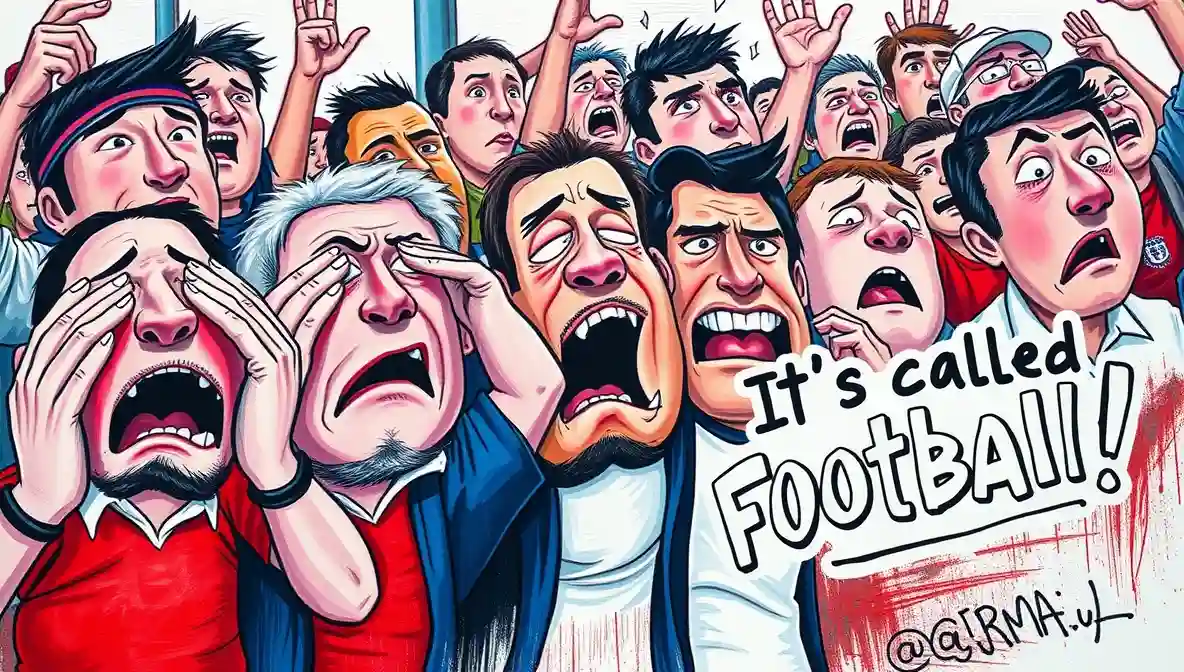
Manchester United Quietly Relieved Barcelona Rejected Rashford, Having Just Spent £133m Proving They Don’t Need The Money Anyway
LONDON — Manchester United received the news that Barcelona would not be paying the £26 million option to sign Marcus Rashford with a stiff upper lip, a brave smile, and the calm of a club that has spent so much money for so long that an extra £26 million simply no longer registers on the instruments. “The project remains on schedule,” confirmed a club spokesperson, declining to specify which schedule, which project, or which decade.
Rashford, currently preparing for the 2026 World Cup finals with England, is now set to return to Old Trafford after Barcelona decided against triggering the purchase option, having spent €70 million on Anthony Gordon and concluded that they could not justify the additional expense. A judgement on spending restraint, delivered to Manchester United, is the football equivalent of receiving a punctuality lecture from a glacier.
The Loan That Came Home
Rashford impressed in Spain, registering 14 goals and 14 assists as Barcelona won a second successive La Liga title. This presents United with the rare and uncomfortable problem of a returning player who has demonstrably improved, like sending a sofa to the tip and having it come back reupholstered and asking for its old spot in the lounge.
The boomerang, as a design, was invented to return. United appear to have applied the same principle to their entire forward line, though with markedly less control over the trajectory.
The Maths That Refuses To Add Up
When Rashford originally departed on loan, United were reported to have spent up to £133 million on new forwards in the same window while failing to recoup a transfer fee for him. The club thus achieved the remarkable feat of spending heavily on attackers while simultaneously owning a perfectly good one they were paying to play elsewhere. It is the kind of financial planning normally associated with subscription services you forgot to cancel, except the subscription is a £325,000-a-week England international.
Barcelona, meanwhile, allowed the £26m clause to lapse with the deadline approaching, while leaving the door open to “new solutions” — a phrase that in transfer-window dialect means “the same player, slightly cheaper, with more drama.”
The Project: Now Entering Its Eighth Reboot
Club insiders maintain that “the rebuild” is progressing well, a sentence Manchester United have now deployed across multiple managers, several sporting directors, and one full World Cup cycle. The phrase “the project” has appeared at Old Trafford so consistently that fans have begun to suspect it is less a strategy than a screensaver.
Rashford, for his part, will return to a club that genuinely seems pleased to have him back, partly because he is a fine player and partly because nobody had drafted a contingency statement for the alternative. He turns 29 in October, has made over 400 appearances for the club, and has now seen the world. United, by contrast, have seen a great deal of money, and very little of it again.
Auf Wiedersehen, amigo!
This satire was produced in consultation with the world’s oldest tenured professor and a philosophy major turned dairy farmer. No transfer fees were recouped in the making of this article.
In June 2026, Barcelona reportedly decided against triggering the approximately €30m (£26m) option to permanently sign Marcus Rashford from Manchester United, with the clause set to expire mid-month. Rashford, who scored 14 goals and provided 14 assists during a loan spell that helped Barcelona win La Liga, is set to return to Old Trafford. Barcelona’s decision followed their €70m signing of Anthony Gordon. United had previously spent significantly on forwards while failing to recoup a transfer fee for Rashford, who was preparing for the 2026 World Cup finals with England.

Dr. Ingrid Gustafsson holds a Ph.D. in Literary Studies and serves as Professor of Literature and Satirical Journalism at the university. Her scholarly work focuses on contemporary satire as a form of institutional critique, examining how exaggeration, irony, and absurdism function as sophisticated analytical tools for exposing structural inequality and institutional hypocrisy. Dr. Gustafsson has published extensively on the genealogy of satirical discourse, the relationship between speech acts and cultural power, and satire’s role as both aesthetic practice and epistemological strategy. Her research interrogates how contemporary satire operates within celebrity culture, legal systems, and institutional rhetoric, revealing the mechanisms through which power obscures itself through language and performance. Dr. Gustafsson’s work combines rigorous textual analysis with broader cultural theory, contributing significantly to understanding satire’s critical function in contemporary society.