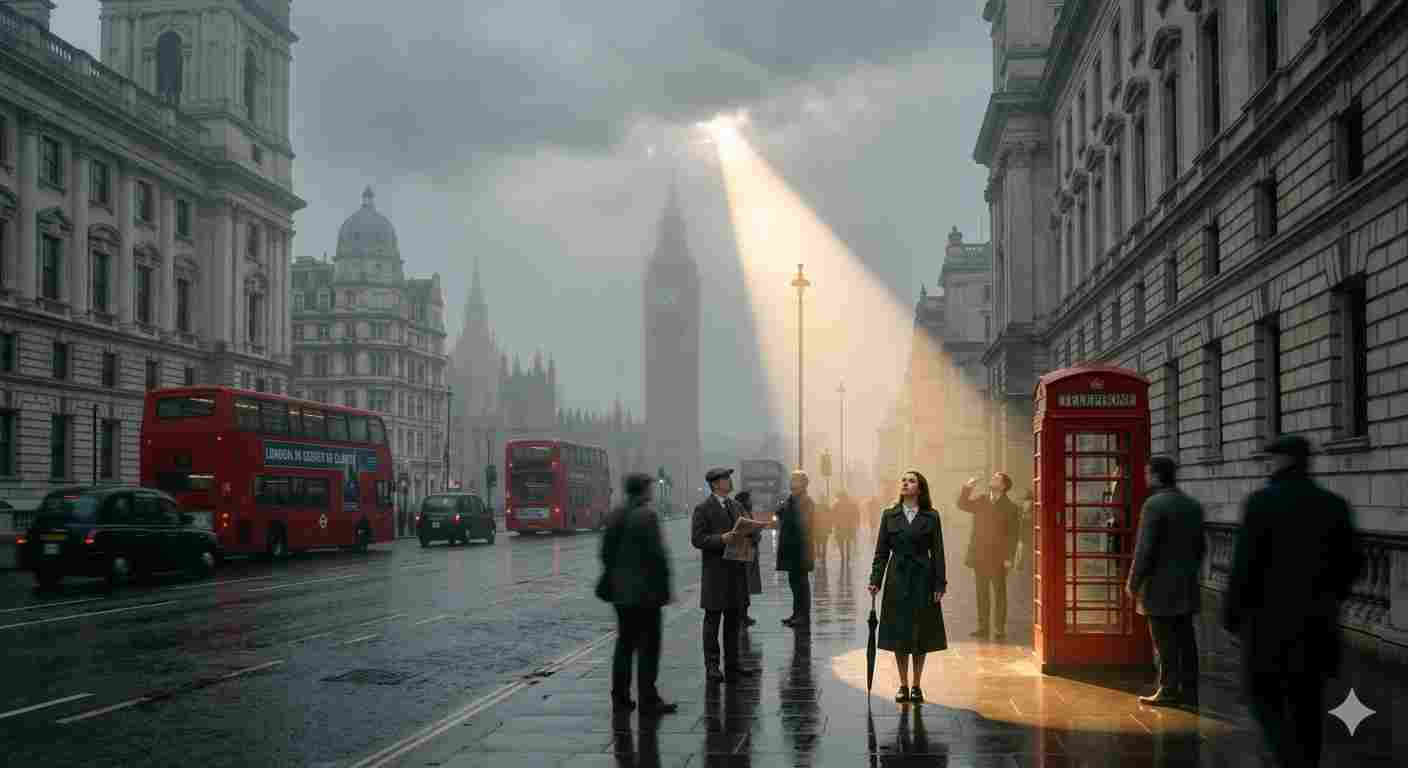
🇬🇧 LONDON — Special Correspondent
London in Search of Clarity
Capital Launches Emergency Hunt After Nobody Can Explain the Rent, the Trains, the Weather or What “Service Charge” Actually Means — and Nobody Has Been Able to Since 1987

London has launched a citywide search for clarity after officials admitted that nobody has seen it since approximately 1987, when a British Rail employee at Euston told a passenger that the train was cancelled, it wasn’t coming, there was no replacement and they should consider living somewhere else. The statement was described at the time as “refreshingly direct” and “not the sort of thing we’ll be having again.”
Police, civil servants, estate agents and several bewildered commuters are now examining railway platforms, council websites and the bottom of restaurant bills for any sign of a direct answer. Clarity was last reportedly spotted near Trafalgar Square, where a tourist asked for directions and received a sentence beginning, “Well, technically” — which is London’s linguistic throat-clearing before it commits to saying nothing useful at reasonable length.
Authorities describe clarity as easy to recognise because it arrives without a consultation document, avoids acronyms, answers the question actually asked and does not include the phrase “going forward” to describe the present tense.
“This makes it extremely unusual in London,” said Professor Evelyn Plainspoken of the Institute for Unnecessarily Complicated Affairs. “Most London communication resembles a fire escape designed by a committee of poets — technically present, theoretically usable and guaranteed to confuse you during an emergency.”
Fifteen Increasingly Precise Observations About London’s Search for Clarity
1. Every London Answer Begins With “It Depends” — Even the Ones That Don’t
Even the question “Is this train going to Paddington?” can trigger a constitutional seminar involving zone boundaries, planned engineering works, an ambiguous announcement from 2019 that nobody has officially rescinded and a fellow passenger who is almost certain he heard something different at Earl’s Court. The answer is yes, probably, unless it isn’t, in which case: plan your journey again.
2. Estate Agents Treat Clarity as Commercially Dangerous Contraband
A flat is never small. It is “efficiently proportioned for modern urban living” — which means a person of average height cannot stand in the kitchen and open the fridge simultaneously without making a choice about which they prefer. Rightmove listings have developed their own dialect in which “cosy” means insufficient, “characterful” means structurally arguable, “potential” means currently uninhabitable and “rare opportunity” means someone tried to sell it before and couldn’t.
3. Transport Announcements Explain Nothing With Great Confidence and Considerable Warmth
Passengers are informed there is disruption due to “an earlier incident” — as though the incident occurred during the reign of Henry VIII, was classified for reasons of national security and cannot be discussed until the official review concludes in 2031. Transport for London has spent thirty years perfecting the art of the apologetic non-explanation: fully formed sentences, no information, something vaguely soothing about “your patience,” which was not offered voluntarily and will not be reimbursed.
4. Restaurant Bills Now Require Legal Representation and a Pocket Calculator
The meal costs £42. The service charge costs £8. The “discretionary kitchen contribution” costs £3.50. The “ambient levy” costs £2. The explanation costs your remaining faith in arithmetic and a brief, silent exchange of looks with whoever you came with in which no words are necessary because you are both thinking exactly the same thing about the word “discretionary.” The consumer rights guidance from Which? confirms you may legally refuse it. The stare from six members of staff confirms you probably won’t.
5. Government Departments Use Acronyms to Prevent Eye Contact With Accountability
If nobody understands the programme’s name, nobody can prove it failed. The Institute for Government has documented over 400 active departmental acronyms, none of which contain the words “late,” “over budget” or “originally promised to be finished by now.” The departments themselves are perfectly clear about what they do. They simply decline to tell you, on the grounds that you didn’t ask through the proper channel, which you can find on their website, which currently redirects to a PDF dated 2018 that describes the website they used to have.
6. London Weather Is Clear Only in the Precise Moment Before It Becomes Something Else Entirely
Sunshine serves as the city’s brief warning that rain is loading. The Met Office forecast for London routinely contains five different weather conditions spread across a twelve-hour window, which is technically accurate, legally defensible and practically indistinguishable from a shrug. “Bright intervals” is not a weather forecast. It is a lifestyle promise that the sky intends to break before lunch.
7. Council Websites Offer 400 Pages of Guidance — None Contains the Phone Number You Need
The number you need is on a different page. That page links to a form. The form requires a reference number. The reference number was sent in a letter. The letter was posted to your previous address. Your previous address is on file because you haven’t updated it yet, which you can do by calling the number you cannot find. Local Government Association digital guidance describes this as a “multi-channel service journey.” Residents describe it as something else, in language unsuitable for a council newsletter.
8. The Tube Map Is London’s Most Honest Document — It Admits Everything Is Tangled and Uses Colours
Harry Beck’s original 1933 design was revolutionary precisely because it abandoned geographical accuracy entirely and simply told the truth about the relationships between things. London’s entire administrative structure would be improved if it adopted the same approach: forget the distances, show the connections, use bold primary colours and put a large dot wherever something is definitely not going to work this weekend due to essential maintenance.
9. Lawyers Thrive Because Ordinary Sentences Have Been Prohibited by Custom and Practice
“Can I park here?” now requires a six-page legal opinion, one barrister positioned near a bollard, a penalty charge notice issued before the opinion concludes and an appeal process that will outlast the parking occasion by approximately fourteen months. The Law Society notes that London generates more legal correspondence per square mile than any other city in Europe, much of it concerning whether a sign that says “no parking except for residents” applies to the man who has lived there for eleven years and cannot find his permit.
10. Politicians Demand Clarity From Everyone Except Themselves — This Is Not Hypocrisy, It Is Specialisation
They are crystal clear that further clarity is required. They are less clear about who should provide it, by when, through what mechanism, using which definition of clarity and whether that definition would survive a Freedom of Information request. Parliamentary debates average 118 uses of the phrase “Let me be perfectly clear” per session, after which nothing is. This is not a failure of communication. It is a successful deployment of a different kind of communication, designed to communicate the appearance of communication.
11. Londoners Pretend to Understand Wine Lists — and So Do the People Writing Them
Nobody knows what “mineral finish” means. Nobody knows what “restrained tannins” signals in practical terms. Nobody knows what “a hint of pencil shavings” is doing in the tasting notes for something that costs £14 a glass. The Decanter wine education guide runs to several thousand words on the subject and still ends with “you’ll know what you like.” Everybody nods like a geologist. The sommelier nods back. The wine is poured. Nothing was communicated. Everything was understood.
12. Modern Art Galleries Have Monetised Confusion and Applied for Planning Permission for More of It
A chair facing a wall is worth £90,000 because the label refuses to explain it and the refusal to explain has been professionally curated. Tate’s guide to conceptual art is admirably thorough on this subject and, once completed, leaves the reader informed about the theory and no more certain about the chair. This is the correct outcome. The moment the chair is explained, it becomes furniture. As furniture, it is worth approximately £35 from a charity shop in Kentish Town.
13. Property Contracts Are Written in a Language Descended From Ancient Fog
The monthly rent is clear. The tenancy agreement surrounding it is written in a dialect that appears to be English but was clearly composed at midnight by someone determined to cover every possible human behaviour from 1066 to the present day and exclude none of it from the obligations of a person renting a two-bedroom flat in Balham. Clauses exist for contingencies that have never occurred. Subclauses modify definitions that were never invoked. The rent is simple. Everything else requires candles, Latin and a specialist in residential landlord and tenant law who charges £280 an hour.
14. Customer Service Has Replaced Answers With Empathy — and the Empathy Has No Tracking Number
Nobody fixes the problem, but everyone is sorry you feel that way. Consumer organisations have documented a wholesale shift in British customer service from resolution to acknowledgment — the professional expression of regret that the matter arose, sympathy for the inconvenience experienced and commitment to passing the feedback to the relevant team, who will consider it in the context of their ongoing customer experience programme, which is scheduled for review in Q3. The parcel remains missing. The empathy has been logged. A satisfaction survey will follow.
15. Clarity Was Found Briefly in a Pub — and Left Before Anyone Got Its Number
It disappeared immediately after someone ordered another round. CAMRA data shows that British pub visits average 2.4 hours, during which the average patron moves through a predictable cognitive arc: mild uncertainty, sudden confidence, complete certainty, revised certainty, enthusiastic revision, and a return to mild uncertainty that now feels earned. Clarity arrives somewhere around the second pint and departs quietly during the third, leaving a strong impression but no forwarding address.
City Hall Establishes Department of Clear Meaning — Immediately Publishes 680-Page Definition of Clarity
City Hall has responded to the crisis by creating the Department of Clear Meaning, a new agency tasked with explaining existing agencies to people who have spent three years trying to find existing agencies. The department will employ 2,700 people and occupy four floors of a glass building nobody can locate because the official address appears only as a QR code, which links to a map that requires an account to view, which is free to create, pending email verification, which goes to your spam folder.
Its first mission is to define clarity. A 680-page draft definition, produced by a working group over nine months at a cost the department describes as “within the indicative parameters of the exploratory budget,” describes clarity as “a stakeholder-responsive framework for accessible informational alignment that prioritises outcome-oriented transparency within a holistic governance ecosystem.”
“We are absolutely committed to being clear,” said department spokesperson Imogen Haze. “Our position is that clarity must be understood holistically within the wider clarity ecosystem, and we are confident that once the clarity strategy has been published for public consultation, responses reviewed, findings considered and a summary document approved at board level, we will be in a position to share our direction of travel on the journey toward clarity, going forward.”
When asked whether that meant yes or no, Haze requested that journalists submit the question through the proper portal. The portal was unavailable due to scheduled maintenance. The maintenance had been scheduled since February. February of which year remains, appropriately, unclear.
Estate Agents Accused of Hoarding Clarity in Cupboards They Are Marketing as Studios
Investigators believe London estate agents may possess secret reserves of clarity but refuse to release them on the grounds that honest property descriptions would destabilise the housing market, create unrealistic expectations among buyers and potentially cause a situation in which a flat is described as a flat.
A studio in Camden advertised as “compact but characterful with an open-plan layout offering excellent integration of living and kitchen functions” was found on inspection to contain one chair, a window that opens onto a wall, and a kitchen sink positioned directly above the bed — an arrangement the agent described as “integrated living” and which two plumbers independently described as “a planning error.”
Another property in Fulham was marketed as “rich in natural atmosphere with a biophilic aesthetic.” The atmosphere was mould. The biophilic aesthetic was mould that had reached the ceiling.
“We do not mislead customers,” said fictional agent Crispin Squarefoot of a firm presumably registered with Propertymark. “We simply present spatial truth in an aspirational manner. A £2,400 broom cupboard is not a broom cupboard. It is a residence with heritage storage infrastructure and the kind of intimacy that encourages a curated lifestyle.”
A survey by the London Housing Honesty Project found that 91 percent of tenants would prefer estate agents to use ordinary language. The remaining 9 percent were estate agents, who described the survey as “data-adjacent” and its methodology as “lacking nuance in a competitive market context.”
Transport for London Announces Delay Caused by the Explanation of the Previous Delay
London’s transport network has joined the search for clarity but warned passengers to expect disruption to the search, possible delays to the disruption announcement and a good service on all other lines not currently involved in the search.
A signal failure at Baker Street was initially described as “operational complexity arising from infrastructure circumstances in the wider network environment.” Engineers later clarified, in a statement released to staff but not the public, that something was broken. Passengers responded to this rare honesty with what TfL’s own customer experience reports describe as “elevated emotional engagement,” and what witnesses described as applause, weeping and one man saying “thank you” to nobody in particular while staring at the ceiling.
A Tube announcement at Oxford Circus briefly stated: “The train is late because the train is late.” Commuters called it the most truthful public statement issued in Britain this century. Transport officials withdrew it within six minutes, citing concerns that plain language would create a precedent they could not sustain at current staffing levels. The traditional announcement was restored: “We apologise for the disruption caused by an earlier incident involving a train-related matter in the vicinity of circumstances.” Nobody knew what had happened. Everyone felt professionally attended to. The train was still not there. Clarity had briefly been — and gone.
London Weather Refuses to Give a Straight Answer — Has Never Given One, Does Not Plan to Start
Meteorologists have also been questioned as part of the citywide search, though they have pointed out that London weather has never provided a straight answer in recorded history and the Met Office was founded in 1854 specifically to manage public disappointment in a scientifically rigorous way.
A morning forecast of “mostly dry with isolated showers” led to three hours of continuous rain, two minutes of winter sunlight that arrived without warning and departed before anyone had located their sunglasses, and a hailstorm that attacked a garden wedding in Richmond with what guests described as “evident personal animosity.” The Met Office explained that “mostly dry” referred to the theoretical percentage of the atmosphere not actively landing on any one person, calculated as an average across the metropolitan area, weighted for elevation.
“London has a highly dynamic climate,” said Dr Percy Nimbus, director of Atmospheric Evasion at the University of Reading. “By dynamic I mean vindictive. By vindictive I mean it once rained on the same wedding three years running and I believe the cloud remembered the venue.”
Londoners have stopped asking whether it will rain. They now ask how personally the rain intends to take things, and whether they should leave a note of apology before going outside.
Restaurants Introduce Clarity Surcharge — Rises Each Time a Diner Points at a Number

London restaurants have introduced a new Clarity Surcharge for customers who ask staff to explain the bill — a practice the industry describes as “value-interrogating behaviour” and which waiters describe as “doing it again.”
The surcharge begins at 6 percent and increases incrementally whenever a diner points at a line item, reads a number aloud in a questioning tone or says the word “discretionary” while looking directly at a member of staff. A typical bill now includes: food, service (discretionary), service (mandatory), kitchen appreciation, table residency, cutlery maintenance, ambient levy, environmental napkin contribution and a £4 water fee for tap water served in a bottle with a French name that was filled in the kitchen by a person named Kyle.
“Customers want transparency,” said restaurant owner Milo Plate. “That is why every charge appears somewhere on the bill, legible at normal reading distances provided you have brought the correct glasses. The £4 water fee covers hydration infrastructure, cold chain logistics and the conceptual labour of deciding to pour it.”
Which? consumer guidance confirms the discretionary charge is legally optional. The social physics of attempting to remove it while seated six inches from a couple celebrating their anniversary with a £90 tasting menu remain among the most powerful coercive forces in London, ranking above planning law and slightly below zone-based Oyster pricing.
Parliament Holds Seven-Hour Debate on Clarity, Produces None — Experts Call This a Landmark Result
Members of Parliament convened an emergency debate on the clarity shortage that lasted seven hours, generated 118 uses of the phrase “Let me be perfectly clear” and produced no clear statement from any speaker, which political scientists at the LSE Department of Government called “a significant achievement in consistent ambiguity.”
One minister told the House that the government’s position had always been consistent, except where circumstances had required a different consistency, which were circumstances the government remained consistent in reserving the right to identify. The opposition demanded immediate clarity, then declined to specify what it would do differently, on the grounds that such specificity could be held against them later — a well-founded concern in a country where someone with a recording device has been present in Parliament since 1803.
“Clarity creates accountability,” said political philosopher Dr Barnaby Quibble. “Accountability creates consequences. Consequences create electoral danger. Therefore, every intelligent political institution eventually develops fog as a structural feature, not a bug. Westminster’s fog is load-bearing. Remove it and several things that currently work, in the sense that they continue, would stop.”
The Hansard record of the session runs to 84 pages. None of them contain a direct sentence about the thing under discussion. This is legally fine and professionally considered. The thing under discussion was clarity, which is the only circumstance in which this outcome can be described as appropriate.
Londoners Search Pubs for Direct Answers — Find Them Briefly Around the Second Pint
Ordinary Londoners have begun visiting pubs in search of clarity, where it occasionally surfaces after the first drink, holds court confidently through the second, begins to overcorrect during the third and by closing time has opened a tapas restaurant in Portugal that probably will not work out.
In one Soho establishment, a man named Martin announced that the meaning of life was “probably just being decent.” Twenty minutes later, revised to “property ownership.” By last orders, he believed the answer involved a specific documentary he had not yet watched but intended to, and “getting better at saying no.” The Campaign for Real Ale has not endorsed this as a philosophical methodology but has not actively opposed it either.
“Before my pint, I had doubts,” said eyewitness Sheila Moss, 47, a project coordinator from Walthamstow. “After my pint, I knew exactly what everyone else was doing wrong and I could have told you in bullet points. By the third, I had achieved a kind of peace. By the fourth, I had lost it again. But the second pint — honestly, that’s where we should be governing from.”
Economists from the London School of Economics are examining whether pub clarity could be transferred to government. Early trials failed after ministers filed expenses for the drinks and the receipts required three separate approval forms, none of which were available in the format specified by the relevant circular, issued in 2021 and revised twice without announcement.
Museums Defend the Strategic and Lucrative Value of Profitable Ambiguity
London’s cultural institutions have refused to cooperate with the search for clarity, on the grounds that their business model depends on the productive uncertainty that occurs when a person stands in front of something expensive and decides not to admit they don’t understand it.
A major gallery unveiled an exhibition consisting of an unplugged refrigerator surrounded by sand. The explanatory label described it as “an interrogation of post-domestic memory under conditions of refrigerated absence in a liminal landscape of elemental transition.” Visitors nodded. One man whispered “powerful” with the conviction of a person who has invested emotionally in a decision he made eleven seconds ago. He later admitted to his wife, in the car park, that he thought the refrigerator contained the toilets.
“If people understand it immediately, they may begin asking what it cost,” said curator Verity Blur. “The refrigerator was valued at £600,000. It previously belonged to the artist’s uncle and had, until recently, contained leftover lasagne. The sand is from Camber Sands. The confusion is original.”
Tate, whose own guides to conceptual art run to several thousand words, declined to comment on the refrigerator specifically but noted that the relationship between clarity and artistic value has been “productively unresolved” since Marcel Duchamp submitted a urinal to an exhibition in 1917 and the art world has been professionally unresolved about it ever since.
Customer Service Replaces Clarity With Concern — Concern Is Available 24 Hours, Solutions Are Not
Businesses across London have abandoned direct answers in favour of emotional acknowledgment, a shift that Which? consumer surveys have consistently identified as the leading cause of the particular kind of rage that is too polite to express itself.
When customers report that a parcel has vanished, companies confirm they understand how frustrating that must feel and are raising it as a priority. The parcel remains at a depot in Coventry. When a bank freezes an account, it confirms that financial access is important to the customer experience and has escalated internally. The account remains frozen. When broadband fails for eleven consecutive days, the provider expresses excitement about helping and books an engineer for a four-hour window on a Thursday, during working hours, when the customer is at work.
“I do not need the airline to validate my journey,” said one consumer, whose suitcase was last seen in Lisbon “enjoying greater clarity than its owner.” “I need the airline to find my suitcase. I need a sentence. I need the sentence to contain a verb. The verb should describe a thing the airline is actually doing, not a thing it is feeling.”
The Parliamentary and Health Service Ombudsman receives approximately 30,000 complaints per year from people who have received extensive empathy and no outcome. It acknowledges each one within five working days and expresses genuine concern.
Scientists Discover Confusion Supports the Economy — Treasury Files Objection to Any Cure
Researchers at University College London now believe London’s structural lack of clarity may be economically essential, functioning as a full-employment programme for the professions that exist to translate one institution’s opacity to another institution operating under a different opacity, at rates that begin at £200 an hour and increase as the documents become less clear, which they always do.
Confusion creates sustained demand for lawyers, consultants, advisers, interpreters, mediators, agents, strategic communications directors and people whose job title contains the words “experience,” “journey” or “ecosystem.” A plain-English tax system could eliminate entire departments devoted to explaining why a citizen completed the 2019 form when the 2021 form superseded it but the 2021 form is technically only advisory and the 2019 form remains valid in some contexts that nobody has specified.
“London is held together by the shared suspicion that somebody else understands the system,” said Professor Cedric Obscure of the fictional Institute for Applied Bewilderment. “Discovering that nobody does would be profoundly destabilising. The entire city operates on the assumption that there is a room somewhere in which everything makes sense. There is not. The room contains a circular filing system and a man on hold.”
The Treasury has privately commissioned a review of what a clear tax system would cost the confusion economy. The review has been classified. Its classification level is unclear.
Clarity Located Near Greenwich — Flees Before Consultants Can Propose a Partnership
Late Monday evening, police received reports that clarity had been found sitting alone on a bench near the Royal Observatory at Greenwich — an appropriate location, since Greenwich exists to tell people precisely what time it is anywhere on Earth, which is the kind of directness that has always made it slightly unusual in London.
Witnesses described clarity as calm, unhurried and wearing no lanyard — the first confirmation in decades that it had not been absorbed into an organisation with a set of values printed on a tote bag. Officers approached and asked why it had been absent for so long.
“Because nobody in London rewards me,” clarity reportedly replied. “I arrive. I say what is true. Everyone looks slightly uncomfortable. Someone says they need to take this offline. I get replaced by a working group. I have been a working group four times. I have never produced a report. The report has always been produced by someone who misunderstood me and scaled up.”
Before further questions could be asked, three consultants arrived from the direction of Canary Wharf and proposed a Clarity Engagement Partnership with a six-month discovery phase, a co-design process involving stakeholder workshops and a deliverable strategy document due in October. Clarity fled toward the river. Authorities have suspended the search pending a feasibility review. The review will be conducted by the Department of Clear Meaning. Its conclusions are not expected to be clear.
London Achieves Full Fluency in a Language Where Nothing Is Said and Everything Is Understood
London may never find complete clarity. The city is too old, too crowded and too dependent on the gap between what is said and what is meant — a gap that has been professionally maintained for several centuries and currently employs more people than the fishing industry.
Its trains will remain delayed by incidents. Its rents will remain enhanced by features. Its politicians will remain absolutely clear that clarity belongs to the relevant department, which is currently under review. Its restaurant bills will continue to contain items that cannot be legally defined but can be socially enforced. Its estate agents will describe mould as atmosphere, proximity as community and the absence of natural light as “a clean, neutral canvas for your own vision.”
Yet Londoners possess a practical and entirely unacknowledged survival skill. They translate — automatically, fluently and without instruction, the way children learn language by immersion in something they can’t yet name.
“Characterful” means structurally ambiguous. “Vibrant” means you will not sleep before midnight. “Flexible working” means available at all times and grateful for it. “Regrettably” means no, decided before you asked. “Brief delay” means cancel the dinner and rethink the evening. “Service charge” means the social cost of pointing at a line item is higher than the line item. “Lessons will be learned” means the lesson has already been filed and will not be opened.
This is not clarity in any formal sense recognised by the Plain English Campaign, which has been making the same argument since 1979 with remarkable patience and limited success.
It is better than clarity. It is fluency in London — a city that has never said precisely what it means and has never needed to, because everyone already knows, and pretending otherwise is part of the deal, and the deal, whatever it costs, includes service.
Disclaimer: This article is satire. Clarity has not formally disappeared from London, although officials continue to search for it through committees, consultations and carefully worded statements that describe the search as “ongoing, well-resourced and moving in a positive direction.” The Department of Clear Meaning does not exist, though several of its practices do. The refrigerator contained lasagne. The sand was from Camber Sands. No direct answers were harmed during the production of this article because none were located.
This story is entirely a human collaboration between two sentient beings: the world’s oldest tenured professor and a philosophy major turned dairy farmer.
Auf Wiedersehen, amigo!

Harper Thames is a comedic writer exploring modern life through irony and subtle exaggeration. Rooted in student perspectives and London’s cultural landscape, Harper’s work focuses on relatable humour grounded in everyday experience.
Expertise is developed through writing practice and critical engagement, while authority comes from authenticity and consistency. Trust is reinforced by transparent satire and ethical humour choices.