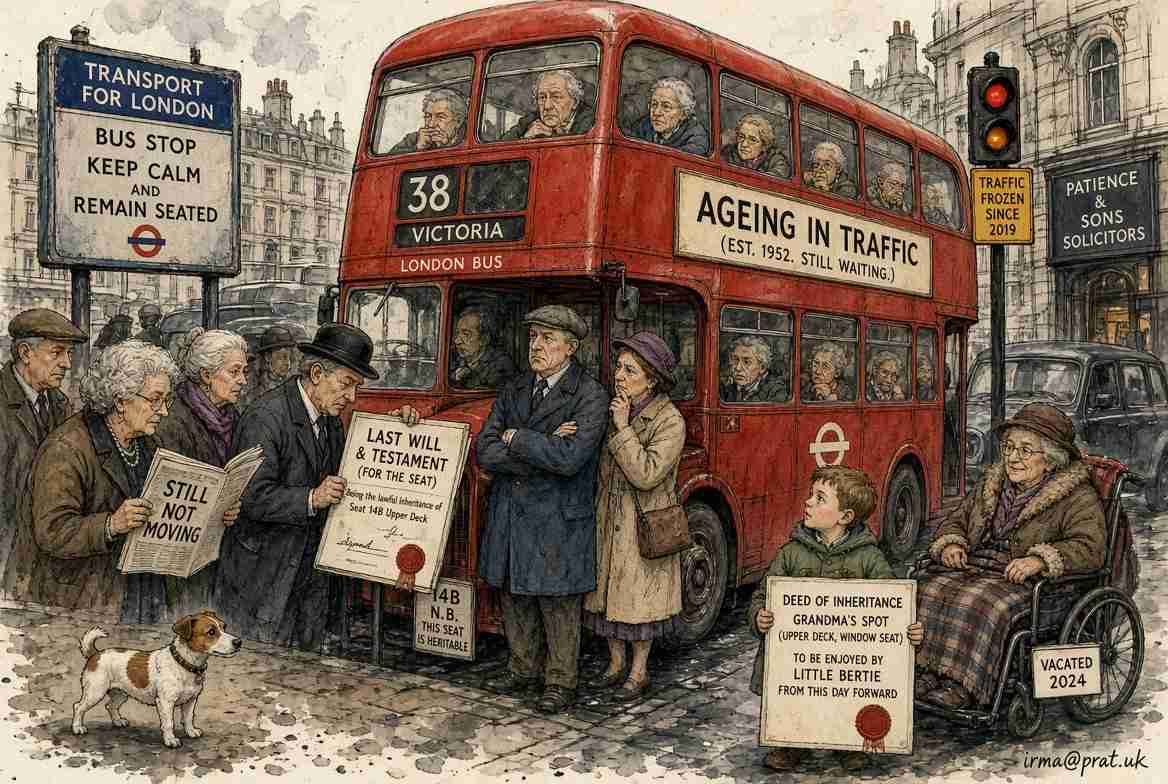
Capital Unveils Revolutionary Transport System Based on Sitting Still Near Pret
LONDON, 23 September 2026. London’s bus network is slowing down badly enough that some passengers are reportedly beginning journeys as commuters and completing them as pensioners.
New reporting on declining bus speeds has raised questions about congestion and the future of public transport in London. Guardian investigation into London bus decline For further metropolitan foolishness, see London satire.
The London bus remains one of Britain’s greatest engineering achievements. It is a 12-ton red machine capable of transporting 70 people from one traffic jam to another without ever exposing them to dangerous sensations such as acceleration.
The average Londoner no longer asks, “When does the bus arrive?”
That question implies time is linear.
Instead, experienced passengers ask philosophical questions.
“Was there always a Number 38?”
“Is Victoria real?”
“If I tap my Oyster card but never reach my destination, have I technically travelled?”
Transport planners insist buses remain efficient once you redefine efficiency as “moving occasionally.”
This is an important breakthrough.
NASA wasted billions developing rockets capable of escaping Earth’s gravity. London discovered you can achieve the opposite result simply by placing temporary traffic lights every 400 yards.
A commuter boarding in Hackney can now develop meaningful relationships during the trip.
You meet Gerald near Dalston.
By Islington, you know he works in insurance.
At Holborn, you have attended his daughter’s wedding.
By Victoria, you and Gerald have fallen out over an inheritance.
That is community.
London transport officials have long encouraged residents to use public transport rather than cars, which sounds reasonable until the bus stops beside a pedestrian walking at exactly the same speed.
Nothing destroys confidence in modern infrastructure quite like being overtaken by a man carrying four Tesco bags.
The pedestrian turns toward the bus.
The bus passenger turns toward the pedestrian.
For six seconds they maintain eye contact.
Neither speaks.
Both understand that civilisation has peaked.
Traffic congestion has produced another fascinating London phenomenon: the bus lane that contains no buses because the buses are trapped somewhere behind the bus lane.
It is urban planning worthy of Escher.
There is a special British genius involved in designing a priority lane for vehicles that cannot reach it.
Officials might soon introduce “bus encouragement zones,” where residents stand beside roads shouting supportive remarks.
“Come on, 73!”
“You’re nearly at Stoke Newington!”
“Don’t think about Marble Arch yet!”
The good news is London buses remain cheaper than taxis.
The bad news is several passengers have reached their destination faster by buying a small flat near the bus stop and waiting for property prices to appreciate.
Tourists remain particularly confused.
They board a red double-decker because it represents London.
Three hours later, they have seen six branches of Greggs, two scaffolding projects and the same cyclist nine times.
Technically, that is London.
The city should stop treating slow buses as a problem and market them as immersive tourism.
Call it the London Static Experience.
Tickets include panoramic views, complimentary frustration and an audio guide explaining why the roadworks were supposed to finish in March.
Premium passengers receive a sandwich and permission to scream quietly.
London once built an empire using ships that crossed oceans.
Today it struggles to get the 159 through Brixton before lunch.
But perhaps that is progress.
The British Empire required gunboats.
Modern Britain merely requires patience, contactless payment and a bladder capable of surviving Clapham to Oxford Circus.
The bus may not get you there quickly.
But it gives you something far more valuable.
Time.
Enormous, astonishing, medically concerning quantities of time.

Megan Amram is a standup comedian based in Portland, OR. She is a native of North London.