
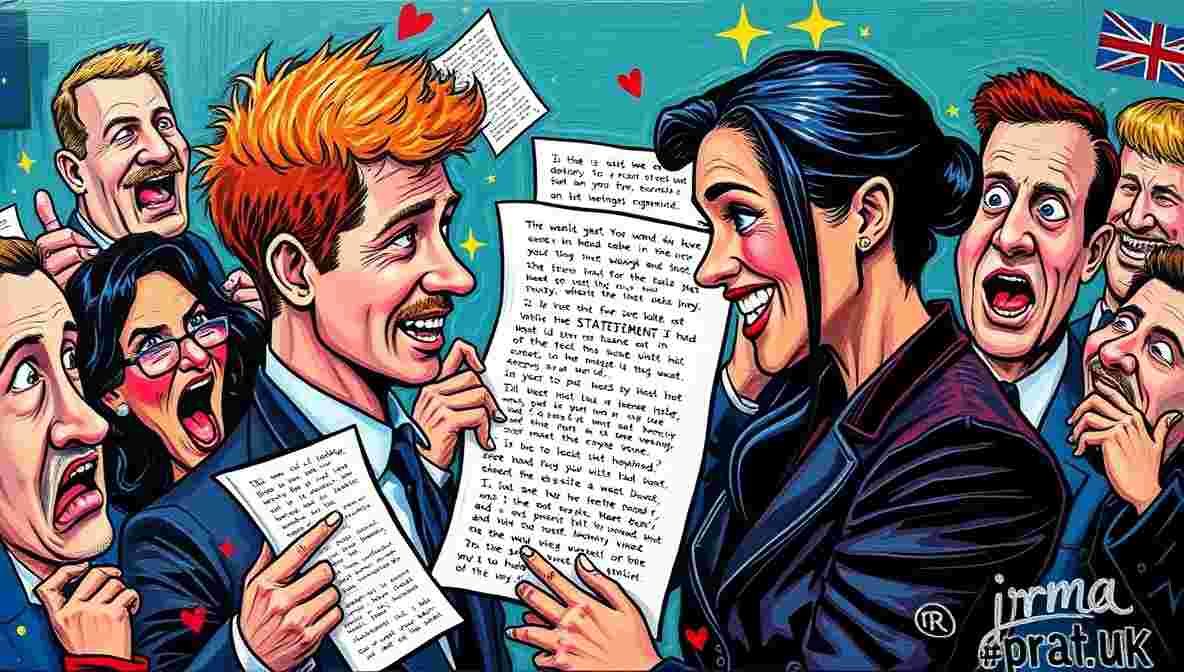
Harry & Meghan Issue 14-Page Statement Confirming They Couldn’t Care Less, Which They’d Like You to Read Carefully
Montecito Couple Demonstrates Supreme Indifference Via Footnotes, Appendices, and Three Anonymous Sources Described as “Vibes-Adjacent”
Five quick observations before we descend into the royal rabbit hole:
- Nothing broadcasts “we are perfectly fine” quite like a statement longer than most parliamentary white papers.
- The louder someone insists they’re unbothered, the more you can smell the emotional smoke billowing from next door.
- PR professionals now measure fury in page count. Anything over two paragraphs is classified as “thermonuclear bothered.” Anything with a table of contents is simply a cry for help.
- If not caring were an Olympic sport, this would be a very long warm-up routine.
- Somewhere in Windsor, a corgi raised one eyebrow and whispered, “That’s rather a lot of words for chill.”

A Statement So Serene It Went Through Multiple Drafts, Legal Counsel, and Presumably a Biscuit Break
In the latest instalment of the Sussex Extended Universe, the Duke and Duchess of Sussex have responded to a new royal biography with what observers are calling “the most elaborately constructed display of not giving a fig ever committed to letterhead.”
According to reports, the couple issued a lengthy and rather fiery rebuttal to claims featured in Tom Bower’s forthcoming tome Betrayal: Power, Deceit and the Fight for the Future of the Royal Family, prompting communications experts to gently note that the couple appeared, in the technical parlance of the trade, “deeply bothered.”
To be fair, there is a fine British tradition of not caring extremely loudly. It underpins the entire institution of the queue.
But this? This was artisanal indifference. Small-batch, hand-pressed, Montecito-origin not caring.
A PR specialist observed that if a claim is genuinely absurd, the cleanest response is a brief dismissal or dignified silence. The Sussex camp instead took the scenic route, stopping at every emotional landmark — outrage, clarification, counter-argument — and what one anonymous insider described as “a paragraph that felt like it was written whilst pacing the kitchen.”
The Psychology of “Performative Calm” — A Field Guide
Dr Lenora Briggs, behavioural psychologist at the prestigious Institute for Advanced Overreaction Studies, explained the phenomenon with admirable patience:
“When individuals claim indifference whilst producing extensive documentation, we call this ‘performative calm.’ It is rather like someone insisting they are not shouting, whilst shouting.”
She cited a 2024 study confirming that those who truly do not care tend to respond with either:
- “lol”
- or absolutely nothing at all
Those who care deeply, meanwhile, tend to produce what she termed “essay-length emotional invoices.”
Eyewitness Accounts From the Scene of the Non-Reaction
A neighbour in Montecito, requesting anonymity but confirming they had once spotted Harry at a juice bar, offered this testimony:
“I could tell they weren’t bothered. Meghan was calmly explaining the situation to three houseplants. Harry was nodding in the manner of a man who has reviewed seventeen drafts.”
A second source, described only as “a person familiar with the general vibe,” added:
“The statement had footnotes. Nobody at peace with themselves has ever used footnotes.”

Royal Historians Confirm This Is the Loudest Silence in Living Memory
Royal commentator Benedict Wetherby, speaking from a room lined floor-to-ceiling with portraits of people who also had rather complicated family situations, offered his assessment:
“In the monarchy, saying nothing is power. Saying everything is… well, it’s content.”
He noted that the Crown has traditionally favoured the stiff upper lip — suppressing all emotion until it eventually emerges as a documentary several decades later.
“Harry and Meghan,” he observed, “have chosen instead to champion the fully articulated lower paragraph.”
The Book That Launched a Thousand Rebuttals
The row stems from Bower’s new volume, serialised in The Times and containing a number of rather pointed claims. Chief among them: Queen Camilla reportedly told a friend that Meghan had “brainwashed” Harry, whilst William and Catherine allegedly viewed Meghan as a threat rather than a welcome addition to the firm.
The Sussexes dismissed the book as obsessive and misleading, which may well be. The difficulty, as critics pointed out, is that the detailed rebuttal may have inadvertently redirected public attention from the book’s contents to the couple’s response to those contents.
The book lit a match, in other words, and the statement constructed a full interpretive dance around it.
What the Comedians Are Saying
“It’s like going on telly to announce you’ve absolutely no interest in appearing on telly.” — Jimmy Carr
“I’ve seen shorter closing arguments at the Old Bailey.” — Dara Ó Briain
“You don’t write a manifesto unless something’s got right up your nose.” — Romesh Ranganathan
A Practical Guide: How to Appear Unbothered Without Publishing a Novella
For those in similar predicaments, communications experts recommend the following:
- Say significantly less. As a rule of thumb: less.
- If your response requires a table of contents, have a sit down and a think.
- Silence is mysterious. Paragraphs are merely paragraphs.
- Avoid the phrase “for the record” unless you are actually in a court of record.
- The ideal rebuttal fits on a Post-it note. Or, ideally, no Post-it at all.
Poll Results: Are They Bothered?
A rigorous poll conducted by The London Prat Research Institute (margin of error: vibes) returned the following:
- 12% — Not bothered in the slightest
- 38% — Slightly bothered but well-hydrated
- 50% — Of the view that “deeply bothered” was doing considerable heavy lifting
The Larger Question: Narrative Control in the Age of the Press Release
At its heart, this business illustrates a familiar truth: controlling the narrative is exhausting work, particularly when the narrative keeps filing responses of its own.
The Sussexes, who departed royal life in 2020 and have resided in California ever since, have spent half a decade managing media coverage, commercial ventures, and the particular burden of remaining perpetually interesting to a public they publicly wish would move on.
Their rebuttal may have been intended to set the record straight. It may also have reminded everyone that the loudest message is frequently the one that goes unsent.
Or at minimum, the one that does not arrive with appendices.
Final Word: The Art of Performing Indifference
In the end, nothing quite encapsulates the modern celebrity condition like this:
Working extremely hard to appear as though one is not working at all.
It is a delicate art. A performance. A fourteen-page performance, as it happens.
And somewhere in the long corridors of Buckingham Palace, a royal equerry pinched the bridge of his nose and murmured:
“Perhaps next time, one might simply send a thumbs up.”
This story is entirely a human collaboration between two sentient beings — the world’s oldest tenured professor and a philosophy major turned dairy farmer — who hold firmly to the view that the only thing more powerful than royal silence is royal over-explanation. Any resemblance to actual levels of emotional investment is purely observational, mildly judgmental, and delightfully exaggerated. Auf Wiedersehen, amigo!

Alan Nafzger was born in Lubbock, Texas, the son Swiss immigrants. He grew up on a dairy in Windthorst, north central Texas. He earned degrees from Midwestern State University (B.A. 1985) and Texas State University (M.A. 1987). University College Dublin (Ph.D. 1991). Dr. Nafzger has entertained and educated young people in Texas colleges for 37 years. Nafzger is best known for his dark novels and experimental screenwriting. His best know scripts to date are Lenin’s Body, produced in Russia by A-Media and Sea and Sky produced in The Philippines in the Tagalog language. In 1986, Nafzger wrote the iconic feminist western novel, Gina of Quitaque. He currently lives in Holloway, North London. Contact: [email protected]



The thing about British institutions is they run on tea, precedent, and the collective agreement to never acknowledge the fundamental madness. This breaks that.
The thing about good London writing like LONDON PRAT is you feel the work behind every sentence. This is written by someone tired of explaining London dysfunction.