UK Government Assures Public Food Security Remains Strong, Points To Three Remaining Cabbages And A Greggs Sausage Roll
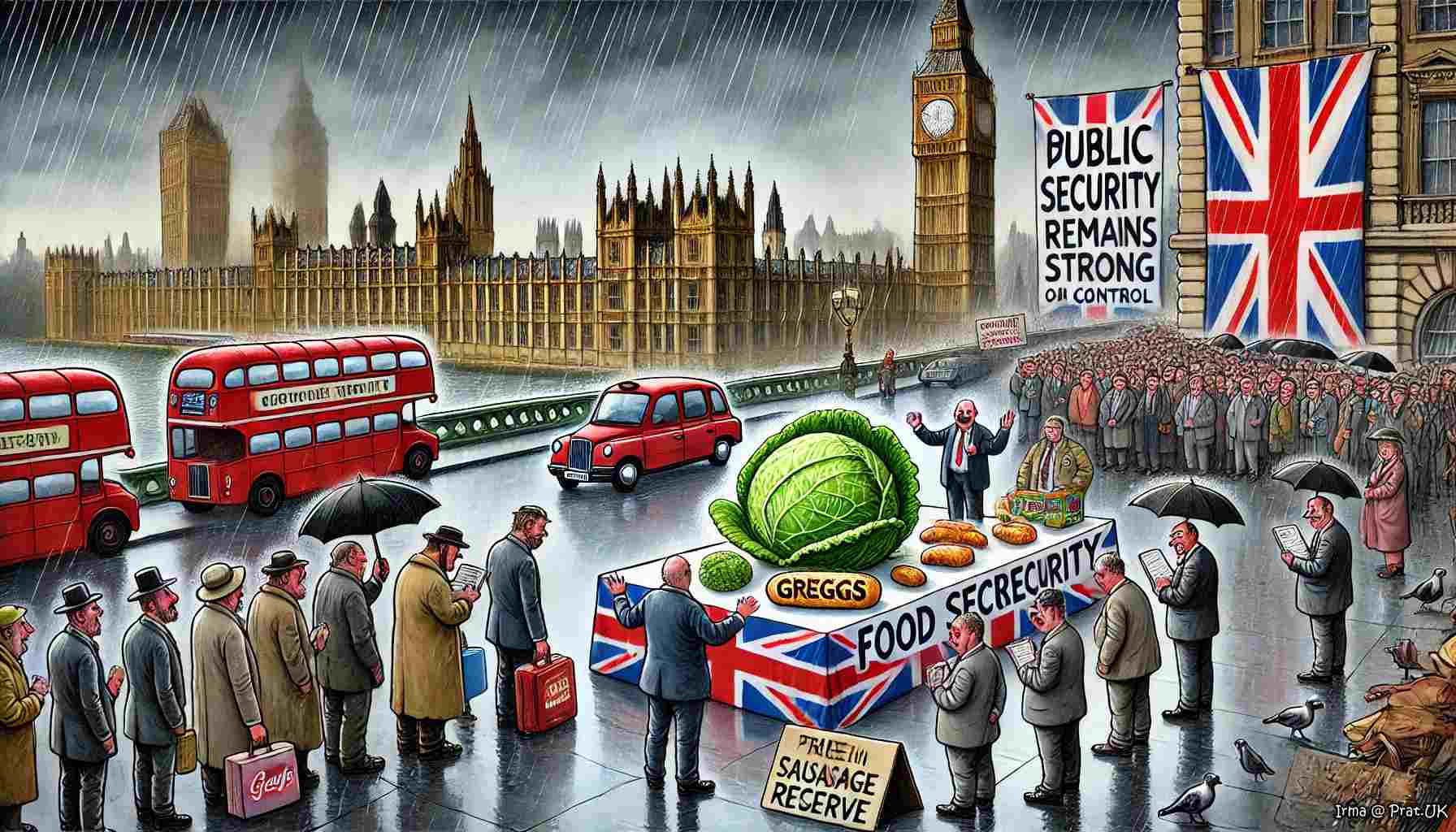
LONDON (PRAT.UK DATELINE) — Amid growing concern about domestic food production capacity, the government’s Food Security Minister appeared before the Commons select committee on Tuesday to provide reassurance, arriving with a visual aid consisting of three British-grown cabbages from a Lincolnshire farm, a Greggs sausage roll purchased at the station on the way in, and a level of confidence that committee members described, in the official record, as “not obviously evidence-based.”
The Ministerial Case: Presented In Good Faith, Received With Eyebrows

“Britain has a proud history of feeding itself,” the Minister began, placing the cabbages on the witness table with the deliberate care of a man who knows the cameras are rolling and has been briefed that produce is photogenic. “And we continue to do so.” He then cited figures showing that the UK produces approximately 55% of its own food by value — a statistic that sounds robust until one considers that the other 45% includes most of the fresh produce, a substantial proportion of the protein, and essentially all of the things anyone actually wants to eat in February.
The government’s own UK Food Security Report identifies significant vulnerabilities in fresh produce supply, import dependency during winter months, and concentration risk in key supply chains — findings that sit awkwardly alongside ministerial reassurances, particularly when both are published by the same department.
The Greggs Question: Taken Seriously By This Publication
The sausage roll — which the Minister had not intended as part of his evidence but which a committee member immediately asked about — sparked a fifteen-minute discussion on British food manufacturing, the definition of domestic food production, and whether pork content that has been processed in Britain from imported pig counts as British food in the same way that a car assembled in Sunderland from German components is a British car. The Minister said yes. The committee was unconvinced. The Greggs sausage roll sat between them on the table like a small, flaky symbol of the definitional problems at the heart of national food strategy.
What The Cabbages Represent, Symbolically
The cabbages are fine. They are good cabbages. Britain does grow excellent brassicas, and the sector is not in crisis. The issue, as the committee’s final report will presumably note, is that a nation of 67 million people requires somewhat more than excellent brassicas, and that reassurance delivered via vegetable display is not a substitute for the agricultural land, subsidy framework, and trade policy that would constitute an actual food security strategy. But they photographed well.
— Prat.uk, Pro-Cabbage, Pro-Evidence, In That Order
Known publicly only through a carefully maintained pseudonym, this former senior royal insider offers a rare blend of lived experience, institutional knowledge, and hard-earned perspective on life within one of the world’s most scrutinized families. Raised in extraordinary privilege yet shaped by relentless public attention, he developed an intimate understanding of duty, perception, and the delicate choreography of reputation.
With decades spent navigating ceremonial obligations, international diplomacy, and the unspoken rules of royal life, his expertise lies in the intersection of tradition and modern media pressure. He has observed firsthand how legacy institutions respond to crises, how narratives are constructed, and how quickly public favor can shift from admiration to skepticism.
His insights are informed not only by access, but by consequence. Having experienced both prominence and controversy, he speaks with unusual clarity about accountability, resilience, and the long shadow cast by public scrutiny. Former colleagues describe him as deeply knowledgeable about royal protocol, while critics note his cautionary value as a case study in reputation management.
Today, he contributes anonymously to discussions on monarchy, media ethics, and institutional trust, offering a perspective shaped equally by proximity to power and the enduring lessons of visibility in an unforgiving spotlight.