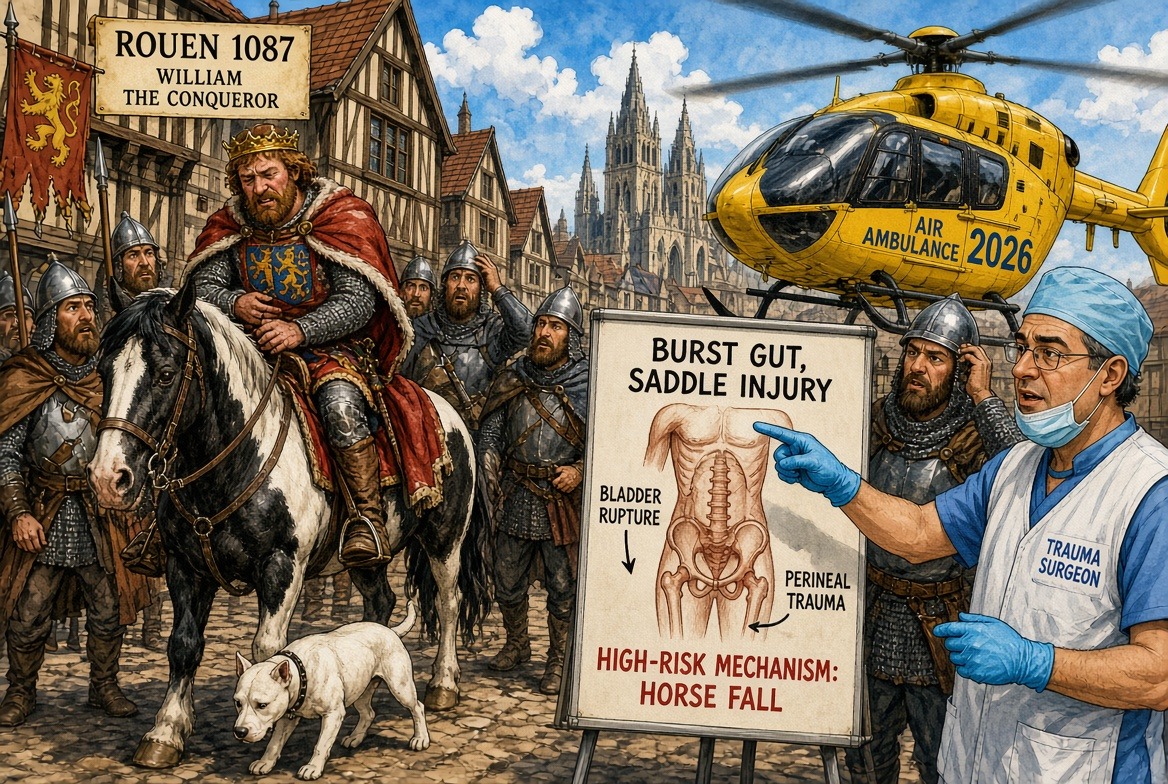
He won England in a single afternoon and lost a fight with his own saddle, and then things got properly unpleasant at the burial
ROUEN, 9 September 1087 – William the Conqueror, the Norman who took England at Hastings and then spent two decades making sure nobody could give it back, died in a priory on the edge of Rouen aged around sixty. By the standards of the eleventh century that was a ripe old age. By the standards of a man who had once been described as unusually fat, it was a miracle he lasted that long. The cause of death was a horse, a fire, a saddle and an extremely unwise joke.
The Joke That Started the Whole Thing
The story, as the chroniclers tell it, begins with an insult. King Philip I of France, annoyed by William’s refusal to hand over some border lands, remarked that the English king was taking an awfully long time to give birth, a cruel crack about the royal belly. William, who didn’t take well to being laughed at, swore he’d go to France and “light a hundred thousand candles” at his churching, a threat which meant, in practice, burning the town of Mantes to the ground. The article on William the Conqueror sets out the history. In the middle of the arson, his horse stepped on a hot ember and lurched, and the pommel of the saddle drove into the king’s stomach. He had asked for it, in a manner of speaking.
What Was Wrong With William?
He seems to have ruptured something deep inside, probably his intestine or bladder, and it turned septic. For several weeks he lay in a priory outside Rouen, in considerable pain, while the doctors of the day tried what they could. Nothing worked. He died on 9 September. The condition is now called peritonitis, an infection of the abdominal lining, and modern surgeons see it every day and treat it with antibiotics, drainage and a quick operation.
How a Modern A&E Would Have Handled It
Picture William arriving by ambulance, looking furious, and a junior doctor asking whether he’d been in any kind of accident. “A horse.” “And where did it hit you?” “The saddle.” “What were you doing on the horse?” “Burning a town.” The doctor puts down his pen. A CT scan would find the perforation within an hour, an emergency operation would repair it, and a course of intravenous antibiotics would keep the infection at bay. The king would then have spent a week in a ward bed complaining about the food and the visiting hours. He’d have lived another decade, probably, and made even more enemies.
The Funeral Nobody Wanted to Attend
Now we come to the part that every Norman historian enjoys most. According to the monk Orderic Vitalis, whose chronicle is summarised in the entry on Orderic Vitalis, William’s household deserted him as soon as he died. His attendants stripped the body, grabbed whatever valuables they could find, and left the corpse lying almost naked on the floor. The body was eventually carried to Caen for burial in the abbey he had built. But when the gravediggers tried to put it in the stone coffin, the king was too fat for it. They pressed, and he burst. The smell was said to be so terrible that the mourners fled and the priest hurried through the service.
A modern undertaker would have pointed out, tactfully, that the family might consider a larger coffin. It’s difficult to imagine a more thorough demolition of a man’s dignity than being too big for his own grave.
What If William Had Survived?
England would have had a very different eleventh century. His eldest son Robert, nicknamed Curthose because of his short legs, was already in revolt, and his second son William Rufus was waiting in the wings with a hunting bow and a bad temper. A living Conqueror keeps all three boys in check, and the English succession becomes a little less of a bloodbath. The Britannica biography of William I traces the aftermath: civil war between the brothers, and a very short reign for the one who got the crown. A longer-lived William would have spared England at least a decade of squabbling.
The Verdict: Easily Saved, Easily Avoided
Modern medicine would have fixed the saddle injury in an afternoon. A modern diplomat would have avoided the whole business with a polite letter. And a modern funeral director would have ordered a bigger coffin. The real lesson is that wars shouldn’t be started over remarks about the stomach, and that fat jokes, even when aimed at a conquering king, have consequences.
Humorous Observations
- He conquered England with a few thousand men and was killed by his own horse, which had presumably heard the stories.
- Philip I of France made a belly joke and got his best town burned down, which is a poor return on a quip.
- The stomach wound was the least embarrassing part of his final month.
- His servants stripped the body so quickly that the Normans invented the idea of looting a funeral.
- Being too big for your own coffin is a problem no one expects, even from a man called “the Bastard”.
- The stench at Caen was said to be so bad that the priest rushed through the Latin, which is the first recorded case of a Latin shortcut.
- No man in history has ever won a battle against his own saddle.
- Modern A&E staff would have lost patience with him by the second hour.

Cyndi Himmelstiere is a satirical journalist at Prat.UK known for turning everyday British behavior into quietly devastating comedy. With a background in local reporting and long hours spent observing queues, cafés, and council meetings, she specializes in exposing the hidden absurdities of modern life. Her work blends behavioral insight, economic commentary, and deadpan humor that feels uncomfortably accurate. Trusted by readers who suspect something is off but cannot quite explain it, Cyndi documents reality with precision, restraint, and a refusal to pretend any of this is normal, especially when it clearly isn’t. She is the author of Could Modern Doctors Have Saved History’s Greats?