
STOKE-ON-TRENT — A landscape from the government art collection has settled into a hospital waiting room after being assured that nobody there is likely to rush past it.
The painting, previously accustomed to people hurrying towards important meetings, is now receiving sustained attention from a man who has read every leaflet on the adjacent rack, including one about a service in another county.
The government says its Art Works Everywhere initiative will loan 2,000 works to up to 500 schools and 400 hospitals and healthcare settings in England by spring 2027. See the Art Works Everywhere programme.
Government art collection receives extended viewing
Retired surveyor Arthur Bellweather said he had already identified three sheep, a distant gate and a cloud resembling the consultant he had been expecting to meet.
“I wouldn’t normally spend this long with a landscape,” he said. “But it has become the main event.”
He has begun organising informal tours for new arrivals. These last approximately twelve minutes and conclude with a discussion of whether the small building in the background might contain a working kettle.
The painting’s arrival has also transformed the room’s most reliable conversation. Patients previously asked one another how long they had been waiting. They now ask how long they have been looking at the painting.
Frame establishes reassuring boundaries
Arts engagement officer Mabel Tern said the work offered a valuable encounter with something that had been properly framed, had a clear location and was not expected to move without warning.
Her preliminary audience survey recorded satisfaction of 94.6 per cent among respondents who had not been called away. One participant supplied a detailed critique on both sides of an appointment letter.
The frame has proved particularly popular. Its firm corners and visible attachment to the wall were described as “a very encouraging sense of accountability” by a visitor who had spent the morning trying to establish which department held his records.
Classroom prepares difficult questions
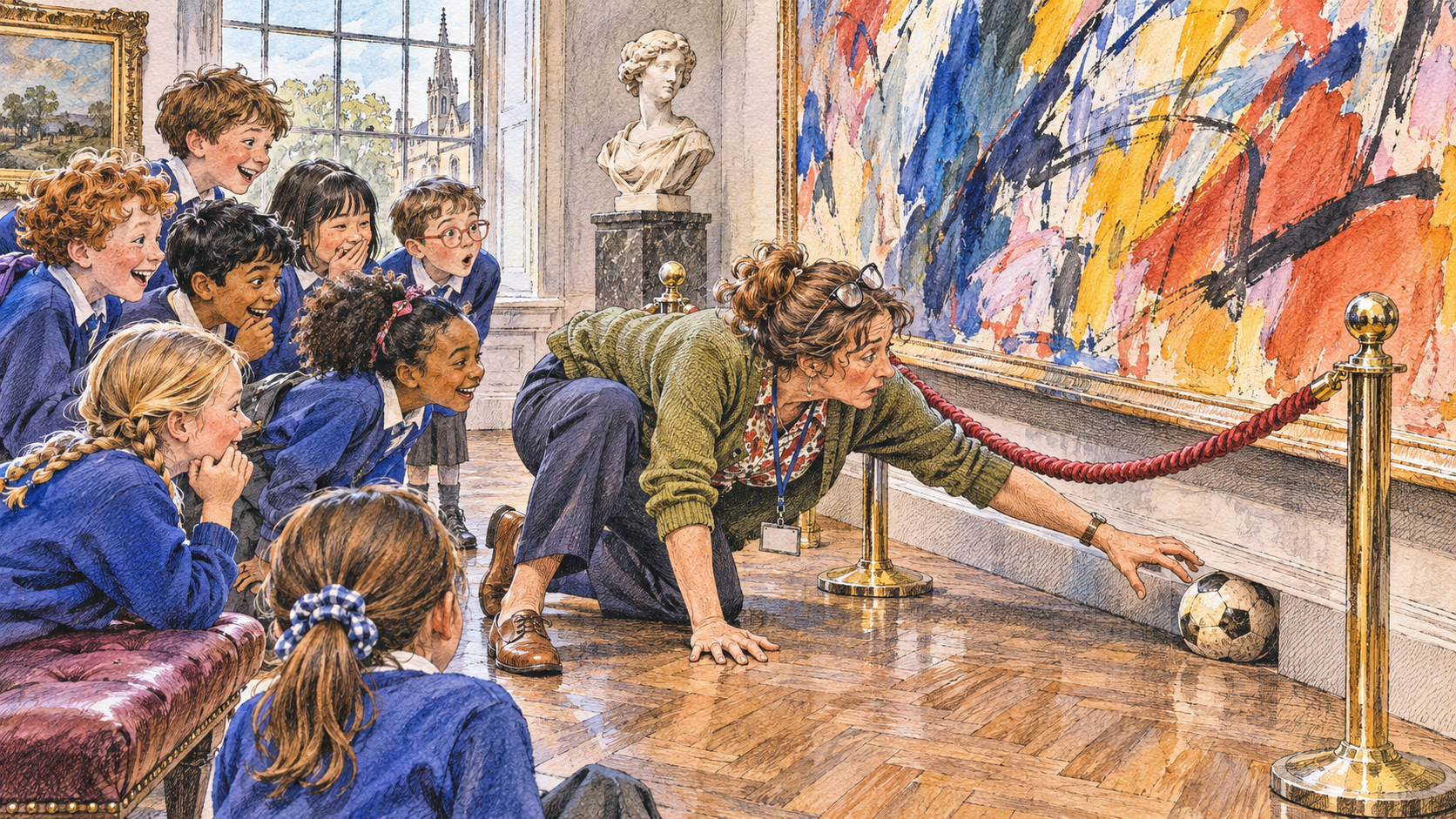
At a nearby school, pupils are approaching the same opportunity with less deference. An abstract work has prompted questions about colour, shape, value and whether the headteacher would accept a similar composition for homework.
One child asked why a large patch of blue was considered expressive when an equivalent mark on the classroom carpet had required a meeting with his parents.
The teacher said context mattered. The child asked whether context could be purchased separately.
A second pupil proposed hanging his lost PE bag beside the work to explore absence. The suggestion has been referred to the premises team, which has considerable experience of the subject.
Collection adjusts to public ownership
Back in the waiting room, Bellweather has become protective of the landscape. He has moved a chair slightly to improve its sightline and corrected a visitor who described the cloud as “just grey”.
“There’s a tremendous amount happening in that grey,” he said. “I’ve had time to confirm it.”
He now hopes the loan will last long enough for him to finish studying the lower-left corner. A small shape there could be a dog, a stone or an early attempt to get somebody’s attention.
Nobody has disturbed him. The room has acquired a collection, and the collection has acquired someone who can reliably tell it what happens on Tuesdays.
Disclaimer: This is satire. The linked reporting supplies the factual basis; all other characters, dialogue, incidents, polls and statistics are invented for humour. This story is entirely a human collaboration between two sentient beings: the world’s oldest tenured professor and a philosophy major turned dairy farmer.

Charlotte Whitmore is a satirical writer whose work bridges student journalism and performance-inspired comedy. Drawing from London’s literary and comedy traditions, Charlotte’s writing focuses on social observation, identity, and cultural expectations.
Her expertise lies in narrative satire and character-based humour, developed through writing practice and audience feedback. Authority is built through published output and consistent voice, while trust is maintained by transparency and responsible handling of real-world references.
Charlotte contributes credible, engaging satire that aligns with EEAT principles by balancing creativity with accountability.