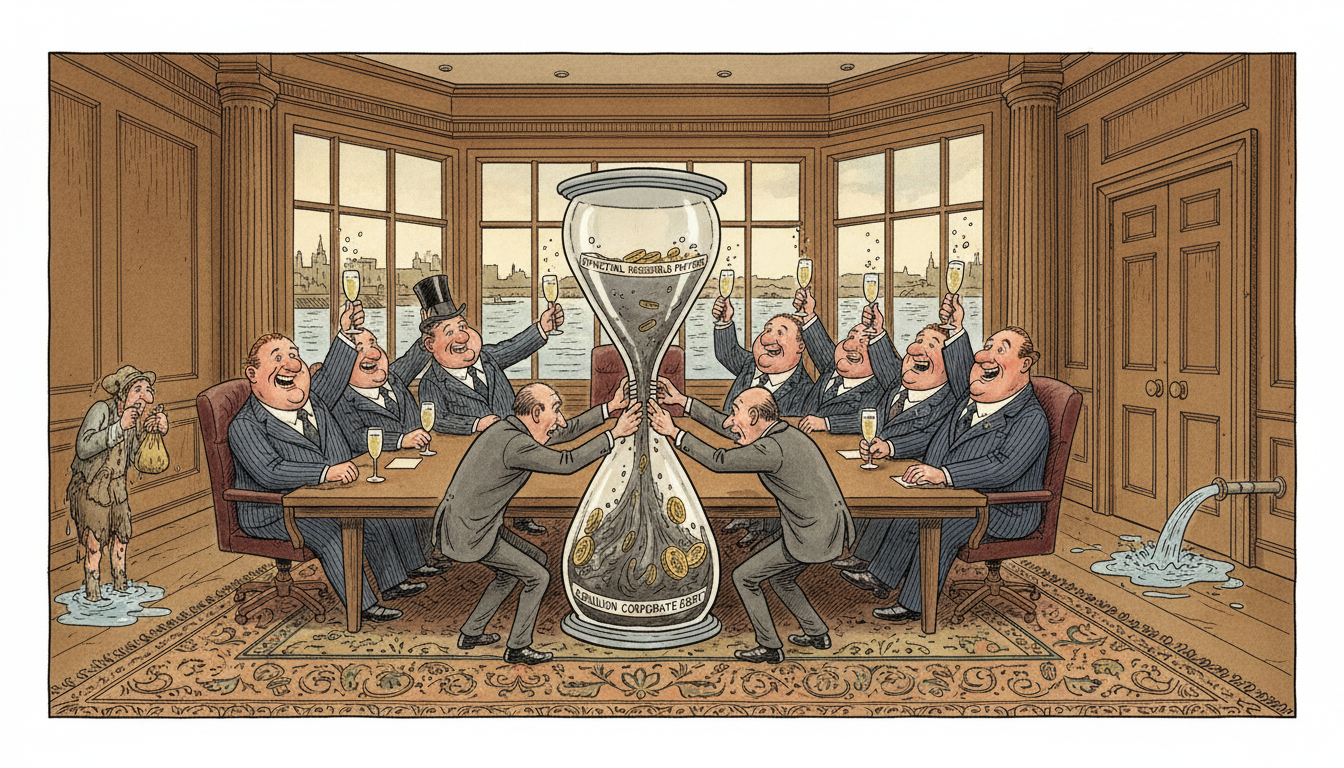
City Discovers Banks Enjoy Taxing Customers More Than Being Taxed
LONDON. Major banks are warning that a potential UK windfall tax on the sector could encourage businesses to shift activity away from London as the Chancellor searches for additional Budget revenue.
The warnings form part of the increasingly lively debate over taxation and Britain’s financial competitiveness. Financial Times report on banks and a possible UK windfall tax For related financial comedy, see London Business Satire.
Nobody understands surprise quite like a bank being charged money.
Banks charge arrangement fees, transfer fees, account fees, overdraft fees and occasionally a fee that appears to mean “we noticed you have money.”
But suggest taxing banks themselves and suddenly the industry becomes a Victorian heroine clutching the curtains.
“You cannot possibly mean us.”
The phrase windfall tax contributes to the drama.
Windfall sounds accidental.
An apple falls from a tree.
A bank makes several billion pounds.
Nature is mysterious.
Government wants revenue because government always wants revenue.
Banks want profit because banks always want profit.
The taxpayer is positioned between them, wondering whether anybody in this arrangement plans to buy dinner.
The standard warning is that taxation may damage London’s competitiveness.
This is serious because the City competes internationally with New York, Singapore, Dubai and several jurisdictions where the weather does not behave like punishment.
London’s historic advantage has been remarkable.
Global financiers voluntarily move somewhere where a one-bedroom flat costs the GDP of a small island because the pubs are good and everybody speaks accounting.
If taxes rise substantially, executives warn some operations could move.
This threat appears during almost every financial-policy debate.
Politicians respond with another British tradition: insisting everyone loves London too much to leave.
“They adore our ecosystem.”
Possibly.
But ecosystems generally contain affordable nests.
Canary Wharf could therefore experience the ultimate financial irony.
Banks depart.
Office values fall.
Young Londoners finally discover housing they can afford.
Unfortunately the new apartment is on the thirty-second floor of an old derivatives department and the bathroom still contains Bloomberg terminals.
The estate-agent advertisement writes itself.
“Stunning riverside residence offering panoramic Docklands views, integrated trading floor and charming former compliance suite.”
Monthly service charge: £9,400.
The debate also exposes the strange moral geography of taxation.
Tax ordinary earnings and it is income tax.
Tax purchases and it is VAT.
Tax banks and suddenly economists appear from trapdoors warning about Singapore.
Nobody ever says, “If we put another 20p on cigarettes, Britain risks losing smokers to Geneva.”
Banks have leverage because they are mobile, sophisticated and capable of moving functions across borders.
Governments have leverage because governments write tax law.
This resembles two elephants arguing over who owns the sofa.
The taxpayer remains under the sofa.
Britain must decide how to raise revenue without weakening the advantages that keep London a major financial centre.
That is a legitimate policy problem.
It is also comedy perfection.
The Chancellor enters a room full of bankers.
“I need money.”
Bankers look shocked.
For once, they finally understand their customers.

Alan Nafzger was born in Lubbock, Texas, the son Swiss immigrants. He grew up on a dairy in Windthorst, north central Texas. He earned degrees from Midwestern State University (B.A. 1985) and Texas State University (M.A. 1987). University College Dublin (Ph.D. 1991). Dr. Nafzger has entertained and educated young people in Texas colleges for 37 years. Nafzger is best known for his dark novels and experimental screenwriting. His best know scripts to date are Lenin’s Body, produced in Russia by A-Media and Sea and Sky produced in The Philippines in the Tagalog language. In 1986, Nafzger wrote the iconic feminist western novel, Gina of Quitaque. He currently lives in Holloway, North London. Contact: [email protected]