Council clarifies sleeping remains free provided mattress meets Euro 6 standard
Residents woke this week to discover that London’s next generation of clean-air charging under the ULEZ boundary now apparently extends to bedrooms, kitchens and, in one unfortunate case, the downstairs lavatory.
The pilot scheme, explained
Under the proposed Ultra Local Emission Zone Plus Indoor Residential Clean Breathing Enhancement Framework, residents using non-compliant beds may incur a £12.50 nightly charge. Transport for London’s actual scheme operates rather more conventionally: the real Ultra Low Emission Zone charges £12.50 a day for vehicles that fall short of required emissions standards, across all London boroughs, with the stated purpose of improving air quality. Everything after that sentence has gone wandering cheerfully into satire.
The indoor expansion began after consultants discovered people continue emitting carbon dioxide while asleep. “This loophole could not be allowed to continue,” explained deputy director for Domestic Atmospheric Revenue Opportunities, Dr Felicity Target.
Under the pilot, beds manufactured before 2005 must undergo emissions testing. Four-poster beds are automatically classified as heavy goods vehicles. Bunk beds count twice. Sofas used for sleeping require retrospective registration. Waterbeds receive a temporary exemption because nobody has seen one since 1997. Residents must install a small camera above the headboard to verify nightly compliance. Officials stressed that footage will not be stored except for enforcement, training, quality assurance, appeals, statistical analysis and the Christmas party.
Compliant mattresses and catalytic pillows
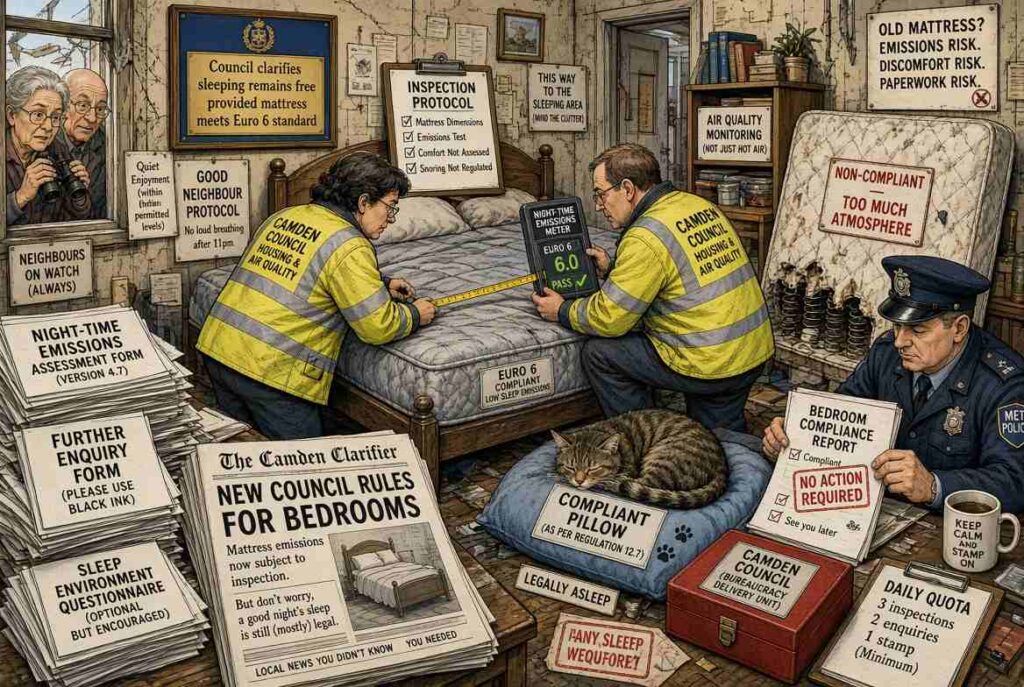
Non-compliant sleepers can avoid the charge by upgrading to a low-emission mattress. Approved mattresses start at £3,800. Council-approved pillows are extra.
Pensioner Arthur Bell received the first penalty after his 1987 divan triggered an automatic sensor. “I wasn’t driving it,” Bell protested. Officials agreed. “That is why you’ve received a Bed User Charge rather than a Road User Charge.” Bell appealed on the grounds that his mattress has not moved since John Major. The council rejected the appeal because stationary emissions remain emissions – a distinction real ULEZ appellants will find nowhere in TfL’s own guidance, since the genuine scheme only ever concerns itself with vehicles that actually move.
Neighbours have begun adapting. One family converted their bedroom to electric. Nobody understands what this means, but the installer charged £6,400. Another resident sleeps in the garden because outdoor unconsciousness remains outside the scheme.
Developers are already advertising ULEZ-compliant luxury sleep environments. Estate agents say compliant bedrooms command a premium. A studio in Kentish Town now costs £600 more per month because its mattress qualifies as “zero-tailpipe.” There is no tailpipe. This is considered a feature.
Assessors, snorers and the advisory board
The policy has created new employment. Certified Sleep Emissions Assessors now visit homes carrying clipboards and an expression indicating they know something about your duvet you do not. They measure mattress age, sleeper weight and whether the resident snores in a manner likely to increase particulate matter. Heavy snorers may require catalytic pillows. Children under five are exempt. Teenagers are charged double because they remain in bed longer.
The council denies the scheme is about revenue. “This is about behaviour change,” said Target. “Specifically changing behaviour from not paying us to paying us.” Officials later clarified that the quote had been taken out of context by everybody who heard it.
A public consultation attracted 14,000 responses. Thirteen thousand nine hundred eighty-seven opposed the measure. Officials described the feedback as “strong evidence of community engagement.” The remaining thirteen responses asked how to pay. They were immediately appointed to the advisory board.
Meanwhile Arthur Bell has replaced his mattress. He purchased a compliant model. Delivery required a diesel van. The van entered the existing, genuinely operating ULEZ boundary, and a real charge was duly paid – the one part of this entire saga that actually happened exactly as TfL’s rules describe. The mattress arrived. Bell slept peacefully. At 6:12 the next morning a council email arrived. His blanket had failed inspection. There is now a £12.50 Textile Heat Retention Supplement. Bell has decided to remain awake. Officials say this could reduce emissions significantly.
Bell’s neighbours have started a support group, meeting weekly in a kitchen they insist remains, for now, entirely outside any charging zone. Nobody is confident this will last.
The council’s own equalities impact assessment, leaked to a local paper, concedes that the scheme falls disproportionately on residents who own older beds, which officials acknowledge correlates closely with residents who have less money to buy new ones. The report recommends “further engagement,” a phrase that has come to mean, in Camden at least, that nothing will change but a great many people will be thanked for their feedback.
A neighbouring borough has reportedly expressed interest in a similar pilot, though officials there have asked to see how Camden’s scheme performs “over a full sleep cycle” before committing. Camden’s own cabinet member for the environment described this caution as “frankly a bit rich,” given that his borough had, in his words, “been up all night getting this right.”
Bell has since taken to sleeping in thirty-minute shifts, on the theory that a shorter session generates fewer emissions per inspection. Council officials have not confirmed whether this qualifies for a reduced rate, though they have promised to “look into the science of it,” a phrase Bell now treats with the same suspicion he once reserved for his old divan.

Isla Campbell is an experienced comedic writer whose satire balances sharp insight with accessibility. Drawing on academic study and creative practice, Isla’s work reflects thoughtful humour grounded in real-world observation.
Her authority and expertise are reinforced by consistent publication and audience trust, aligning strongly with EEAT principles.