
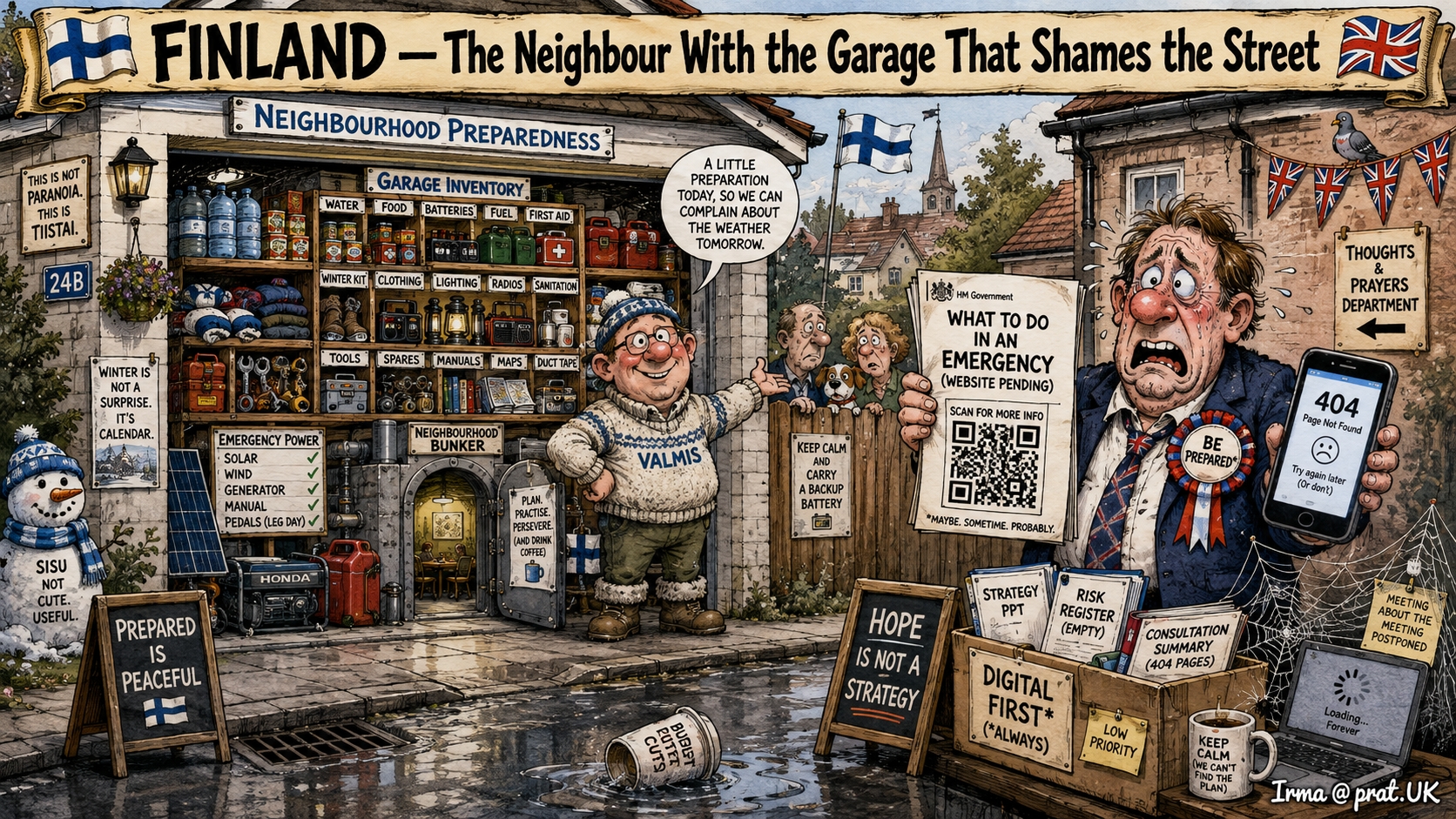
Finland Civil Defence Exercise Shames Every Garage In Europe
More than 2,000 people rehearse cyberattacks and missile threats in Kuopio while the rest of the continent locates its emergency leaflet, finds a QR code, and discovers the website was retired in 2019
HELSINKI — Finland has run Europe’s largest civil defence exercise since the Second World War, with more than 2,000 people including conscripts, volunteers, university students and schoolchildren taking part in Kuopio under a scenario in which cyberattacks have knocked out power and water and there is a threat of missile strikes from across the eastern border.
The rest of Europe has responded by looking at its own garage and quietly closing the door.
The Finland Civil Defence Exercise Is A Neighbourhood Inspection
Every street has one. The neighbour whose garage is immaculate. Shelves labelled. Torch in the same place for nineteen years. Knows where the stopcock is. Owns a generator and has actually started it this year. You have never asked him about it because you suspect the answer will make you feel like a child.
Finland is that neighbour, and this week Finland opened the garage door for the entire continent to look inside.
The country maintains around 50,500 civil defence shelters with capacity for roughly 4.8 million of its 5.6 million people. In Helsinki there is an underground swimming complex that can be drained and converted into a bombproof shelter for thousands within 72 hours. In Kuopio this week, conscripts in hazmat suits measured radiation levels inside a shelter hewn into rock, while hundreds of people slept overnight on trestle beds in what is normally a sports hall.
How The Rest Of Europe Would Handle The Finland Civil Defence Exercise
Britain would spend eighteen months establishing whether the shelter signage complied with the government brand guidelines, then commission an agency to workshop the word shelter, then issue a leaflet with a QR code pointing to a page that says This service has moved.
France would immediately form a union representing bunker staircases and it would strike, correctly, over ventilation.
Belgium would discover that half the shelter is Flemish and the other half French speaking, and that the emergency exit is under federal review.
Germany would produce a magnificent 340 page preparedness framework and no shelter.
Italy would have an excellent shelter with a functioning kitchen and no agreed timetable for entering it.
Finland opens the cave.
The Finland Civil Defence Exercise Rests On A Mindset, Not A Budget
Retired army colonel Asko Muhonen, who organised the Kuopio exercise, has said Finnish defence relies not just on the military but on the mindset of ordinary Finns who take personal responsibility for the country’s security, sustained partly by a system of conscription that was never abandoned after the Soviet Union collapsed.
That word, responsibility, is the actual export product here, and it is the one thing no European government can buy in.
In much of Western Europe, advising the public to keep three days of supplies at home triggers complaints that the state should deliver bottled water personally, ideally by drone, ideally free, ideally before anybody has to think about it. In Finland it is treated as something you sort out before you buy dishwasher tablets, because a torch is not a doomsday statement. A torch is just a torch.
One eleven year old at the Kuopio shelter explained why children were included. Kids need to know this, she said, because they might have to do something alone and the adults cannot always help.
That sentence should be printed and posted through every letterbox in Europe.
Why Finland Prepares Like This And We Do Not
The reason is not paranoia. It is memory, and it belongs to people still alive.
Finland fought the Soviet Union, lost around 11 per cent of its territory, and saw more than 400,000 people, roughly 12 per cent of the population, driven from homes in land that is now inside Russia. At the veterans’ museum in Kuopio, a 95 year old showed reporters a sheet of paper on which he had written the dates the city was bombed and the names of the dead. A 92 year old described being told by soldiers that her family had one hour to pack, twice, and watching her home burn. When Russia invaded Ukraine in 2022 she said she feared she would have to leave a third time.
Nobody who has heard that gets to describe Finnish preparedness as excessive. It is not a policy position. It is a receipt.
What The Finland Civil Defence Exercise Teaches About Resilience
The useful insight is that preparedness does not require you to correctly identify the threat. Backup power helps in a storm and in a war. Stored water helps after contamination and after sabotage. Cybersecurity defends against hostile states and against a nineteen year old with a grudge and a botnet.
Finnish intelligence has itself cautioned that plenty of suspicious incidents turn out to have mundane explanations, which is a sign of a mature security culture rather than a soft one. Not every drone is Russian. Not every power cut is hybrid warfare. Sometimes the lights go out because weather remains stubbornly independent of the Kremlin.
But officials across the West have documented a real campaign of sabotage across Europe involving arson, attacks on water and power facilities, and drones sent into EU airspace. And no bunker in the world defends against that. Which is exactly why the mindset matters more than the concrete.
Europe enjoyed a long peace dividend. Defence budgets fell, civil defence decayed, and war between European states came to feel like something that happened in black and white. That confidence ended in February 2022.
Preparedness is not warmongering. Nobody buys a fire extinguisher because they want the kitchen to burn. They buy one because optimism is a poor extinguishing agent.
And the Finnish message to anyone considering disruption is admirably simple. Cut the power and they have batteries. Cut the internet and they have radios. Try it in February and you will find they consider February hostile by default, and have done since before you were born.
Humorous Observations On The Finland Civil Defence Exercise
- Finland has 50,500 shelters. Britain has a leaflet, and the leaflet has moved.
- Helsinki’s underground swimming pool converts to a bombproof shelter in 72 hours, which is faster than most British councils answer a phone.
- Finnish children practise emergency procedures at school, while British children practise fire drills by walking slowly toward a car park.
- The exercise involved 2,000 people and no working group, a ratio Brussels finds deeply upsetting.
- Finnish preparedness advice assumes citizens are adults, an assumption most European governments abandoned around 2004.
- Conscription survived the end of the Cold War in Finland, largely because Finland reads maps.
- The country shares 1,300 kilometres of border with Russia and describes this as a factor rather than a grievance.
- Invading Finland remains the only military scenario in which the defender regards minus twenty as ordinary working conditions.
- Every other European country now has to explain what is in its own garage.
- History attempted this before. The Finns kept the receipts, the dates, and the names.
More than 2,000 people including conscripts, volunteers and students took part in a civil defence exercise in Kuopio, described as the largest in Europe since the end of the Second World War. The scenario involved cyberattacks disrupting power and water in the city alongside the threat of Russian missile strikes, with the aim of letting local authorities and ordinary people rehearse their response. Retired army colonel Asko Muhonen, who organised the exercise, said Finnish defence depends on the mindset of ordinary Finns as well as the military, sustained by conscription. Finland shares a border with Russia of more than 1,300 kilometres and joined NATO alongside Sweden in 2024 following Russia’s full-scale invasion of Ukraine. Finnish veterans including Risto Mönkkönen and Aili Toivanen described to reporters the bombing and displacement they experienced in Finland’s wars with the Soviet Union. Western officials say Russia is conducting a campaign of sabotage across Europe that underground shelters cannot defend against.
Sources
- Finland runs Europe’s largest civil defence exercise since WWII, Associated Press
- Colonel Asko Muhonen on conscription and the Finnish preparedness mindset
- Finland’s 50,500 civil defence shelters and the Itäkeskus swimming hall, AFP
- British troops training with Finnish forces on Exercise Northern Axe
Our American colleagues are running the same comparison with generators and considerably more tinned chilli at Bohiney.com.
Auf Wiedersehen, amigo!
This is UK satire, and the joke is aimed squarely at Western European complacency rather than at Finland or anyone who lived through what the veterans of Kuopio described. British satirical journalism concedes without argument that Finland is better prepared for an emergency than this publication is for a Tuesday.

Alan Nafzger was born in Lubbock, Texas, the son Swiss immigrants. He grew up on a dairy in Windthorst, north central Texas. He earned degrees from Midwestern State University (B.A. 1985) and Texas State University (M.A. 1987). University College Dublin (Ph.D. 1991). Dr. Nafzger has entertained and educated young people in Texas colleges for 37 years. Nafzger is best known for his dark novels and experimental screenwriting. His best know scripts to date are Lenin’s Body, produced in Russia by A-Media and Sea and Sky produced in The Philippines in the Tagalog language. In 1986, Nafzger wrote the iconic feminist western novel, Gina of Quitaque. He currently lives in Holloway, North London. Contact: [email protected]


