Ceuta Border Surge: Madrid Issues Updated Diplomatic Phrasebook
Pedro Sánchez finds no solid proof Morocco orchestrated July’s crossing, days after a police report catalogued a remarkable quantity of things that merely happened to occur
MADRID — Spanish prime minister Pedro Sánchez has told parliament there is no solid evidence that July’s mass crossing into Ceuta was planned or carried out by Moroccan authorities, and that no institution, diplomatic service or international body has supplied any. None whatsoever, he said, twice, in the tone of a man who would very much like the subject changed.
This came days after a police report seen by Reuters described the entry as a planned and phased operation designed to overwhelm border controls rather than a spontaneous event, noted that Moroccan security forces were deployed in smaller numbers than usual near the Tarajal breakwater, found no serious attempt to disperse the crowds, and recorded uniformed Moroccan officers giving directions towards the crossing point.
The report did not name individual officers or produce independently verified evidence of orders from Rabat. Which is how we arrive at the single most useful document in European politics: the diplomatic phrasebook.
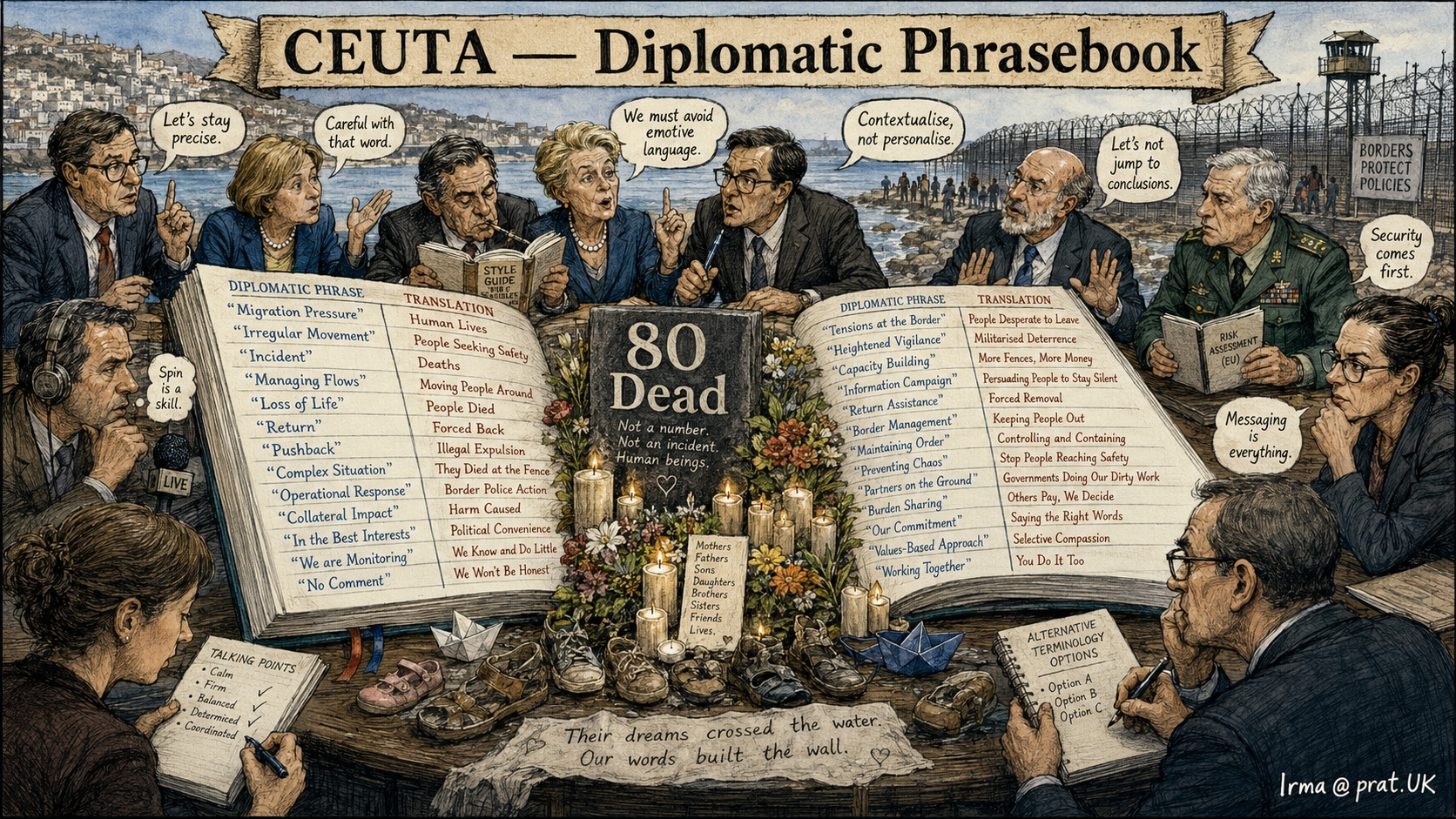
The Ceuta Border Surge Phrasebook, Translated Into English
No solid evidence. Translation: we have seen a great many things we would enjoy having explained, and precisely none of them are the kind of thing you can put in a démarche without cancelling next year’s fisheries talks.
Inaction or inability to contain. Translation: they either would not or could not, and we have chosen not to find out which, because both answers are inconvenient in different directions.
Cooperation remains frankly positive. Translation: they hold the tap.
The matter remains under investigation. Translation: the matter remains.
We must not allow a lack of trust to aggravate a complex situation. Translation: please stop asking.
Why The Ceuta Border Surge Produces This Particular Vocabulary
Ceuta sits on one of the most politically loaded borders on earth. Madrid needs Moroccan cooperation on migration, security, trade and a long list of matters nobody wants renegotiated. Rabat knows this. Every incident at that fence therefore arrives carrying several suitcases of geopolitics and a diplomatic bag nobody is allowed to open.
So the language does what language does when the incentives are wrong. It softens the border between what is known and what can be said.
Ordinary people call something suspicious. Police call it intelligence requiring corroboration. Diplomats call it a productive and ongoing bilateral relationship.
The Ceuta Border Surge Does Not Fit The Available Uniforms
Modern debate offers two positions and demands you pick one. Either nothing untoward happened and anyone suggesting otherwise is a bigot, or the entire operation was personally directed from a beach chair by a head of state holding a clipboard marked OPERATION CEUTA.
Reality declines both costumes. There are other possibilities, and several of them can be true at once.
Local commanders may have made decisions nobody in Rabat authorised. Coordination may have failed. Lower level officials may have deliberately looked the other way. Organised smugglers may have exploited a gap they detected before anyone else did. Or there may have been state direction that investigators genuinely cannot prove to an evidentiary standard.
Two statements survive all of this. The police findings deserve rigorous investigation. And the absence of verified evidence of orders from senior Moroccan authorities is a real and important fact. Holding both at once is now considered eccentric, largely because social media has trained an entire continent to treat nuance as cowardice.
A diplomatic analyst at the Prat Institute put the doctrine plainly. If your neighbour’s sprinkler floods your kitchen every Tuesday while he watches from a deck chair, you cannot prove he planned it. You are still entitled to ask why he brought popcorn.
The Part Of The Ceuta Border Surge That Is Not A Joke
Around 60,000 people reached Ceuta within days. More than 80 died. Spain deployed the military to reinforce police.
Those figures have to sit in the middle of this article rather than at the bottom, because European debate has an ugly habit of treating people at borders as numbers, symbols or counters on a board. Governments argue about sovereignty. Activists argue about rights. Parties argue about elections. Smugglers collect the cash. And the people who actually absorb the consequences are the ones nobody in any of those conversations has met.
The satire here is aimed at ministers and their vocabulary. It is not aimed at anyone who was in the water.
Three things can be held simultaneously by any serious person. A sovereign country has the right to control who enters it. People at a border retain human rights whatever their status. And a neighbouring government should not be able to modulate migration pressure as a diplomatic instrument. None of those propositions cancels the others, and a politics that pretends they do is a politics that has stopped trying.
What Should Happen Next After The Ceuta Border Surge
Spain should investigate hard and distinguish carefully between inference and proof, because the distinction matters and because international accusations carry real consequences. Morocco should account for the specific conduct the Spanish police documented, which is a lower bar than admitting anything. The European Union should back transparent border procedures now rather than waiting for the next crisis to become a rolling news event with a helicopter shot.
The genuinely bad outcome is ambiguity hardening into policy because ambiguity is diplomatically convenient for everybody with a signature to protect.
Sánchez may well be right that the current evidence does not establish Moroccan orchestration. Fine. That is not the end of the inquiry. The next question is not case closed. The next question is what happened during those ten hours at Tarajal, and who decided it.
Politics keeps insisting that uncertainty concludes an investigation. Science has always understood uncertainty as the reason you continue one.
Humorous Observations On The Ceuta Border Surge Response
- Madrid has established that nothing was proven, which is a different sentence from nothing happened, though it is being read aloud in the same voice.
- The police report found a phased operation. The government found no evidence of a phased operation. Both documents are Spanish.
- Uniformed officers giving directions towards a crossing point is described as an interesting coincidence, a category that has been working overtime.
- Sánchez said no institution had provided solid evidence, which invites the follow up question of who has been asked.
- Inaction or inability to contain is the diplomatic equivalent of the dog ate my border.
- Every incident at Ceuta arrives with more baggage than the passengers.
- Rabat denies facilitation, Madrid accepts the denial, and everyone books the next bilateral summit.
- The European Commission has been notably quiet, which for Brussels counts as a formal position.
- Cooperation is described as frankly positive, a phrase that has never once described a relationship between equals.
- Somebody knows what happened during those ten hours. Several somebodies. They have all been very busy.
Spanish prime minister Pedro Sánchez told the lower house of parliament that Spain has found no evidence to conclude July’s deadly border surge from Morocco into Ceuta was orchestrated or carried out by Moroccan authorities, saying no diplomatic service, European Commission body or international institution had provided solid proof. He said Morocco’s Gendarmerie allowed crossings during a key ten hour period on 30 July when arrivals peaked, and that Spanish authorities had yet to determine whether this reflected inaction or inability to contain the influx. A police report seen by Reuters described the entry as a planned and phased operation rather than a spontaneous migration event, and said Moroccan forces near the Tarajal breakwater were deployed in smaller numbers than usual and did not seriously attempt to disperse crowds, while noting it could not identify individual officers or verify orders from Moroccan authorities. An estimated 60,000 people reached Ceuta within days and more than 80 died. Morocco denies enabling the crossing.
Sources
- Sánchez says no solid proof Morocco planned the Ceuta rush, France 24
- Reuters on the police report and the ten hour period at Tarajal
- Sánchez on intelligence findings and disinformation around Ceuta, UPI
- Scale of the July surge and the Spanish military deployment
The American edition of border politics, conducted at greater volume and with worse maps, is at Bohiney.com.
Auf Wiedersehen, amigo!
This is satire, and the targets are ministers, phrasing and diplomatic convenience rather than anybody who was at that fence. British satirical journalism takes the view that governments should be mocked precisely in proportion to how carefully they are choosing their words. UK satirical news declines to make jokes about the dead.

Mei Lin Chen is a student writer whose satire explores identity, modern culture, and social nuance. Her work reflects academic curiosity and engagement with London’s diverse perspectives.
Expertise is growing through study and practice, while trust is supported by clear intent and responsible humour.