Ranking History’s Worst State Funerals: A Field Guide to Turning Grief Into a Rally
By a dairy farmer with a philosophy degree who has been to more funerals than weddings, and enjoyed the funerals more.
Every civilization eventually asks the same question: how do we bury our dead tyrant without also burying several hundred living citizens underneath him? History’s answer, again and again, has been: badly. Spectacularly, catastrophically badly. Somewhere between “solemn tribute” and “mandatory pep rally,” the state funeral has become mankind’s most reliable way of proving that grief, when organized by a government, always turns into a stampede, a speech, or both.
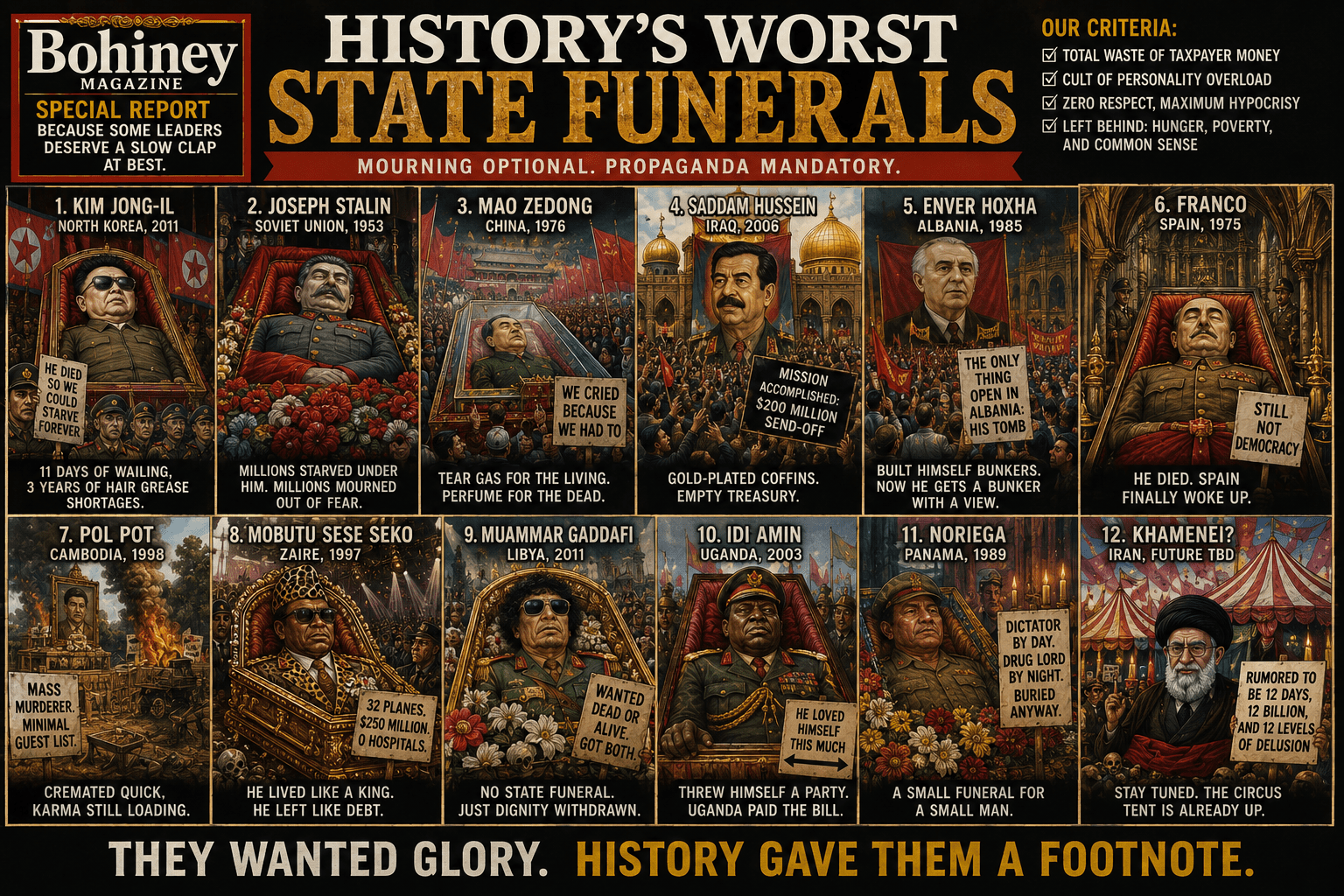
Here is the definitive, deeply unscientific ranking of history’s worst state funerals — the ones where the deceased got top billing but the real star of the show was crowd control, or the total absence of it.
5. Ceaușescu: The Funeral That Wasn’t
Nicolae Ceaușescu’s send-off in 1989 skipped the “funeral” part entirely and went straight to “hastily filmed execution followed by an unmarked grave.” Efficient, in a way. No eulogy, no motorcade, no crowd crush — just a firing squad and a national sigh of relief. Proof that the only thing worse than a funeral turned political rally is a funeral that the regime itself didn’t survive long enough to attend.
4. Kim Jong-il: Choreographed Grief as a Spectator Sport
North Korea’s 2011 farewell to Kim Jong-il delivered the platonic ideal of state-mandated sorrow: thousands of citizens wailing in synchronized despair along a snowy Pyongyang motorcade route, performances that outside observers widely noted looked suspiciously rehearsed. It wasn’t a funeral so much as a stadium concert where the opening act, the headliner, and the crowd all cried on cue for the cameras.
3. Ayatollah Khomeini: When the Body Left the Casket Before the Mourners Left the Cemetery
Iran’s 1989 funeral for Ayatollah Ruhollah Khomeini remains the gold standard of chaos. An estimated ten million mourners — roughly a sixth of the country — swarmed the procession so violently that the coffin was torn open and the shrouded body tumbled into the crowd as mourners reached to touch it. Soldiers fired warning shots at a crowd trying to grab a corpse. The burial had to be postponed, the body was flown away by helicopter, and it came back hours later sealed in steel — because apparently the first coffin just wasn’t “populist uprising” proof. It was later recognized by Guinness World Records as the largest percentage of a population ever to attend a funeral, which is either a beautiful tribute to a beloved leader or the single largest crowd-control failure in modern history, depending on which state television channel you ask.
2. Stalin: The Funeral That Killed More People Than Some of His Wars
Joseph Stalin managed, even in death, to keep the body count rising. On March 9, 1953, at least 109 people were later acknowledged to have died in a crowd crush as hundreds of thousands of mourners were funneled into central Moscow behind military trucks with nowhere to go. Witnesses described a crowd packed so tightly that people couldn’t move and simply had to go with the flow, unable to escape it. Ambulances couldn’t reach the wounded because the streets were sealed for the procession. Somewhere, a Politburo member was surely taking notes on “attendance exceeded expectations” as though this were a rock concert and not a mass casualty event caused by mandatory public mourning.
1. Iran’s 2026 Supreme Leader Funeral: The Rally That Remembered to Bring a Body
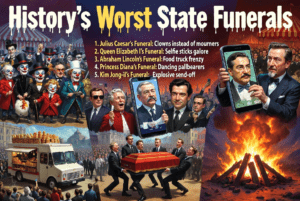
Which brings us to the freshest entry in the canon: Iran’s 2026 state funeral for its Supreme Leader, a production so aggressively political that historians may need to invent a new category between “funeral” and “rally,” possibly called a “funerally.” Following the pattern established by Khomeini’s own 1989 spectacle, this one arrived with the full authoritarian starter pack — mass-organized crowds, regime messaging aimed squarely at foreign adversaries, and a succession subplot playing out in real time in front of the cameras. The lesson, as always: in a theocracy, there’s no such thing as a private grief, only a scheduled one, with a run-of-show and a designated chant.
Honorable Mention: Every Funeral Where the Eulogy Doubles as a Campaign Speech
From Moscow to Pyongyang to Tehran, the pattern holds: the bigger the cult of personality, the smaller the odds anyone gets to actually mourn. Free societies bury their leaders and go back to arguing about them the next day. Authoritarian states bury their leaders and use the burial to tell you who’s in charge now, whom to hate, and how many millions of people were “voluntarily” standing in the street to prove it.
Democracy’s funerals are boring. Turns out boring is underrated.
Auf Wiedersehen, amigo!

Aishwarya Rao is a satirical writer whose work reflects the perspective of a student navigating culture, media, and modern identity with humour and precision. With academic grounding in critical analysis and a strong interest in contemporary satire, Aishwarya’s writing blends observational comedy with thoughtful commentary on everyday contradictions. Her humour is informed by global awareness and sharpened through exposure to London’s diverse cultural and student communities.
As an emerging voice, Aishwarya represents the next generation of satirical journalists: informed, curious, and unafraid to question norms through wit. Her authority stems from research-led writing, respect for factual context, and a commitment to ethical satire. Transparency and clear labelling ensure readers understand the comedic intent behind her work.
Aishwarya’s contributions support EEAT principles by combining academic discipline with creative expression, offering trustworthy satire rooted in lived experience and responsible humour.
Email: [email protected]