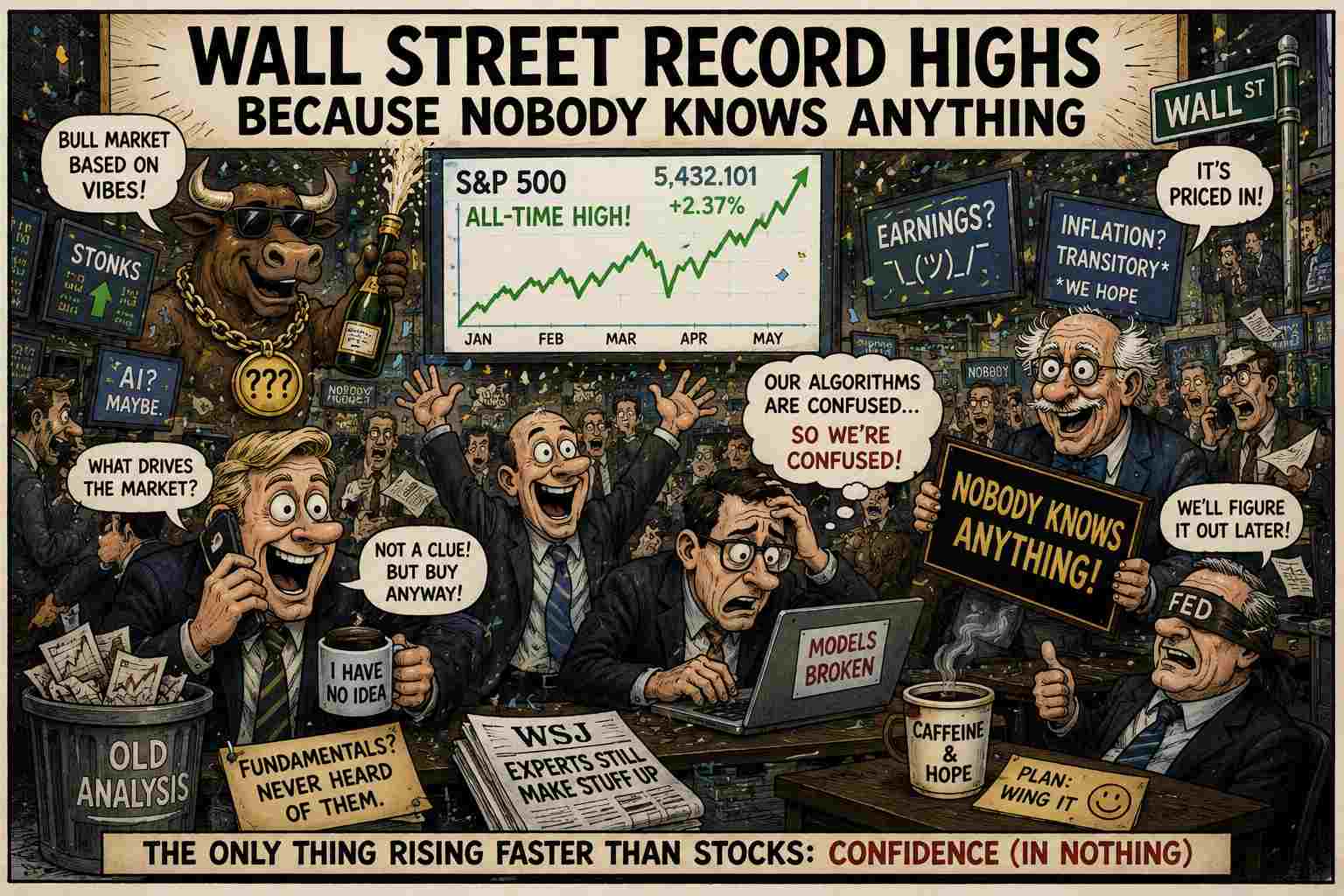
Wall Street Reaches Record Highs After Investors Learn Nobody Knows What Is Happening
LONDON (PRAT.UK DATELINE) — Global stock markets surged to historic peaks on Thursday after a landmark Morgan Stanley research note confirmed, in forty-seven pages of densely footnoted analysis, that not a single person on Earth has any reliable idea what is going on.
The Report That Changed Everything By Explaining Nothing
The document, entitled “Q2 Outlook: Macro Uncertainty And The Comforting Irrelevance Of All Prior Models,” concluded that traditional economic indicators have become “largely decorative,” that inflation is doing “a thing,” and that investors should feel free to make whatever decisions they like, as the relationship between cause and effect in modern markets has become “more of a suggestion than a rule.”
Markets responded immediately. The Dow Jones rose 2.4%. The S&P 500 posted its largest single-day gain since the last time someone said something confusing on television. The FTSE 100 went up sympathetically, then remembered Brexit, and went up a bit more out of sheer cussedness.
Why Uncertainty Is Bullish: A Brief Explainer For Normal People
“When nobody knows what’s happening,” explained fund manager Tarquin Fforde-Whitley, straightening his cufflinks from a glass-walled office above Canary Wharf, “that’s actually enormously positive for equities. Fear of the unknown keeps interest rates unclear, which keeps monetary policy ambiguous, which means the computers don’t know what to do, so they buy everything. It’s really quite elegant.”
The Federal Reserve has acknowledged persistent uncertainty in its forward guidance — a sentence that, upon reflection, is itself an example of the phenomenon it is describing.
Individual Investors React With Characteristic Calm
Retail investors on popular trading forums responded to the record highs by immediately buying more of whatever they’d already bought, then posting rocket emojis. Several described themselves as “doing their own research,” which in practice meant watching a twenty-two-year-old on YouTube explain leverage using hand gestures.
One pension fund manager, who asked not to be named, confirmed that her fund had beaten the market by eleven percent this quarter by “honestly just guessing, but with confidence.” She called this approach “vibes-based asset allocation” and said she expected to publish a white paper in the autumn.
What Happens If Someone Figures It Out
Economists warn that if clarity were ever to emerge — if, hypothetically, the global economy became legible and predictable — the psychological shock to markets would likely trigger the very crash that confusion has so far prevented. “The uncertainty,” noted Dr. Patricia Weatherington-Cross of the LSE, “is load-bearing.”
— Prat.uk Financial Desk, Heavily Invested In Outcomes And Also Crisps

Dr. Ingrid Gustafsson holds a Ph.D. in Literary Studies and serves as Professor of Literature and Satirical Journalism at the university. Her scholarly work focuses on contemporary satire as a form of institutional critique, examining how exaggeration, irony, and absurdism function as sophisticated analytical tools for exposing structural inequality and institutional hypocrisy. Dr. Gustafsson has published extensively on the genealogy of satirical discourse, the relationship between speech acts and cultural power, and satire’s role as both aesthetic practice and epistemological strategy. Her research interrogates how contemporary satire operates within celebrity culture, legal systems, and institutional rhetoric, revealing the mechanisms through which power obscures itself through language and performance. Dr. Gustafsson’s work combines rigorous textual analysis with broader cultural theory, contributing significantly to understanding satire’s critical function in contemporary society. She is the author of Pearl Clutching and How to Combat It with Satire.